
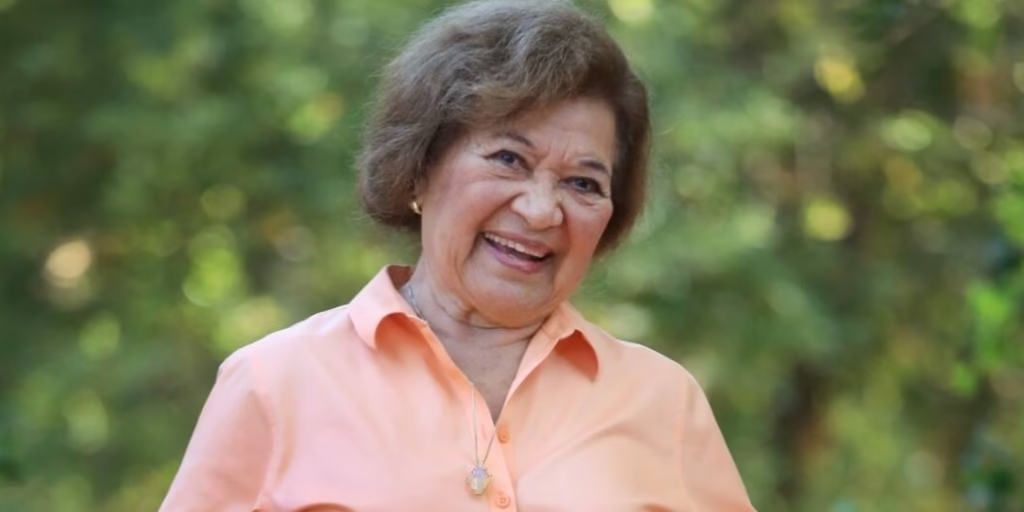
Betty Ann Ka’ihilani Bruno lived three remarkable lives across nine decades, first as a child actress dancing through Munchkinland in cinema’s most beloved film, then as an Emmy-winning investigative journalist who covered her own home burning while reporting live on television, and finally as a cultural ambassador teaching ancient Hawaiian hula in California wine country.
She died at 91 on July 30, 2023, just one month after her final appearance at the Oz-Stravaganza festival in Chittenango, New York, collapsing at a hospital emergency room entrance after performing “Pua Mana” (Majestic, Everlasting Flower) at a Hawaiian music gathering.
Betty Ann Bruno Biography
Betty Ann Ka’ihilani Bruno was born on October 1, 1931, in Wahiawa, Hawaii. Her mother brought Hawaiian-Chinese roots to the family, while her father contributed Dutch-Irish ancestry. This mixed heritage created a lifelong search for identity and belonging, as Bruno later described.
When her family packed up and moved from Oahu to Hollywood, they landed directly across the street from 20th Century Fox Studios. Talk about perfect timing. As Bruno wrote in her 2020 memoir, “It was the 1930s and Hollywood was in love with all things Hawaiian.” At just five years old, she made her film debut in John Ford’s The Hurricane (1937), playing a native child in what she remembered as her “one and only nude scene,” a typical portrayal of South Seas islanders in Depression-era films.
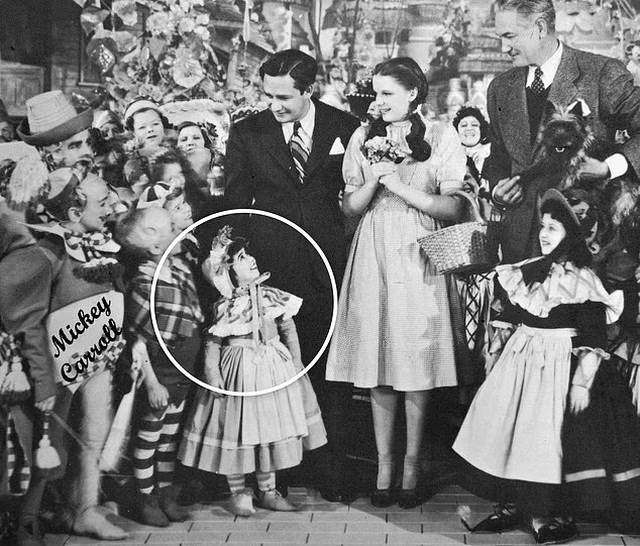
But her defining childhood moment arrived in late 1938 when Metro-Goldwyn-Mayer cast her as one of 12 child Munchkins in The Wizard of Oz. Unlike the 100-plus adult little people hired for speaking roles and close-ups, the children served as “little bodies in the background,” as Bruno explained decades later. She witnessed Hollywood’s darker side firsthand, too. She was on set during Margaret Hamilton’s famous fire accident, when the Wicked Witch actress suffered burns during the Munchkinland scene. That incident became one of cinema’s most notorious production accidents.
Her show business career ended abruptly at age 10 when the family relocated to a farm near San Jacinto, about 100 miles from Hollywood. She’d accumulated $750 from her movie work, “a lot of money back then,” but left behind her brief brush with stardom.
Education and Early Adulthood
Betty Ann’s education took her to Stanford University, where she graduated in 1953 with a degree in Political Science. She continued her education with graduate work at George Washington University, setting the stage for an unexpected career turn that would eventually lead her to television journalism.
Betty Ann Bruno Career
Bruno’s career took an interesting detour when she briefly worked as a CIA secretary in the personnel department in Washington, D.C. It’s where she met her first husband, Russell Bruno. The couple moved to Berkeley, California, in 1966, where they raised three sons together.
What really changed her life was confronting the ethnic identity crisis that had haunted her since childhood. “I was a brown-skinned girl in a white man’s world who wasn’t told the truth about her ancestry,” she wrote. Her mother had suppressed information about their Hawaiian-Chinese heritage, leaving Betty Ann caught between worlds. Island cousins called her “haole” (mainlander) while mainland Americans saw her as an “Island person.”
In her mid-20s, she discovered hula lessons in San Francisco. Training with master teacher Ida Namanuokawa’a Wong Gonsalves, who became her “Hawaiian mom” and lifelong friend, Bruno found her anchor. “I sought my Hawaiian identity through the hula,” she explained. “It’s a beautiful culture and I’m so proud of it and that is a core of my life.”
Her venture into journalism started from activism rather than traditional routes. As president of the League of Women Voters of Oakland during the 1960s, serving multiple terms, she nearly won a seat on the Oakland City Council in a hard-fought race. That political involvement caught KTVU Channel 2’s attention, and they came calling.
In 1970, she joined KTVU’s community affairs department, producing election broadcasts and public service announcements before hosting the public affairs program “On the Square.” Station management eventually persuaded her to transition to the newsroom, launching a 22-year career that would earn her three Emmy Awards and establish her as one of the Bay Area’s most respected investigative journalists.
Bruno’s journalism colleagues consistently describe one exceptional quality that sets her apart: her uncanny ability to secure interviews that others couldn’t. Rob Roth, a retired KTVU reporter, recalled, “Other reporters would try to get those same people, but they would say ‘no, no, no way.’ Betty Ann was always able to get the interview.”
Gary Kauf, a former KTVU producer with over 20 years at the station, explained her secret: “Betty Ann’s amazing talent was that she could get anyone to talk to her, anyone. She was non-threatening and gentle with everyone.”
Her investigative work earned her three Emmy Awards from the National Academy of Television Arts and Sciences San Francisco/Northern California Chapter for breaking news, news-feature series, and investigative series. She became KTVU’s go-to reporter for sensitive stories. As a former boss stated, “If a story involves political corruption or corporate wrongdoing, put Betty Ann on it.”
Her major investigations included a five-part series on local prostitution problems, exposing a notorious drug lord who subsequently threatened to kill her, and crossing paths with the Mafia during investigative work.
Bruno had a unique advantage among her colleagues: being the only KTVU reporter who could take shorthand, giving her rapid access to public records and meeting notes. Her husband, Craig Scheiner, noted that she was proud to be “the best investigative reporter at KTVU,” working during the station’s “salad days” when Dennis Richmond anchored the ratings-dominant “10 O’Clock News.”
The Day She Reported on Losing Everything
But her most memorable story combined professional duty with personal devastation. On October 20, 1991, the Oakland Hills firestorm erupted, ultimately destroying over 3,000 homes and killing 25 people. Betty Ann’s house for more than 30 years, sat directly in the fire’s path.
As flames consumed her Oakland Hills residence, she stood on a producer’s roof in Lower Rockridge, about three blocks from her house, and delivered live reports. She went on television to comment on losing her own home while covering the disaster for viewers. “Looking back, I was numb. I was really in shock,” she reflected years later. “But you just do what needs to be done, and you get through it. That personality trait is in everybody. I think in news people, it’s magnified, and it’s bigger than life sometimes.”
Her composure during this crisis was what colleague Rita Williams remembered: “Betty Ann had a zest for life and a youthful exuberance that stayed with her ’til the end. She was an inspiration. Never bitter, she forgave and brought people together.”
Bruno officially retired from full-time reporting in 1992, continuing part-time work until 1994. Beyond her three Emmys, she received a presidential certificate from President George H.W. Bush recognising her two-decade impact on Bay Area journalism.
Teaching Hulu Dance
After surviving the devastating 1991 fire and retiring from journalism, Betty Ann Bruno initially thought she’d lost all her hula costumes, choreography notes, and sheet music. Yet in 2008, she reconnected with Barbara Parkin and Jackie Simpkins, fellow students in Ida Wong’s classes decades earlier.
The following year, after leading a highly successful hula workshop at Vintage House senior centre in Sonoma, where she’d moved in 2002 with husband Craig Scheiner, she founded Hula Mai (Hawaiian for “come and dance”). The nonprofit became her retirement calling. She taught both modern and ancient hula styles, proud to be “one of the few people who could teach the old style of hula.”
Her close-knit group of approximately 55 dancers performed throughout the Bay Area, with monthly shows at hospitals and care facilities, annual “Hula in the Plaza” performances at Sonoma’s Grinstead Amphitheatre, and monthly kanikapila (Hawaiian jam sessions) at Sonoma Valley Woman’s Club, attracting 70-plus people and 30 musicians playing ukuleles. One student, Gail Ford, recalled, “Betty Ann always turned conversations around to the other person. She rarely or never said ‘no’ to anything, and gave so generously of her time, willing to cram 48 hours of work and fun into every 24 hours.”
Her cultural work earned prestigious recognition. She was named Sonoma Treasure Artist in 2020 and 2021 by the Cultural and Fine Arts Commission and received a Lifetime Achievement Award from the Berkeley Hawaiian Music Festival. “Hula makes you happy,” became her motto. “What it’s about is connecting to everything around you. It’s all about the heart.”
Publishing Her Story at 89
In 2020, at age 89 during the COVID-19 lockdown, Bruno published “The Munchkin Diary: My Personal Yellow Brick Road.” The 346-page memoir had originated two decades earlier as private stories she wrote for her three sons on her 70th birthday. “Very candid,” she said. “I wanted my sons to see the truth of my life experiences.” A local writers’ group convinced her to publish.
“In weighing whether I should publish and have strangers read the stories, I hesitated but eventually decided that at the age of 90, it doesn’t really matter anymore,” she explained. The book achieved 4.16 out of 5 stars on Goodreads and became the number one bestseller in non-fiction paperback at Reader’s Books in Sonoma in March 2021.
The memoir covered far more than Oz. She wrote about her father’s suicide, childhood sexual abuse attempts by an ex-seminarian church mentor when she was 12, the devastating Oakland Hills fire, her CIA work, and, most personally, confronting the ethnic identity crisis her mother created by suppressing their Hawaiian-Chinese heritage.
Reviews praised her “crisp details,” “wonderful writing voice,” and the riveting Oakland Hills fire section that “kept me up way past my bedtime to finish it.”
Betty Ann Bruno Personal Life
Betty Ann’s first marriage to Russell Bruno produced three sons, whose names are not listed in public records. The marriage lasted 31 years before ending in divorce, though the former couple maintained a close friendship.
But it was her 1977 marriage to Craig Scheiner, a longtime KTVU photographer, cameraman, producer, and editor, that became her life’s anchor. They met at KTVU, where Bruno joked she married him “because he helped her to get through her first day as a news reporter.” Their partnership lasted 46 years.
“We were together 46 years. I am devastated,” Craig posted on Facebook after her death. In interviews, he described them as “like peas in a pod. We worked together on everything. We enjoyed each other’s company more than anything else. We always seemed skilled in complementary areas.” They survived the 1991 Oakland Hills fire together, rebuilt their lives in Sonoma, co-founded Hula Mai, and collaborated on publishing her memoir. “I loved her with all my heart,” he said. “Nobody can replace her. She was my honey bunch.”
Beyond her sons, Betty Ann’s family included brother Everett, who also appeared in Hawaiian-themed films as a child, granddaughter Chelsea, and great-grandchildren Jimmy and Emily. But her extended family grew through Hula Mai, where she created an “ohana” (Hawaiian for family) atmosphere, with three generations sometimes dancing together. Grandmothers, daughters, and granddaughters all found their place in her hula community.
Betty Ann Bruno Legacy
Bruno’s Oz legacy experienced a remarkable late-career resurgence. In May 2022, at age 90, she appeared on CBS’s To Tell the Truth, where “panellists and viewers were startled” to learn this vibrant woman with “seemingly boundless energy, sharp wit and strong voice” had appeared in an 84-year-old film.
In June 2022, she made her first appearance at Chittenango, New York’s Oz-Stravaganza festival, the world’s largest Wizard of Oz gathering. Held annually by the author L. Frank Baum’s birthplace, the event attracts 30,000 people. She returned in June 2023, riding in the parade in a bright yellow VW Bug wearing a replica Munchkin costume (yellow instead of the original gray), teaching hula dances with her Hula Mai troupe, and being named an honorary member of the International L. Frank Baum and All Things Oz Historical Foundation.
It was her final public triumph.
Just one month later, on July 30, 2023, after dancing “Pua Mana” (Majestic, Everlasting Flower) at a kanikapila, she developed a sudden splitting headache. Craig rushed her to Sonoma Valley Hospital, where she collapsed at the front desk entrance with a massive heart attack. She was 91 years old, just two months shy of her 92nd birthday.
Her September 10, 2023, memorial celebration at Sonoma Veterans Memorial Building, conducted by award-winning hula master Mahealani Uchiyama, drew over 200 people. Patrick Landeza, the first mainland-born Hawaiian to win the prestigious Nā Hōkū Hanohano Award, provided “talk story” and Hawaiian catering. Attendees wore Hawaiian dress, shared memories, and committed to carrying on her cultural work.
She was laid to rest at San Jacinto Valley Cemetery in Riverside County, California, not far from the farm where her Hollywood childhood had ended decades earlier.