

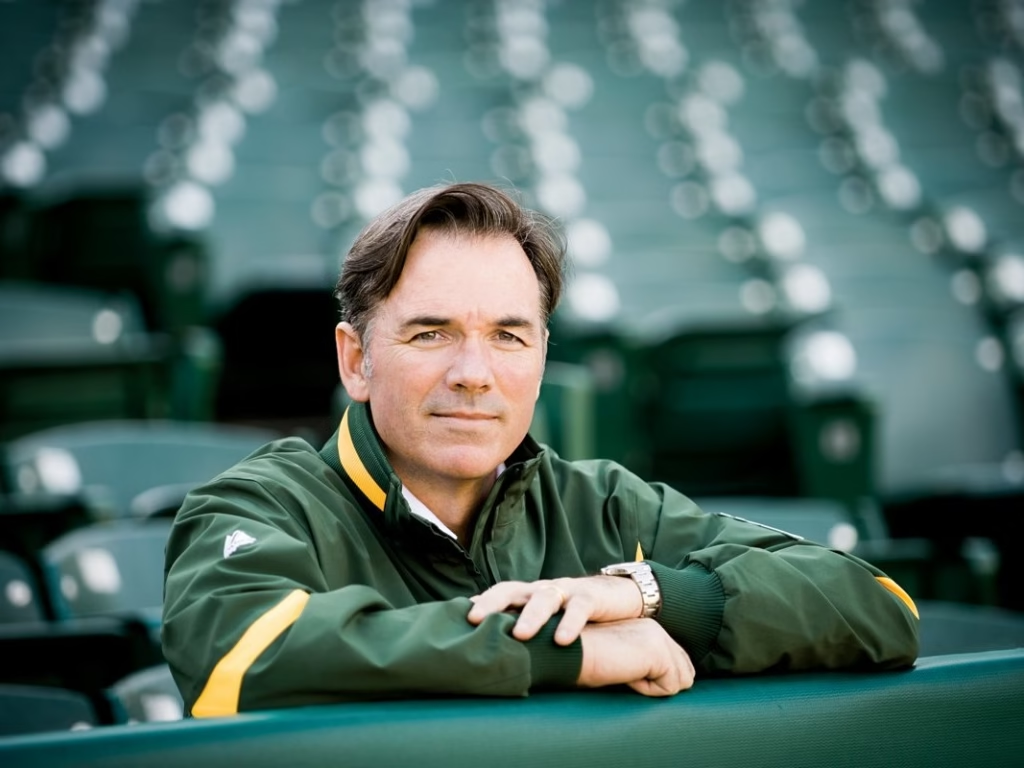
Billy Beane was offered $12.5 million to become the highest-paid general manager in sports history, and he turned it down. Not once, but twice in his career. He proved that sometimes the best decisions aren’t about the money at all.
His story reads like Hollywood fiction, except it actually became one. Brad Pitt played him in “Moneyball,” the 2011 film that grossed over $110 million and earned six Academy Award nominations.
He was supposed to be a baseball superstar, but he completely flopped. That failure? It became the foundation for changing how every professional sports team in the world evaluates talent.
At 63, the Orlando-born executive has built a $20 million fortune not by hitting home runs, but by proving that old-school baseball scouts were wrong. As Senior Advisor to Oakland Athletics owner John Fisher, he’s watched the team he transformed relocate to Las Vegas. At the same time, his “Moneyball” methodology continues influencing decisions in boardrooms far beyond baseball. From European football clubs to Fortune 500 companies, everyone wants to know how Beane turned a $40 million payroll into wins that embarrassed teams spending triple that amount.
Biography
William Lamar Beane III was born on March 29, 1962, in Orlando, Florida, to a U.S. Navy officer father who taught him baseball from an early age. Growing up as a military kid meant frequent relocations before his family eventually settled in San Diego during his elementary school years. His father, an amateur baseball player himself, coached young Billy through Little League with a disciplined, military-style approach that built Billy’s competitive instincts.
Beane’s athletic talents became undeniable at Mt. Carmel High School in Rancho Peñasquitos, California. He wasn’t just good at one sport; he dominated three. He quarterbacked the football team, scored prolifically on the basketball squad (earning All-CIF recognition), and absolutely crushed it in baseball with a remarkable .501 batting average during his sophomore and junior years. Stanford University came calling with a joint baseball-football scholarship, positioning him to succeed then-sophomore John Elway as the Cardinal’s quarterback.
But Beane made what he’d later call “the only decision he would ever make in his life about money.” Instead of Stanford, he signed with the New York Mets as a first-round pick, 23rd overall, in the 1980 MLB Draft. The signing bonus? A hefty $125,000, which would be worth about $477,000 today. That choice would haunt him for years, but it also planted the seeds for his later philosophy on talent evaluation and the dangers of making decisions based solely on financial incentives.
Career
Despite being tagged as a five-tool prospect by scouts who saw future stardom, Beane’s MLB playing career became the ultimate cautionary tale about traditional scouting methods. He made his major league debut with the Mets on September 13, 1984, but the success everyone predicted never materialised.
The struggles started immediately in professional ball. Assigned to Class A Little Falls Mets in 1980, he batted just .210, a shocking drop from his high school dominance. While roommate Lenny Dykstra and fellow prospect Darryl Strawberry thrived, Beane found himself paralysed by self-doubt and unable to adjust to advanced pitching. Over six major league seasons with four teams (the Mets, Twins, Tigers, and Athletics), he compiled a disappointing .219 batting average with just 3 home runs and 29 RBIs in 148 games.
By April 1990, tired of the minor league grind at age 28, Beane approached Athletics GM Sandy Alderson about a scouting position just one day after being reassigned to the minors. His playing career was over, but his revolutionary front office career was about to begin.
The Moneyball Revolution
Beane’s rise through the Athletics’ organisation was rapid. Starting as an advance scout in 1990, he became Assistant General Manager in 1993 and was named General Manager on October 17, 1997. Under Sandy Alderson’s mentorship, he learned to “find value that other teams did not see using sabermetrics,” a statistical approach that would change baseball forever.
The methodology crystallised when owners ordered payroll cuts in the mid-1990s. With a budget of approximately $40 million, competing against the Yankees’ $125 million, Beane and assistant Paul DePodesta focused on undervalued metrics like on-base percentage and OPS rather than traditional scouting attributes like speed and “baseball bodies.”
The 2002 season became the Moneyball showcase. The Athletics finished 103-59, matching the big-spending Yankees, while setting an American League record with a 20-game winning streak from August 13 to September 4. The cost efficiency was staggering: the Yankees spent approximately $1.4 million per win while Oakland spent just $260,000.
Michael Lewis’s 2003 book “Moneyball: The Art of Winning an Unfair Game” spent 18 consecutive weeks on the New York Times Best Seller list and sold over 1.7 million copies. The film adaptation starring Brad Pitt earned six Academy Award nominations, including Best Picture and Best Actor, cementing Beane’s place in pop culture history.
After the 2002 season, Boston Red Sox owner John Henry offered Beane a $12.5 million, five-year contract that would have made him the highest-paid general manager in sports history. Beane initially accepted verbally, but after a weekend of deliberation at home, he declined. He couldn’t uproot his 12-year-old daughter, Casey, and he was determined not to make another decision based solely on money. The Red Sox instead hired Theo Epstein, who won World Series championships in 2004 and 2007.
In 2021, the New York Mets offered another historic contract, but Beane again withdrew his name, stating the role was better suited for a younger executive.
Current Role
Beane transitioned to Senior Advisor to owner John Fisher in November 2022, stepping back from daily operations to allow David Forst complete control as head of baseball operations. He remains a minority owner, holding approximately 4% of the franchise.
The team he helped build is undergoing massive changes. After decades of failed stadium negotiations, MLB owners unanimously approved the Athletics’ relocation to Las Vegas in November 2023. The team played its final game at the Oakland Coliseum on September 26, 2024, bringing an end to a 56-year tenure. They’re now playing temporarily at Sutter Health Park in West Sacramento through 2027, awaiting completion of a $2 billion, 33,000-seat domed stadium in Las Vegas, targeted to open for the 2028 season.
Beane’s influence extends well beyond America’s pastime. He joined a consortium that purchased Barnsley Football Club in England’s League One in December 2017. In September 2020, he acquired approximately 5% of Dutch club AZ Alkmaar, though he sold that stake in October 2025 while remaining as an advisor.
His business partnership with Gerry Cardinale of RedBird Capital Partners led to the co-founding of RedBall Acquisition Corp in July 2020, a $575 million sports-focused SPAC. From 2007 to 2016, he served on NetSuite’s board of directors, earning approximately $4 million in total before Oracle acquired the company for $9.3 billion.
Personal Life
Beane married his first wife, Cathy Sturdivant, a UCSD tennis All-American, in February 1986. Their daughter Casey, born December 8, 1984, now works as Business Development Manager at CFI Partners. After divorcing Sturdivant, Beane married Tara Beane in 1999, a childhood neighbour from San Diego with whom he reconnected. They have twins born January 4, 2008: son Brayden and daughter Tinsley.
The family resides in the San Francisco Bay Area, likely in Danville or Piedmont, California. Beane purchased a home in Danville for $1.735 million in 2002 and listed it for $1.895 million in June 2013. Despite the Athletics’ relocation, there’s no indication he’s moved to Las Vegas, maintaining his roots in the Bay Area, where he built his legacy.
Net Worth
Billy Beane’s net worth is estimated at approximately $20 million as of 2025, derived from multiple income streams. His current salary as Senior Advisor to the Athletics is roughly $3 million annually, a far cry from the historic offers he’s turned down but comfortable nonetheless.
His wealth comes from several sources beyond his base salary. The minority ownership stake in the Athletics he acquired in 2002 (starting at 2.5% and growing to approximately 4% by 2005) is significant value. He’s also made smart investments in technology companies, including Facebook and eBay stock, as well as sports analytics companies like Zelus Analytics and Teamworks.
His time on NetSuite’s board from 2007 to 2016 earned him approximately $4 million total before Oracle acquired the company. He continues to receive royalties from the Moneyball book and film, as well as substantial speaking fees from corporate events where he discusses data-driven decision-making and competing with limited resources.
Beane’s real estate portfolio has also appreciated nicely. That Danville home he bought for $1.735 million in 2002 is now valued at approximately $3.9 million after remodelling, even though he listed it for sale back in 2013.
His speaking engagements in 2024-2025 have taken him to conferences across industries far removed from baseball, including manufacturing, legal, technology, and business leadership summits.
