
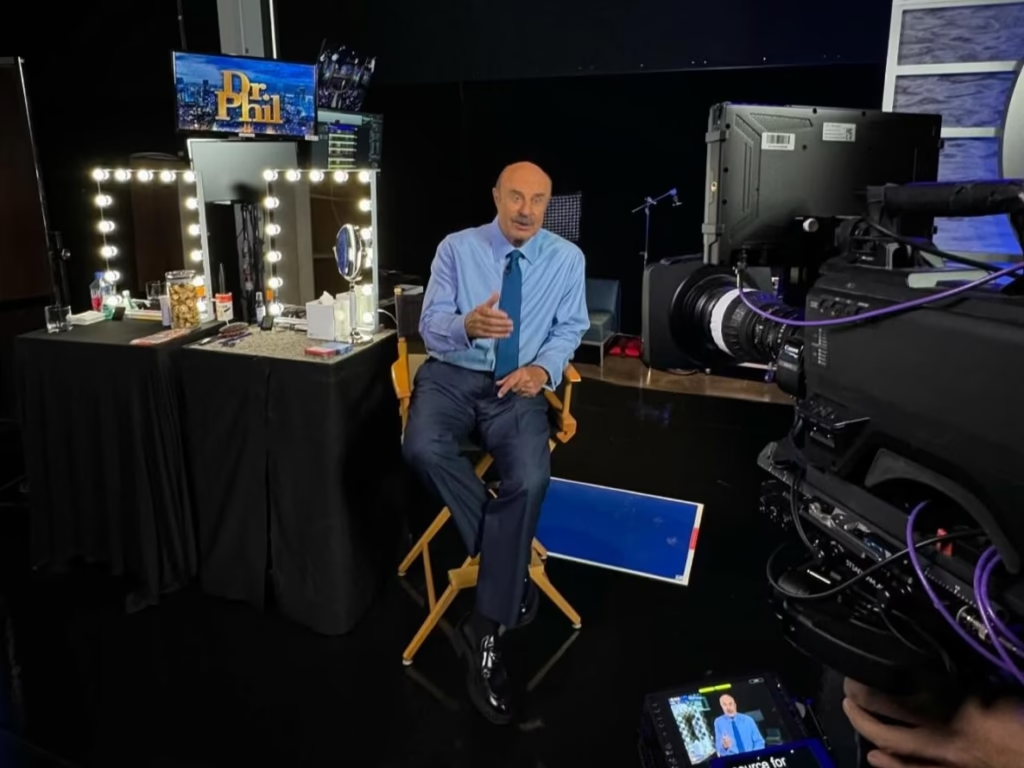
Dr Phil McGraw suffered a devastating courtroom defeat on October 29, 2025, when a federal bankruptcy judge ordered his failed television network, Merit Street Media, into Chapter 7 liquidation, rejecting his attempt to maintain control through Chapter 11 reorganisation.
The ruling, delivered by U.S. Bankruptcy Judge Scott Everett in Texas, found McGraw deleted incriminating text messages and attempted to manipulate the bankruptcy process to favour friends and business associates while “wiping out” claims from major creditors owed hundreds of millions of dollars.
The decision caps the spectacular collapse of a $500 million, 10-year deal that lasted barely 15 months and represents one of the most dramatic business failures in recent television history.
Importantly, this is Merit Street Media’s corporate bankruptcy, not Dr Phil’s personal bankruptcy. McGraw remains personally wealthy with an estimated net worth of $400-460 million.
Merit Street Media was launched in April 2024 as a joint venture between McGraw’s production company, Peteski Productions, and Trinity Broadcasting Network, one of the world’s largest Christian broadcasters.
The venture promised to extend Dr Phil’s media empire beyond his 21-year CBS daytime talk show run with family-friendly programming reaching 80 million homes.
Instead, the network averaged a catastrophic 17,000-27,000 primetime viewers, burned through over $100 million of TBN’s investment, and filed for bankruptcy just 15 months after launch.
Judge Everett’s ruling strips McGraw of all control, appointing an independent trustee to liquidate Merit Street’s assets, including its media library, Dallas production facilities, and lawsuit against TBN, to pay creditors led by Professional Bull Riders ($181 million claim) and Trinity Broadcasting Network (over $100 million invested).
Judge Everett’s October 29 ruling was extraordinarily harsh in its characterisation of McGraw’s conduct. “This case is an anomaly,” Everett declared from the bench during a two-hour recitation, calling Merit Street “dead as a doornail” when bankruptcy was filed and finding “there never has been a pretence of a rehabilitation or a reorganisation.”
The judge determined McGraw formed Envoy Media Co. on July 1, 2025, one day before Merit Street filed for Chapter 11 bankruptcy on July 2, as part of a scheme to transfer employees and assets to the new company while avoiding obligations to creditors.
The court’s most damning findings centred on deleted evidence. Judge Everett determined McGraw deleted an “unflattering” text message describing his strategy to “wipe out” Trinity Broadcasting Network and Professional Bull Riders’ claims through bankruptcy.
The judge stated McGraw “evidently did so to avoid having it produced in the court proceeding” in violation of court orders. Another deleted message to friend and creditor Jamie Ribman promised Ribman’s $5 million investment was “safe” regardless of how the court ruled, with McGraw offering to reimburse him “by wire transfer when he wanted.”
This text was recovered only because it existed on consultant Phil McIntyre’s phone, proving that McGraw had deleted it from his own device.
“Candor to the court is critical,” Everett emphasized, describing the case as a “broken three-legged stool” with three fundamental problems: McGraw “who deletes unfavorable text messages he doesn’t want me to see, who vows to pay favored creditors no matter what the court does”; Chief Restructuring Officer Gary Broadbent “who worked for Mr. McGraw’s newly created company after the petition date, without pushing back honest and direct answers”; and a creditors committee “half composed of the Ribmans who enjoy a favorable payment guarantee from either Mr. McGraw or the debtor.”
The judge revealed he “lost sleep” over testimony in the case, stating, “Generally not a good thing when the judge loses sleep.”
Merit Street collapsed after promises McGraw failed to deliver
The $500 million deal signed in January 2023 promised a conversion. McGraw would receive $50 million annually for 10 years, with Trinity Broadcasting providing all production and distribution services while Peteski Productions delivered 160 new 90-minute episodes of “Dr Phil.” TBN paid $20 million upfront as a good-faith gesture and spent over $100 million to build out Dallas studio facilities and fund operations, at up to $13 million per month.
McGraw promised to slash production costs by 40 per cent, from $68 million to about $41 million annually, by moving from California to Texas, eliminating unionised employees, and hiring local workers.
The reality proved vastly different. According to TBN’s lawsuit, McGraw never produced a single 90-minute episode as required by the contract, instead delivering 60-minute shows that didn’t meet the terms of the agreement.
Rather than cutting costs, McGraw hired dozens of existing Dr Phil Show employees from California, “many of whom were pre-existing union-based employees who were paid California union-based compensation.”
The network’s viewership was catastrophic: averaging just 27,000 primetime viewers in 2024, dropping to 17,000 by the second quarter of 2025, ranking 130th among broadcast and cable outlets.
McGraw’s team maintains they produced 214 episodes, but the parties fundamentally disagree on what constitutes contractual compliance.
Merit Street’s programming lineup included “Dr Phil Primetime” as the flagship show at 8 PM, along with content from Steve Harvey, Nancy Grace, Chris Harrison, and Bear Grylls.
The network signed a four-year media rights deal with Professional Bull Riders in May 2024 for over 300 hours of programming annually. PBR delivered 2.4 million unique viewers to the network, but Merit Street allegedly failed to pay the guaranteed broadcast rights fees.
After just five months, PBR terminated the agreement in November 2024 via a public social media post, later filing a $181 million claim in the bankruptcy proceedings.
Creditors will see cents on the dollar in liquidation.
Under Chapter 7 liquidation, an independent trustee appointed by the court will take control of Merit Street’s assets, sell them through appropriate channels, and distribute the proceeds to creditors in accordance with bankruptcy priority rules.
Merit Street listed both assets and liabilities between $100-500 million, with over 200 creditors. The central claims include Professional Bull Riders at $181 million, Trinity Broadcasting Network with over $100 million invested (plus unspecified fraud damages sought), DirecTV owed $1.7 million, and Dish Network owed $900,000.
Assets to be liquidated include Merit Street’s media library containing 214-220 episodes of “Dr Phil Primetime” (including interviews with Donald Trump and Benjamin Netanyahu), the five-acre Dallas-Fort Worth production campus with soundstages and broadcasting equipment, distribution agreements, intellectual property rights, and most significantly, Merit Street’s $100+ million breach of contract lawsuit against TBN.
The trustee will decide whether to continue that litigation or settle, with any recovery going to the estate for distribution to creditors.
Realistic expectations are grim. Given that total claims ($181 million from PBR alone plus TBN’s $100+ million) likely exceed asset values, major creditors will receive only a fraction of what they’re owed.
Equity holders including Peteski Productions (66.5 percent), TBN’s remaining stake (28.5 percent), and Steve Harvey’s SHG Partnership (5 percent) will almost certainly be wiped out entirely, as equity holders are paid last in bankruptcy liquidation.
U.S. Trustee Asher Bublick indicated a Chapter 7 trustee could be appointed as quickly as October 30, 2025, though McGraw’s attorneys immediately requested a stay pending appeal. Trinity Broadcasting general counsel John Casoria stated in response to the ruling: “TBN appreciates the court taking the time and energy to hear the facts, learn the truth, and provide a detailed recitation of the events that transpired. TBN looks forward to bringing this matter to a conclusion with a Chapter 7 trustee at the helm.”
Dr Phil plans an appeal but faces an uphill battle
McGraw’s representatives issued two statements following the October 29 ruling, with the second being notably more aggressive. Peteski Productions announced: “We are filing an immediate appeal. We take great exception to the court’s improper assertions regarding the alleged destruction of evidence, which simply did not happen. We will not let this stand.”
The statement emphasised McGraw’s efforts to “protect Merit Street employees, distributors, and other interested parties” and expressed satisfaction that he can now “devote his time and energy to his new network, Envoy.”
A separate statement characterised McGraw as “a leader of the highest integrity whose actions reflect honesty, ethics, and a life-long commitment to helping people,” directly contradicting Judge Everett’s findings about deleted evidence and lack of candour.
The defence maintains that McGraw became the sole director of Merit Street “long after the company became overwhelmed by debt thanks to Trinity Broadcasting’s mismanagement” and disputes the claim that zero episodes were produced, claiming 214-220 episodes aired.
Envoy Media Co.
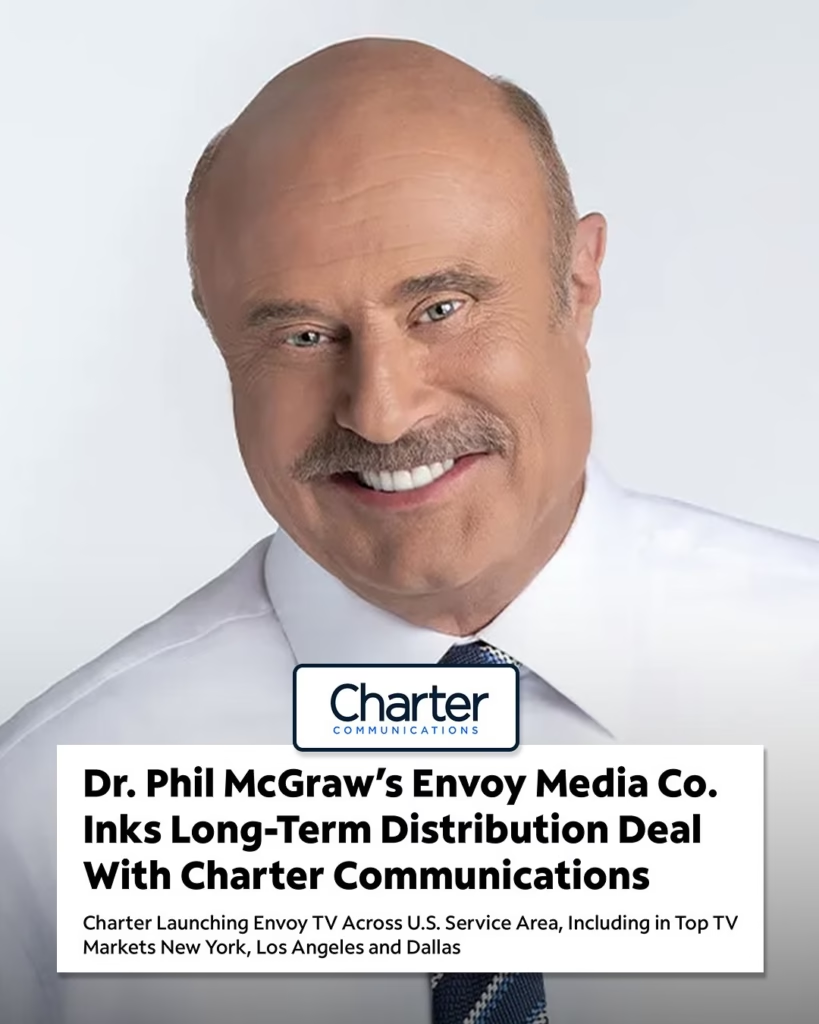
While Merit Street was collapsing, McGraw was building its replacement. Formed on July 1, 2025, one day before the bankruptcy filing, Envoy Media Co. represents McGraw’s attempt to continue his television ambitions free from Merit Street’s creditor obligations. The new venture uses the same Dallas-area production facilities, hired former Merit Street employees (all but six were laid off after bankruptcy), and features the same business model of live news and talk shows.
Envoy distinguishes itself through a “citizen journalism” concept, with a digital app allowing users to submit news and stories from their communities for potential broadcast. McGraw positioned the venture as offering “live, balanced news, original entertainment programming and immersive viewer experiences” serving “flyover states” and middle America. Programming includes content from McGraw and Steve Harvey, who remains committed as a strategic partner.
If Dr Phil had won, he would have kept the network, protected favoured investors, shifted assets into his new venture, paid creditors very little, and suffered no reputational damage.