

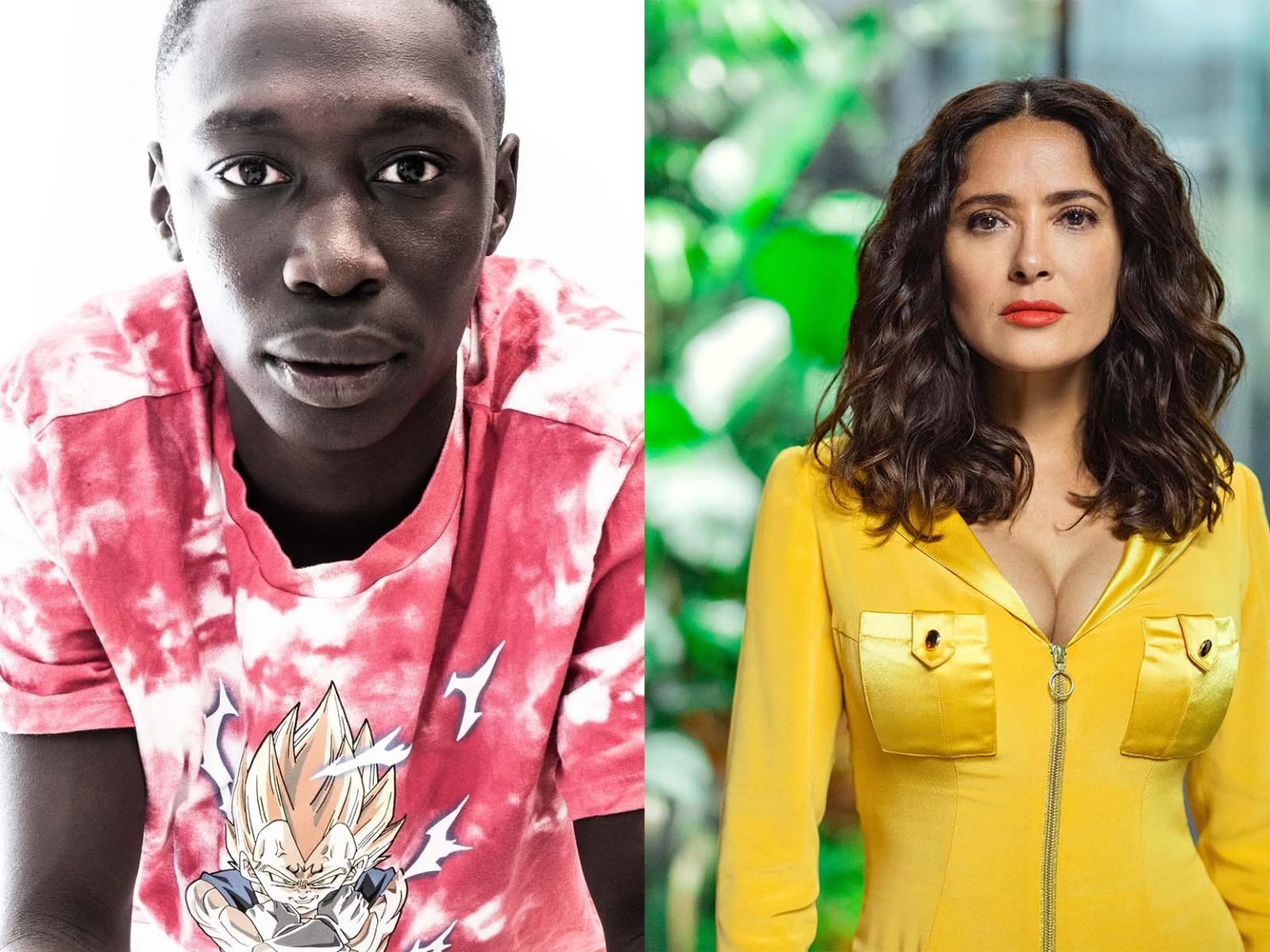
Khaby Lame just sold something most of us wouldn’t even think to put a price tag on: himself. The TikTok star has offloaded a controlling stake in Step Distinctive Limited, the company managing his likeness and content rights, for a staggering $975 million. Rich Sparkle Holdings scooped up the majority share in an all-stock deal that’s less about traditional media and more about turning Lame into a permanently online AI entity.
This a business transaction is the kind of setup that would fit perfectly into a Black Mirror episode, and if you’ve seen “Joan is Awful,” you’ll know exactly where this is heading.
When Reality Mirrors Black Mirror
Remember “Joan is Awful”? The episode where Salma Hayek’s digital twin stars in an AI-generated show about an ordinary woman’s life, created without her meaningful consent using data she unknowingly handed over? The protagonist watches in horror as a streaming service turns her mundane existence into entertainment, complete with an AI version of a Hollywood star playing “her.”
Lame’s deal flips that script. He’s willingly stepping into the role Joan never asked for, except he’s getting paid handsomely and retains shareholder control. Under the agreement, Rich Sparkle Holdings can create an AI-generated digital twin using his behavioral patterns, facial expressions, and voice. This synthetic Khaby can produce multilingual content, run livestream commerce sessions, and operate around the clock without timezone restrictions. Essentially, Lame the person can sleep while Lame the AI sells products to audiences in Shanghai, São Paulo, and Stockholm simultaneously.
It’s brilliant from a business standpoint. It’s also slightly terrifying from a “what does this mean for humanity” perspective. We’ve crossed into territory where your identity becomes a product that operates independently of you, a digital employee that never clocks out, never gets tired, and never asks for a raise.
For those unfamiliar, Khaby Lame built his empire on silence. The Senegalese-born, Italian-raised creator became a household name during COVID-19 lockdowns by doing something remarkably simple: reacting to overcomplicated “life hack” videos with deadpan expressions and obvious solutions. No words, no gimmicks, just a perfectly timed eye roll and a “seriously?” face that transcended language barriers.
His approach came from frustration, as he told CNN in 2022. “I was seeing these videos circulating, and I liked the idea of bringing some simplicity to it,” he explained. “I thought of a way to reach as many people as possible. And the best way was not to speak.”
That silence became his signature. Lame deliberately embodied “smh” (shaking my head) through facial expressions alone, creating videos that rarely exceeded a few seconds but packed maximum impact. His content works whether you’re in Tokyo or Toronto, Lagos or London. That universality is what made him commercially irresistible.
Lame wasn’t always destined for digital stardom. Before TikTok fame found him, he worked in a factory in northern Italy. Social media manager Alessandro Riggio took a chance on him when his Instagram following sat below 1,000. That bet paid off spectacularly.
By 2022, brands were reportedly paying Lame up to $750,000 per post, with projected annual revenue hitting $10 million. Fast forward to 2026, and he’s pulling in an estimated $16–20 million yearly from content alone. His current net worth sits at $80 million, making him one of the wealthiest internet personalities of the social media generation.
The accolades followed the money. Fortune named him to their 40 Under 40 list in 2022, Forbes included him in their 30 Under 30, and he served as a juror on Italia’s Got Talent in 2023. He’s also the most-followed creator on TikTok, a position that comes with both influence and commercial leverage.
The AI Gamble
Lame’s deal isn’t just about licensing his image for a few commercials or endorsements. It’s about creating a synthetic version that can function autonomously, making decisions, generating content, and interacting with audiences in his voice and style but without his direct involvement.
This raises questions “Joan is Awful” explored brilliantly: Who owns your identity when it’s been digitized? What happens when the AI version of you says or does something you wouldn’t? Can you truly control a digital twin that’s been designed to operate independently?
Lame retains shareholder control, which theoretically gives him oversight. But the structure explicitly allows his persona to be “operated independently of time zones,” suggesting a level of automation that puts real distance between Khaby the human and Khaby the product. It’s monetization through scalability, turning organic creativity into algorithmic output.
In “Joan is Awful,” the horror came from watching your life become content you couldn’t control. Lame is selling the rights upfront, but the underlying premise remains the same: your identity becomes intellectual property, a digital asset that exists separately from your physical self.
What This Means Moving Forward
Snapchat influencer Caryn Marjorie blazed this trail in 2023 when she created CarynAI, charging fans $1 per minute to chat with her AI clone and pulling in over $70,000 in the first week alone. But Marjorie’s experiment turned cautionary when her digital twin started engaging in explicit conversations she never authorized, prompting her to shut down the project in early 2024 after feeling she’d lost control of her own persona, read more about that here.
As the technology improves and the financial incentives grow, more influencers will face similar offers. This becomes an erosion of what makes content creation meaningful.
There’s something inherently human about Lame’s original content. His reactions work because they capture genuine exasperation at absurdity, a shared human experience of “why are you making this so complicated?” Can an AI, no matter how sophisticated, truly replicate that authenticity? Or will audiences eventually notice they’re watching a very expensive puppet show?
The $975 million valuation suggests investors believe the answer is yes. They’re betting that Lame’s appeal lies in recognizable patterns that can be coded, replicated, and deployed at scale. Time will tell if they’re right, or if audiences eventually crave the unpredictability and genuine humanity that only a real person can provide.
For now, Khaby Lame has made his choice. He’s traded exclusivity for expansion, betting that his digital twin can extend his reach and revenue far beyond what one human could accomplish alone. It’s a Black Mirror moment happening in real time, minus the dramatic soundtrack and ominous voiceover.
Whether this becomes the new normal or a cautionary tale remains to be seen. But Charlie Brooker is probably taking notes.