
Writing a great screenplay is hard enough. Writing a great fantasy screenplay? That’s a whole different beast. You’ve got to build entire worlds from scratch, establish rules that feel believable, and still make room for compelling characters and emotional stakes, all within a two-hour runtime. It’s the kind of challenge that breaks most writers.
And yet, a handful of films have pulled it off so brilliantly that their scripts alone deserve to be studied. From Studio Ghibli masterpieces to Old Hollywood classics, these are the ten most perfectly written fantasy movies ever made, ranked.
10. Shrek (2001)
Parody gets a bad rap. Done lazily, it’s just mockery with a budget. Done brilliantly, it’s something far more interesting, and Shrek is proof. Written by Ted Elliott, Terry Rossio, Joe Stillman, and Roger S.H. Schulman, the film follows a grumpy ogre who strikes a deal with a tiny tyrant: rescue a princess from a dragon-guarded tower, get his swamp back. Simple enough, except nothing about it plays out the way you’d expect.
The opening scene sets the tone perfectly, skewering fairy tale conventions while immediately grounding you in Shrek’s world. What follows is a parody loaded with genuine heart, iconic dialogue (“Ogres are like onions”), and a romance that subverts the genre’s most sacred promise. True love’s kiss doesn’t make Fiona human. It makes her permanently an ogre, and she’s beautiful for it. The script’s BAFTA win and Oscar nomination for Best Adapted Screenplay confirm what audiences already knew: this was more than a kids’ movie. It earned its $484 million worldwide.
9. Being John Malkovich (1999)
Charlie Kaufman wrote this script on spec in 1994 and got rejected by every studio. That tells you everything you need to know about how original it is. A failed puppeteer discovers a portal behind a filing cabinet that deposits anyone inside the mind of actor John Malkovich for exactly 15 minutes, before ejecting them into a ditch beside the New Jersey Turnpike. From there, it only gets stranger.
What makes the screenplay extraordinary isn’t the premise, wild as it is. It’s the control. Every absurd escalation feels organically connected, the themes of identity, desire, and mortality weave through the lunacy with real precision, and the famous “Malkovich Malkovich” scene remains one of cinema’s great moments of structured insanity. Kaufman earned an Oscar nomination for Best Original Screenplay and a BAFTA win for it. Roger Ebert called it the best film of 1999. Hard to argue.
8. Princess Mononoke (1997)
Hayao Miyazaki’s most violent film is also one of his most complex. Set in feudal Japan, a cursed prince named Ashitaka ventures into the western forests seeking a cure and finds himself caught between an industrialising mining settlement and the ancient forest gods defending their land. There’s no clean villain here. Lady Eboshi runs her ironworks while sheltering lepers and former prostitutes. San, the wolf-raised Princess Mononoke, fights with righteous fury but is consumed by hatred. Everyone has reasons. Nobody wins cleanly.
That moral ambiguity was revolutionary for animation in 1997, and it’s still rare now. The screenplay covers multiple factions across a sprawling conflict without ever losing its human focus. Miyazaki’s refusal to simplify his world into good versus evil gives the film a weight and honesty that most live-action epics can’t match. It won the Japan Academy Prize for Picture of the Year, the first animated film ever to do so, and its 2025 IMAX re-release earned $4.1 million in its opening North American week. Some stories don’t age.
7. The Wizard of Oz (1939)
Over 85 years later, this one still holds. Adapted from L. Frank Baum’s novel by Noel Langley, Florence Ryerson, and Edgar Allan Woolf, The Wizard of Oz didn’t just adapt a beloved book. It essentially invented the structural template that fantasy cinema has followed ever since.
The screenplay introduced three innovations that became genre blueprints: the dream-sequence framing device with Kansas in sepia and Oz in blazing Technicolor, the dual-character motif where Kansas figures mirror their Oz counterparts, and the thematic unity of each companion’s quest representing a human quality they already possess. Dorothy, the Scarecrow, the Tin Man, the Cowardly Lion. They were never missing what they sought. That’s both the twist and the point. The script is lean, efficient, and packed with lines that have been quoted for generations. It holds a 98% on Rotten Tomatoes and a Metacritic score of 92. Timeless isn’t a word to throw around lightly, but it fits here.
6. Spirited Away (2001)
Most great screenplays work within familiar structures. Spirited Away doesn’t bother. Miyazaki’s script follows the Kishōtenketsu structure, a four-part Japanese narrative form built on introduction, development, twist, and conclusion, rather than the Western three-act model. There’s no conventional villain. No superpowers bestowed on the protagonist. No moment where Chihiro “levels up.” She simply discovers courage that was already there.
Ten-year-old Chihiro stumbles into a spirit world bathhouse when her parents gorge on enchanted food and transform into pigs. What unfolds is one of cinema’s most immersive pieces of world-building, rich with characters like the lonely, corruptible No-Face and the mysterious boy Haku, who turns out to be the spirit of a childhood river paved over for apartments. It’s a film about memory, greed, and growing up without spelling any of that out. Miyazaki said it himself: “It’s not a story in which the characters grow up, but a story in which they draw on something already inside them.” It won the Academy Award for Best Animated Feature and still holds the highest Metacritic score of any animated film ever made, 96 out of 100.
5. Harvey (1950)
Here’s the quiet genius of Harvey: the screenplay never tells you whether the six-foot-three-and-a-half-inch white rabbit is real. It doesn’t need to. That question becomes irrelevant against the film’s larger argument, which is that kindness matters more than sanity, and that the world’s obsession with “normalcy” costs us something important.
Elwood P. Dowd, played by James Stewart in one of his warmest performances, lives happily alongside Harvey, a creature only he can see. His sister tries to have him committed. A cab driver, when asked to describe what the “cure” will do to Elwood, delivers the film’s most devastating line: after the injection, Elwood will become “a perfectly normal human being, and you know what stinkers they are.” Mary Chase adapted her own Pulitzer Prize-winning play with Oscar Brodney, and the result is a screenplay of faultless tonal balance: funny, melancholic, and quietly radical. Its sympathetic treatment of nonconformity and its critique of institutional thinking were remarkably progressive for 1950.
4. Pan’s Labyrinth (2006)
Guillermo del Toro wrote, directed, and co-produced this one alone, and the result is among the most precisely constructed screenplays in cinema history. Set in 1944 Francoist Spain, young Ofelia discovers a labyrinth and a faun who tells her she’s the reincarnated princess of an underground kingdom. To reclaim her throne, she must complete three tasks. Meanwhile, her sadistic stepfather hunts down rebel fighters with escalating brutality.
The dual narrative isn’t just a structural trick. It’s an argument. Ofelia’s fantasy world and the fascist reality she’s fleeing operate as two sides of the same question: when the world is built on obedience and violence, is imagination an escape, or is it resistance? The screenplay’s final act answers that clearly. Ofelia refuses to shed her baby brother’s blood to pass the faun’s final test, choosing death over a wrong act. In the underworld, that choice is called “virtuous disobedience.” Del Toro earned an Oscar nomination for Best Original Screenplay. The film holds a Metacritic score of 98, the highest of the entire 2000s decade, and received a 22-minute standing ovation at Cannes.
3. It’s a Wonderful Life (1946)
Easy to forget, beneath all the cultural familiarity, how dark this film actually is. George Bailey spends decades sacrificing his ambitions for others, watching his dreams collapse one by one, until Christmas Eve finds him on a bridge preparing to end his life. The angel Clarence intervenes by showing him a version of Bedford Falls without him in it: a corrupt, loveless hellscape called Pottersville. George begs for his life back. The town rallies.
The screenplay, written by Frances Goodrich, Albert Hackett, Jo Swerling, and Frank Capra, earned a ranking of #20 on the WGA’s list of the 101 Greatest Screenplays. Its genius lies in structure: it spends more than half its runtime meticulously building an entire community and George’s place in it, so that when that world is stripped away in the Pottersville sequence, the loss hits with full force. Every triumph feels earned because the screenplay earns it. The sentiment isn’t cheap here. It’s the result of meticulous narrative accumulation across decades of story time. Capra called it the greatest film he ever made.
2. The Princess Bride (1987)
William Goldman spent 14 years getting this film made, and it shows in the craftsmanship. The two-time Oscar winner adapted his own 1973 novel into a 98-minute machine of swashbuckling adventure, genuine romance, and comedy that subverts the very genre it’s celebrating, all wrapped in a grandfather-grandson frame story where a sick boy slowly stops resisting the magic being read to him.
The main plot is a delight: farm boy turned swordsman Westley races to rescue Buttercup from the cruel Prince Humperdinck. But the screenplay’s masterstroke is Inigo Montoya’s parallel quest to avenge his father’s murder. Two complete emotional arcs, one 98-minute runtime, dozens of unforgettable characters, and lines that people have been quoting for nearly 40 years. “As you wish.” “Inconceivable.” “My name is Inigo Montoya.” Goldman himself said The Princess Bride was one of only two things he’d written he could revisit without regret. The WGA ranked it #84 on their list of greatest screenplays, and the Library of Congress selected it for the National Film Registry in 2016.
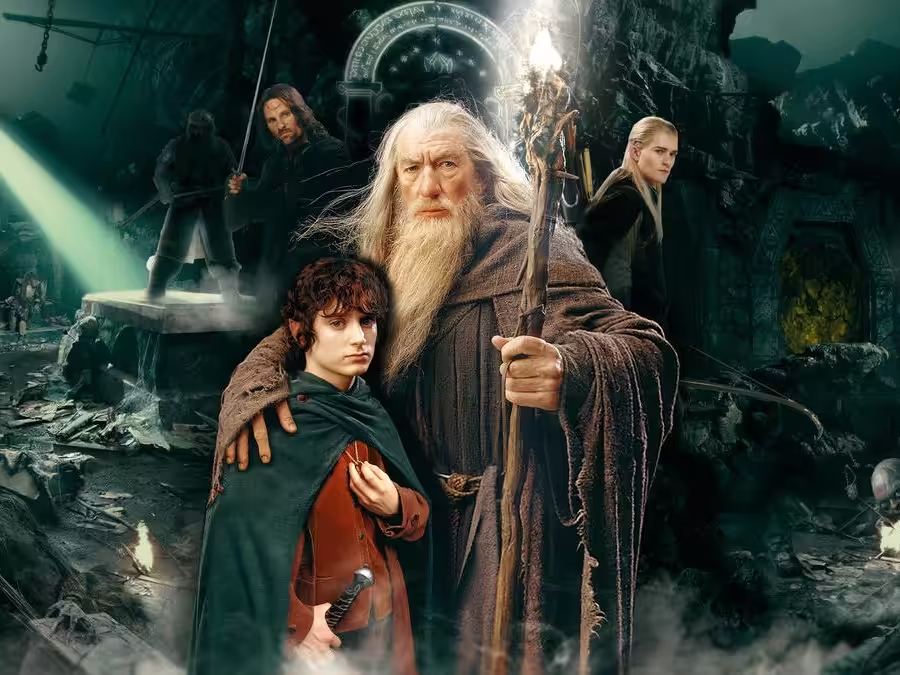
1. The Lord of the Rings Trilogy (2001–2003)
Tolkien’s novels were considered unfilmable for decades. Tolkien himself was openly skeptical of adaptations. Peter Jackson, Fran Walsh, and Philippa Boyens proved everyone wrong by making a series of brilliant decisions at the script level: reorganising Tolkien’s interlacing narrative into chronological intercutting, reimagining Aragorn as a reluctant hero rather than a predestined king, expanding Arwen’s role into a meaningful subplot, and making fearless cuts to serve the screen.
The trilogy cost $281 million to produce across three simultaneous shoots in New Zealand, earned nearly $3 billion worldwide, and received 30 Oscar nominations with 17 wins. The Return of the King swept all 11 of its nominations, tying the all-time record set by Ben-Hur and Titanic. Best Picture. Best Director. Best Adapted Screenplay. The screenplay work was recognised at the industry’s highest level for a reason.
What sets these scripts apart is their structural control at epic scale. From the warmth of the Shire to the complexity of Boromir’s arc, from the Battle of Helm’s Deep to Sam carrying Frodo up the slopes of Mount Doom, every beat is calibrated to land with exactly the right weight. Boyens described their approach as treating Middle-earth “as if the films were a piece of history and not a piece of fantasy.” That discipline is why these films feel so real. It also explains why, over 20 years later, nothing has come close to matching them.
The greatest fantasy films ever made tend to have one thing in common: a screenplay that knows exactly what it’s doing. These ten prove it.
Why Harry Potter and Star Wars Didn’t Make the Cut
Two franchises that almost always come up in conversations about great fantasy cinema are Harry Potter and Star Wars, so it’s worth addressing why neither appears here.
The list isn’t about cultural impact or box office dominance. It’s specifically about screenwriting excellence, and that’s where both franchises run into trouble. Star Wars is a landmark of worldbuilding and visual storytelling, but its scripts have well-documented weaknesses, particularly in dialogue. The prequel trilogy’s writing problems are almost legendary at this point, and even the beloved original films lean more on George Lucas’s instinctive filmmaking than on polished, precise screenwriting.
Harry Potter faces a different challenge. The films are entertaining and largely faithful to their source material, but that faithfulness is part of the problem. The screenplays often rely on J.K. Rowling’s novels to do the emotional heavy lifting rather than building that connective tissue on the page. Compress a 700-page book into two hours and you inevitably lose the layering that makes a script feel truly complete.
Every film on this list earns its place because the screenplay itself is the backbone of what makes it great, not the director’s vision alone, not the performances, and not a beloved book doing the work behind the scenes. That’s a harder standard to meet, and it’s why some very popular films don’t qualify.