
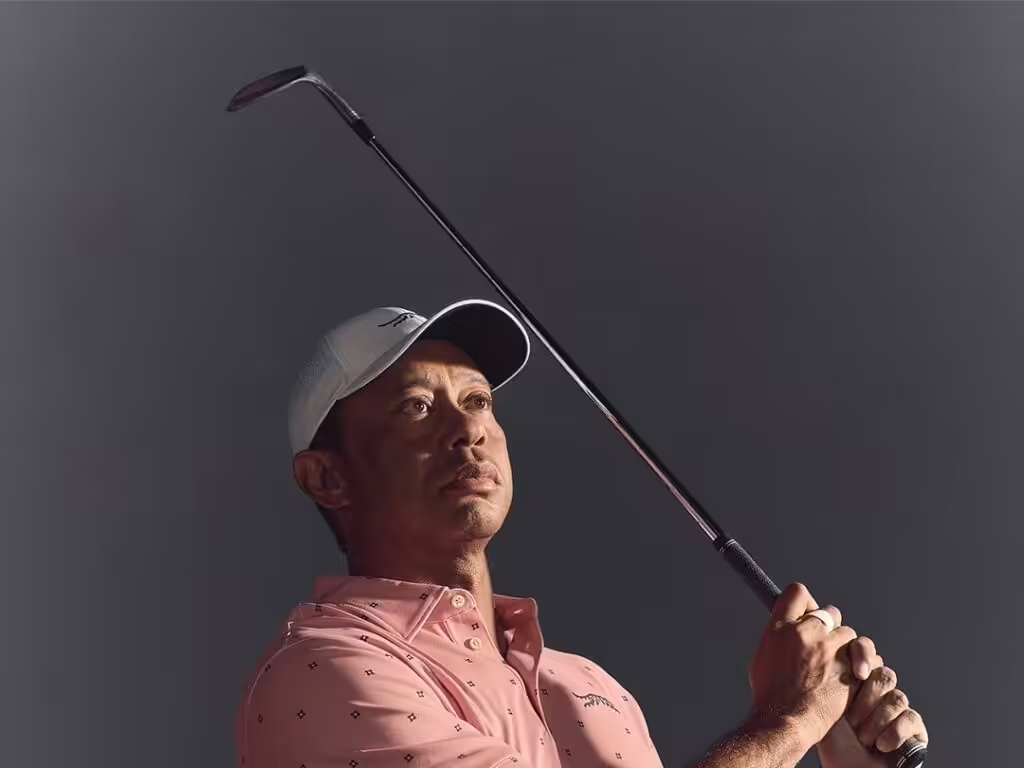
Some careers begin on a stage. Tiger Woods’ began in a high chair. Before he could properly walk, his father Earl, a retired U.S. Army Green Beret, had already placed a putter in his son’s hands. By age two, the boy was putting against Bob Hope on national television.
Quick Facts
| Date of Birth | December 30, 1975 |
|---|---|
| Age | 50 years |
| Nationality | American |
| Zodiac Sign | Capricorn |
| Occupation | Professional golfer, businessman |
| Net Worth | $1.3 billion to $1.5 billion |
| Birthplace | Cypress, California |
| Ethnicity | Self-described as "Cablinasian" (Caucasian, Black, American Indian, and Asian) |
| College | Stanford University (left 1996 after two years) |
| Turned Professional | August 28, 1996 |
| Marital Status | Divorced from Elin Nordegren (m. 2004, div. 2010); in a relationship with Vanessa Trump since late 2024 |
| Children | Sam (b. 2007), Charlie (b. 2009) |
| Parents | Earl Woods and Kultida Woods (Kultida passed away February 4, 2025) |
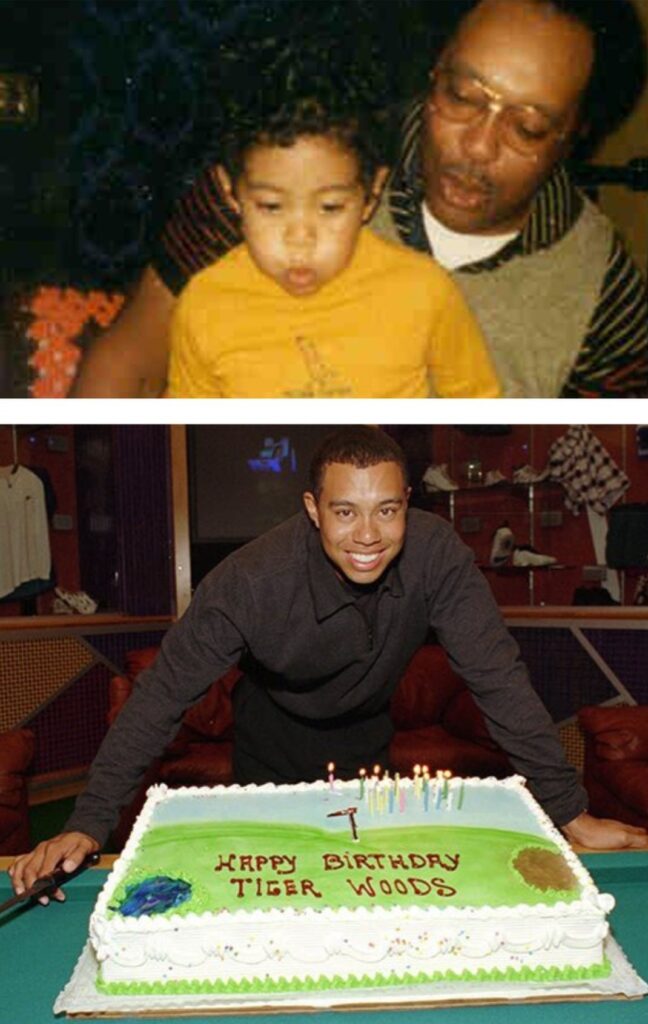
Born Eldrick Tont Woods on December 30, 1975, in Cypress, California, Tiger grew up with golf as a second language. He shot 48 over nine holes at age three, got his first hole-in-one at six, broke 80 at eight, and broke 70 at twelve. Those aren’t typos. Earl employed deliberate psychological conditioning during practice, jingling coins and dropping clubs mid-swing to harden his son’s mental game. By age eleven, Tiger beat his father at full effort. Earl never won another round against him.
Tiger would later describe his own heritage as “Cablinasian,” reflecting his Caucasian, Black, American Indian, and Asian roots. That mixed identity became inseparable from his role as golf’s most visible barrier-breaker.
The “Hello World” Moment That Changed Everything
Before turning professional, Tiger had already rewritten the amateur record books. He won three consecutive U.S. Junior Amateur titles from 1991 to 1993, then three consecutive U.S. Amateur titles from 1994 to 1996. No golfer had ever won both, let alone three of each.
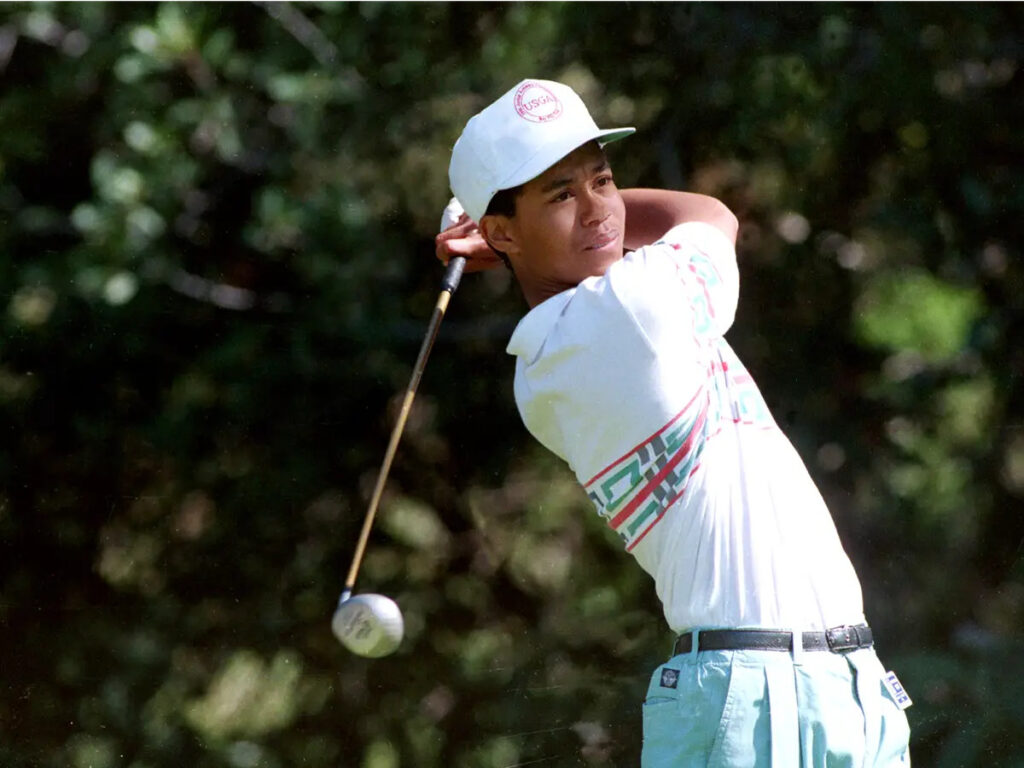
He left Stanford University in 1996 after two years, ten collegiate wins, and an NCAA individual championship. On August 28, 1996, the 20-year-old turned professional at the Greater Milwaukee Open with three words: “Hello world.” Nike launched a $40 million endorsement deal the same day. The campaign pointedly noted that some American golf courses still wouldn’t let Woods play. That pointed observation made the moment even bigger than the money.
The 1997 Masters
Nothing quite announced Tiger Woods to the world like Augusta in April 1997. He opened with a 40 on the front nine, then torched the back nine with a 30. He never looked back. His final score of 270 won by 12 strokes, the largest margin in Masters history, and at 21, he became the youngest champion and the first person of African American or Asian descent to win at Augusta National. Some 44 million American viewers watched. By June, he was world No. 1.
What followed was a decade of dominance that reshaped the sport entirely. He finished with 82 PGA Tour victories tying Sam Snead’s all-time record, 15 major championships, 683 weeks at world No. 1, and PGA Tour Player of the Year honours 11 times. Golf prize purses ballooned. Fitness became standard for players who’d previously considered it optional.
How His Money Grew
Woods crossed $1 billion in career earnings by 2009, faster than any athlete before him. At his peak in 2007, he earned $122.7 million in a single year, with $99.8 million coming from endorsements alone. His Nike partnership, which began with that $40 million deal in 1996, eventually generated an estimated $500 to $700 million over 27 years through several extensions, including an eight-year $320 million deal in 2005. Even after a 2009 personal scandal cost him Accenture, AT&T, Gatorade, and General Motors as sponsors, and a reported $100 million divorce settlement, he rebuilt methodically.
Forbes certified him as a billionaire in 2022, only the second active athlete ever to reach that milestone after LeBron James. His total career earnings now approach $2 billion pretax, per Sportico’s December 2025 analysis, making him the second-highest-earning athlete in history behind only Michael Jordan. His PGA Tour prize money alone stands at a record $121 million, yet that figure represents barely 6% of everything he’s made. The real money was always off the course.
When the Nike partnership ended in January 2024, Woods didn’t look for another apparel sponsor. He launched his own brand, Sun Day Red, in partnership with TaylorMade, featuring a logo with 15 tiger stripes, one for each major. Current partners include TaylorMade, Rolex, Bridgestone Golf, Monster Energy, and Hero MotoCorp. Even in 2024, with virtually no competitive golf played, he earned an estimated $67 million.
Net Worth
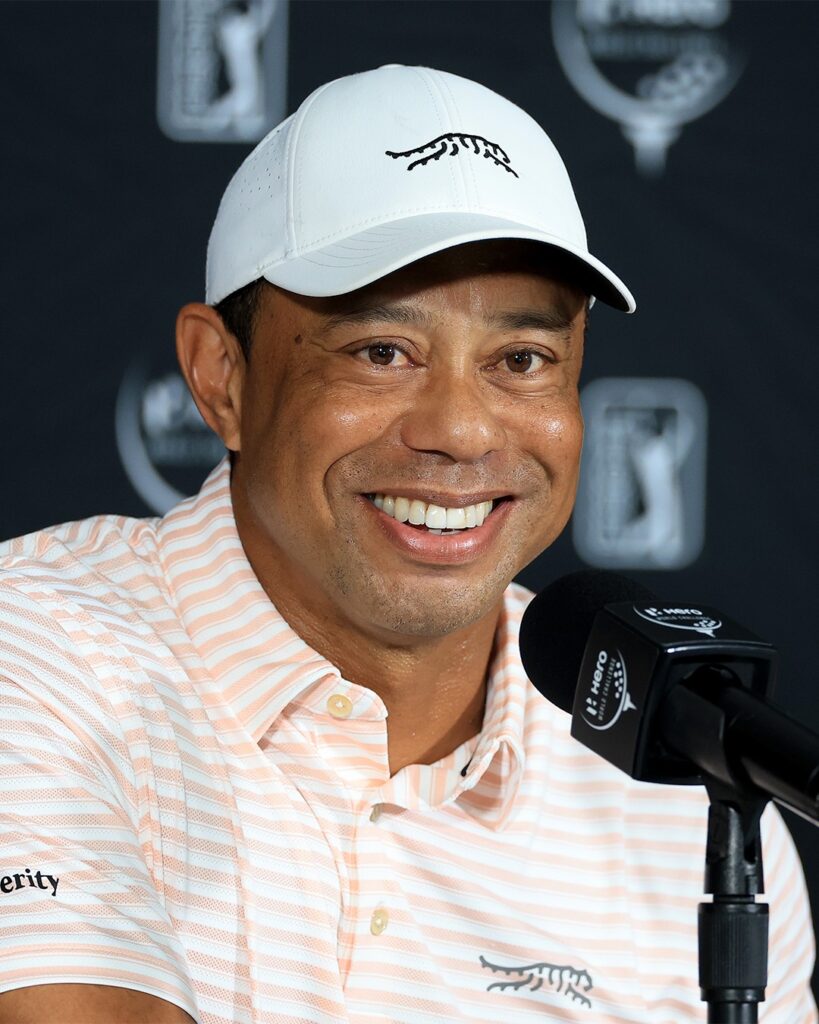
As of early 2026, Tiger Woods’ net worth sits at an estimated $1.3 to $1.5 billion, according to Forbes and CelebrityNetWorth, making him one of only a handful of athlete billionaires in the world and comfortably the wealthiest golfer in history.
His primary residence on Jupiter Island, Florida, one of America’s most exclusive addresses, is valued at over $54 million. Woods purchased two adjacent properties there in 2006, and the compound now serves as both his home and private training facility, complete with a custom golf course, a gym, and a swimming lagoon.
Away from land, he owns a yacht named Privacy, a vessel he’s used for family holidays and quiet recovery during injury layoffs. The name has always felt fitting. For someone whose private life became global tabloid fodder in 2009, it represents exactly the kind of retreat money can buy but attention can’t follow. His Gulfstream G550 private jet offers the same freedom, letting him manage a global business empire without the constraints of commercial travel.
Beyond his personal assets, his TGR Ventures portfolio includes TGR Design, developing around 17 golf courses worldwide, and PopStroke, a golf entertainment chain with 17 venues across the U.S. and 15 more planned. His co-founded TGL league, valued at nearly $500 million after a 2024 funding round, counts Stephen Curry, Serena Williams, and Shohei Ohtani among its investors.
Personal Life
Tiger’s personal life has been as eventful as his career, and often just as public. He married Swedish model Elin Nordegren in 2004, and the couple had two children, daughter Sam, born in 2007, and son Charlie, born in 2009. The 2009 scandal and subsequent divorce, finalised in August 2010, was one of the most covered celebrity splits in modern media history.
He later dated skier Lindsey Vonn from 2013 to 2015, a high-profile pairing of two elite athletes navigating fame simultaneously. He has been in a relationship with Vanessa Trump since late 2024.
His mother Kultida, a constant presence throughout his career, passed away on February 4, 2025. Daughter Sam now attends Stanford, his alma mater, while son Charlie committed to play golf at Florida State University in February 2026. That last detail carries a certain poetry: the next generation of Woods, carrying on the game Earl once placed in Tiger’s hands before he could walk.
At 50, his competitive future remains uncertain. Seven back surgeries, a ruptured left Achilles tendon in March 2025, and a lumbar disc replacement in October 2025 have taken a serious toll. On March 27, 2026, he was involved in a vehicle incident on Jupiter Island and subsequently charged with DUI involving property damage. Four days later, he announced he would step away from golf indefinitely to seek treatment and focus on his health.
Whether another PGA Tour victory or a record-breaking 16th major ever comes is now genuinely unclear. What isn’t unclear is the legacy. Tiger Woods didn’t just dominate golf. He changed what the sport could be, what it could earn, and who it could belong to.