
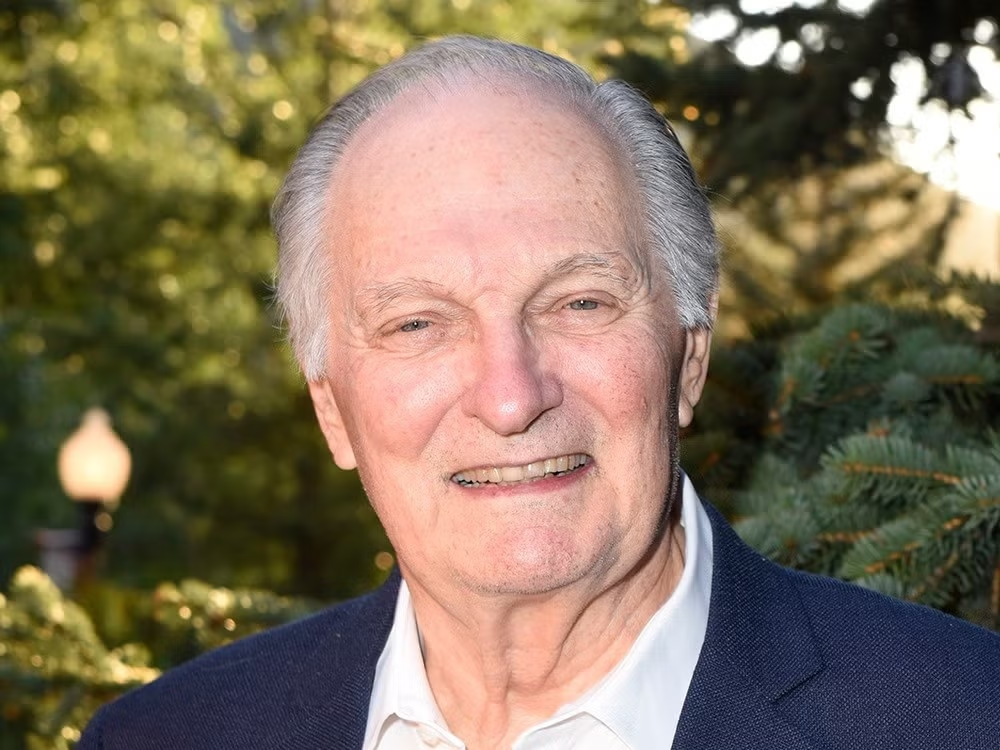
Who Is Alan Alda?
Alan Alda is an American acting legend best known for playing Hawkeye Pierce in the groundbreaking sitcom M*A*S*H. That role made him a household name and defined an entire generation of television.
But he’s so much more than just Hawkeye. He’s an accomplished actor, director, writer, and science advocate who continues to work at the age of 89. His career spans seven decades, and he shows no signs of slowing down.
Alda made television history on M*A*S*H by becoming the only person to win Emmys for acting, writing, and directing the same show. In 2025, he appeared in Netflix’s The Four Seasons, proving that even with Parkinson’s disease, he’s still got the magic that made him a star.
Quick Facts
Full Name: Alphonso Joseph D’Abruzzo
Date of Birth: January 28, 1936
Age: 89 years old
Birthplace: New York City
Nationality: American
Height: 6’2″ (1.9 metres)
Spouse: Arlene Alda (married since 1957)
Children: Eve, Elizabeth, and Beatrice
Net Worth: $50 million
Early Life And Education
Alan was born in Manhattan on January 28, 1936, with the rather impressive name Alphonso Joseph D’Abruzzo. His father, Robert Alda, was an actor and singer who created the stage name “Alda” by combining the first two letters of his first and last names. His mum, Joan Browne, was a former beauty queen who became a homemaker.
Life wasn’t easy for young Alan. His dad worked in burlesque theatre, which meant the family travelled constantly across the United States. Sometimes, young Alan would perform with his father in the less risqué sketches, getting his first taste of show business.
But the real challenge was at home. His mother struggled with schizophrenia, and her behaviour was unpredictable and sometimes violent. Alan has recalled how she once tried to stab his father when he was just six years old. He learnt to scan her moods and improvise responses for his own safety.
When Alan was seven, disaster struck in the form of polio. The treatment was ruthless: his parents wrapped scalding blankets around his limbs every hour for six months whilst repeatedly stretching his muscles. It was agonising, but he survived and eventually made a full recovery.
His parents divorced when he was ten, and his father later remarried actress Flora Marino in 1955. Alan also has a half-brother, Antony Alda, born in 1956, who followed the family tradition into acting.
Alan attended Archbishop Stepinac High School in New York, where his passion for performance began to flourish. During his junior year, he had a remarkable international experience—studying in Paris, acting in a play in Rome, and performing on television in Amsterdam alongside his father.
He continued his education at Fordham University, where he studied English while working at the campus radio station, WFUV. He graduated in 1956 with his Bachelor of Arts degree, but his education didn’t stop there.
As a member of the ROTC at the university, Alan entered the U.S. Army Reserve after graduating. He served for six months at Fort Benning, and despite persistent rumours to the contrary, he never actually served in Korea during the war. After completing his active duty, he finished his service in the reserves back in New York.
Career
Alan launched his professional acting career in the 1950s by joining the Compass Players, an influential improvisational comedy troupe. He then moved to the Cleveland Play House, where he appeared in several productions, including “Job,” “To Dorothy a Son,” and “Heaven Come Wednesday” between 1958 and 1959.
His television debut came in 1958 on The Phil Silvers Show, followed by his Broadway debut in Only in America the following year. In 1961, he starred in Purlie Victorious alongside Ruby Dee and Ossie Davis, a role that showcased his dramatic range.
His first film was Gone Are the Days, released in 1963, which was based on the movie version of Purlie Victorious. Throughout the 1960s, he bounced between stage and screen with impressive versatility. He appeared in Paper Lion (1968), playing writer George Plimpton, and made guest appearances on popular shows such as Route 66 and Naked City.
Broadway loved him, too. He starred in Fair Game for Lovers (1964), The Owl and the Pussycat, and The Apple Tree (1966-67), which earned him his first Tony nomination. By the end of the decade, he was an established actor with a growing reputation.
M*A*S*H
Then came 1972, and everything changed. Alan landed the role of Captain Benjamin Franklin “Hawkeye” Pierce in M*A*S*H, and television would never be the same.
The show was set during the Korean War and followed doctors at a mobile army hospital as they dealt with the horrors of war. They used dark humour and compassion to cope with impossible situations. It was both amusing and dire, tackling real political and social issues.
Alan appeared in every single episode – that’s 256 episodes over eleven seasons. He was the only cast member to achieve that feat.
But he wasn’t just acting. He wrote and directed numerous episodes, gaining more creative control as the series progressed. Under his influence, MAS*H evolved from a traditional service comedy into something much more profound—a show that openly addressed the politics and social issues of the 1970s.
The financial rewards were substantial. By the final seasons, Alan was earning $300,000 per episode, which translated to approximately $6 million per season. When adjusted for inflation, that’s nearly $20 million per season in today’s money, making him one of the highest-paid actors on television at the time.
The awards were just as impressive. He won five Emmys for MAS*H and received more than 20 nominations. He won for acting, writing, and directing—something nobody had ever done before for the same series.
The 1983 finale, which Alan directed, was watched by 125 million people. At the time, it was the most-watched television episode in American history, and it remains one of the most significant moments in TV history.
Film
Whilst juggling M*A*S*H, Alan maintained an active film career. He appeared in California Suite (1978) with Jane Fonda and Maggie Smith, bringing his trademark wit to Neil Simon’s comedy. He also wrote and starred in The Seduction of Joe Tynan (1979) with Meryl Streep, showcasing his talents behind the camera as well.
In 1981, he made his directorial debut with The Four Seasons, which he also wrote and starred in alongside Carol Burnett. The film was a commercial and critical success, leading to more directorial opportunities. He went on to direct Sweet Liberty (1986), A New Life (1988), and Betsy’s Wedding (1990), all of which he also wrote.
His collaboration with Woody Allen proved particularly fruitful. Alan appeared in Crimes and Misdemeanours (1989), Manhattan Murder Mystery (1993), and Everyone Says I Love You (1996). Working with Woody gave him the chance to explore more complex, morally ambiguous characters.
Other notable films include Same Time, Next Year (1978), What Women Want (2000), Tower Heist (2011), Bridge of Spies (2015), and Marriage Story (2019). Each role demonstrated his versatility and ability to adapt to different genres and styles.
His best shot at an Oscar came in 2004 when he played Owen Brewster in Martin Scorsese’s The Aviator. The performance earned him a nomination for Best Supporting Actor. Though he didn’t win, the nomination proved that decades into his career, he could still deliver award-worthy performances.
Television
After M*A*S*H ended in 1983, Alan didn’t disappear from the small screen. From 1993 to 2005, he hosted Scientific American Frontiers on PBS, a show that explored cutting-edge science and technology. This role reflected his genuine passion for making science accessible to everyone.
In 2004, he joined The West Wing as Republican Senator Arnold Vinick, a role that earned him another Emmy in 2006. It was a meaty part that allowed him to play against type, and he absolutely nailed it.
He continued appearing in acclaimed series throughout the 2000s and 2010s. His credits include ER (1999), 30 Rock (2009), The Big C (2011-2013), The Blacklist (2015), Louis C.K.’s Horace and Pete (2016), Ray Donovan (2018-2020), and The Good Fight (2018-2019).
In 2025, he made a guest appearance in Netflix’s The Four Seasons, a series adaptation of his 1981 film created by Tina Fey, Lang Fisher, and Tracey Wigfield. The show premiered on May 1, 2025, and was quickly renewed for a second season. Even at 89, Alan proved he’s still got the charm and talent that made him a star.
Theatre
Despite his success in film and television, Alan never abandoned Broadway. He returned regularly throughout his career, keeping his connection to live theatre alive.
He starred in Jake’s Women (1992), QED (2001-02), and Glengarry Glen Ross (2005), the latter earning him another Tony nomination. In 2014, he appeared in Love Letters alongside Candice Bergen, delighting audiences with his stage presence.
The stage was where he started, and it’s clearly where he felt most at home. Even as a Hollywood star, he never lost his love for performing in front of a live audience.
Science Communication
Here’s another side to Alan. In 2009, he founded the Alan Alda Centre for Communicating Science at Stony Brook University, where he also became a visiting professor in 2010.
The centre’s mission is simple yet vital: to help scientists explain complex ideas to the general public. Alan uses acting techniques and improvisation exercises to teach scientists how to communicate more effectively. It’s a brilliant fusion of his two great passions—performance and science.
He serves on the advisory boards of the Future of Life Institute and the World Science Festival. In 2011, he wrote a play called Radiance: The Passion of Marie Curie, focusing on her life between winning her two Nobel Prizes.
His dedication to science communication has earned serious recognition. In 2014, he received the American Chemical Society’s James T. Grady-James H. Stack Award. In 2016, he won the National Academy of Sciences Public Welfare Medal. Most recently, in 2021, the Kavli Foundation gave him its first-ever Distinguished Kavli Science Communicator award.
He’s genuinely passionate about cosmology and even participated in BBC coverage when the Large Hadron Collider was opened in Geneva in 2008. Not many actors can claim that on their CV.
Political Activism
Alan has been politically active throughout his life, particularly on issues related to women’s rights. He chaired the “Men for the Equal Rights Amendment” campaign and was appointed to the International Women’s Year Commission—a notable achievement for a male actor in the 1970s.
In the early 1970s, he collaborated with Marlo Thomas on Free to Be… You and Me, a groundbreaking children’s album about gender equality. The project became one of the earliest public signs of his support for women’s rights and progressive causes.
He’s also done extensive charity work. In 2005, he narrated a television special for St. Jude Children’s Research Hospital titled “Fighting for Life.” His wife, Arlene, and he are close friends with Marlo Thomas, who dedicates much of her time to raising money for the hospital her father, Danny Thomas, founded.
Personal Life
In 1956, Alan met Arlene Weiss at a dinner party hosted by a mutual friend. A rum cake accidentally fell on the floor, and they were the only two guests who didn’t hesitate to eat it anyway. That’s how their love story began.
Alan later recalled, “We did eat the rum cake off the floor and were inseparable after that. But I was captivated by her even earlier in the meal when I heard her at the end of the table laughing at my jokes. She had me at Ha.”
They married on March 15, 1957, and have now been together for 68 years. In Hollywood, where marriages often crumble under the spotlight, their enduring relationship is genuinely remarkable.
They have three daughters: Eve (born 1958), Elizabeth (born 1960), and Beatrice (born 1961). All three have gone on to successful careers in their respective fields, and the family remains close.
The Aldas lived in Leonia, New Jersey, for many years and have owned properties in Manhattan’s Park Millennium building and various Los Angeles neighbourhoods. They’ve built a life together that’s lasted through decades of Hollywood pressures.
Regarding his religious beliefs, Alan describes himself as agnostic. He doesn’t follow organised religion, though he occasionally prays during moments of fear. He prefers finding meaning in this life rather than worrying about what comes next.
Parkinson’s Disease
On July 31, 2018, Alan appeared on CBS’s This Morning and publicly announced that he’d been diagnosed with Parkinson’s disease three years earlier, in 2015. He’d kept it private for three years before deciding to go public.
At 89, his attitude towards the disease is remarkably upbeat. When asked in May 2025 how he’s doing, he smiled and replied, “Making progress. I didn’t say in which direction.” That’s classic Alan Alda humour right there.
He also lives with prosopagnosia, commonly known as face blindness, which makes recognising people incredibly difficult. But neither condition has stopped him from living his life entirely.
“Almost every day I’m finding a new way to do something,” he explained in an interview. “It’s a little like a game. I’ve found whatever the little problem is, if I keep at it, I can eventually solve it, and then I feel like a million bucks. It’s a way to have a good time under poor circumstances.”
He continues to play tennis regularly, takes boxing lessons, and maintains an active life.
Books
Alan has authored three memoirs, each offering unique insights into his life, philosophy, and experiences.
Never Have Your Dog Stuffed (2005) – His first memoir shares stories from his career and personal life. The title comes from a childhood incident when his father had Alan’s deceased dog stuffed, thinking it would comfort him. Young Alan was horrified by the result, learning that sometimes you have to accept things as they are rather than desperately trying to change them.
Things I Overheard While Talking to Myself (2007) – This memoir weaves together advice from his public speeches with personal recollections about his life and beliefs. The audiobook version earned him a Grammy nomination in 2008 for Best Spoken Word Album.
If I Understood You, Would I Have This Look on My Face? (2017) – His third memoir explores his quest to learn how to communicate better and teach others to do the same. It draws heavily on his experiences in science communication and is full of practical wisdom.
All three books are witty, honest, and deeply insightful—well worth reading if you want to understand the man behind Hawkeye.
Awards
Alan has accumulated an extraordinary collection of honours throughout his career. Here’s what he’s won:
Emmy Awards: Six wins from an incredible 34 nominations, covering acting, writing, and directing
Golden Globe Awards: Six wins from 16 nominations
Tony Awards: Three nominations for his Broadway performances
Academy Award: One nomination for Best Supporting Actor in The Aviator (2004)
Screen Actors Guild: Life Achievement Award in 2019
Grammy Award: One nomination for audiobook narration in 2008
Plus numerous science communication honours, including awards from the American Chemical Society, the National Academy of Sciences, and the Kavli Foundation. The man’s trophy cabinet must be absolutely massive.
Net Worth
As of 2025, Alan Alda’s net worth stands at approximately $50 million. That’s a substantial fortune built over seven decades in the entertainment industry.
The bulk of his wealth came from M*A*S*H, where he earned $300,000 per episode in the final seasons. That worked out to roughly $6 million per season, or nearly $20 million per season when adjusted for today’s inflation. He was genuinely one of the highest-paid actors on television at the time.
Even now, he earns about $1 million annually in M*A*S*H residuals. The show remains popular in syndication decades after it ended, providing a steady income stream.
His wealth also comes from his work as a writer, director, producer, and author. He has also made smart property investments over the years. In 2000, he and Arlene bought two adjoining flats in Manhattan’s Park Millennium building for $4.9 million, later adding a third unit for $3 million in 2008.
They’ve owned homes in New York and various Los Angeles neighbourhoods, including properties in the Pacific Palisades, Bel Air, and Brentwood.
Where’s Alan Now?
Alan hosts a podcast called Clear+Vivid with Alan Alda, where he explores communication and human connection with fascinating guests from various fields. He previously hosted Science Clear+Vivid as well, continuing his mission to make science accessible to everyone.
His 2025 appearance in Netflix’s The Four Seasons showed that he’s not ready to retire.