

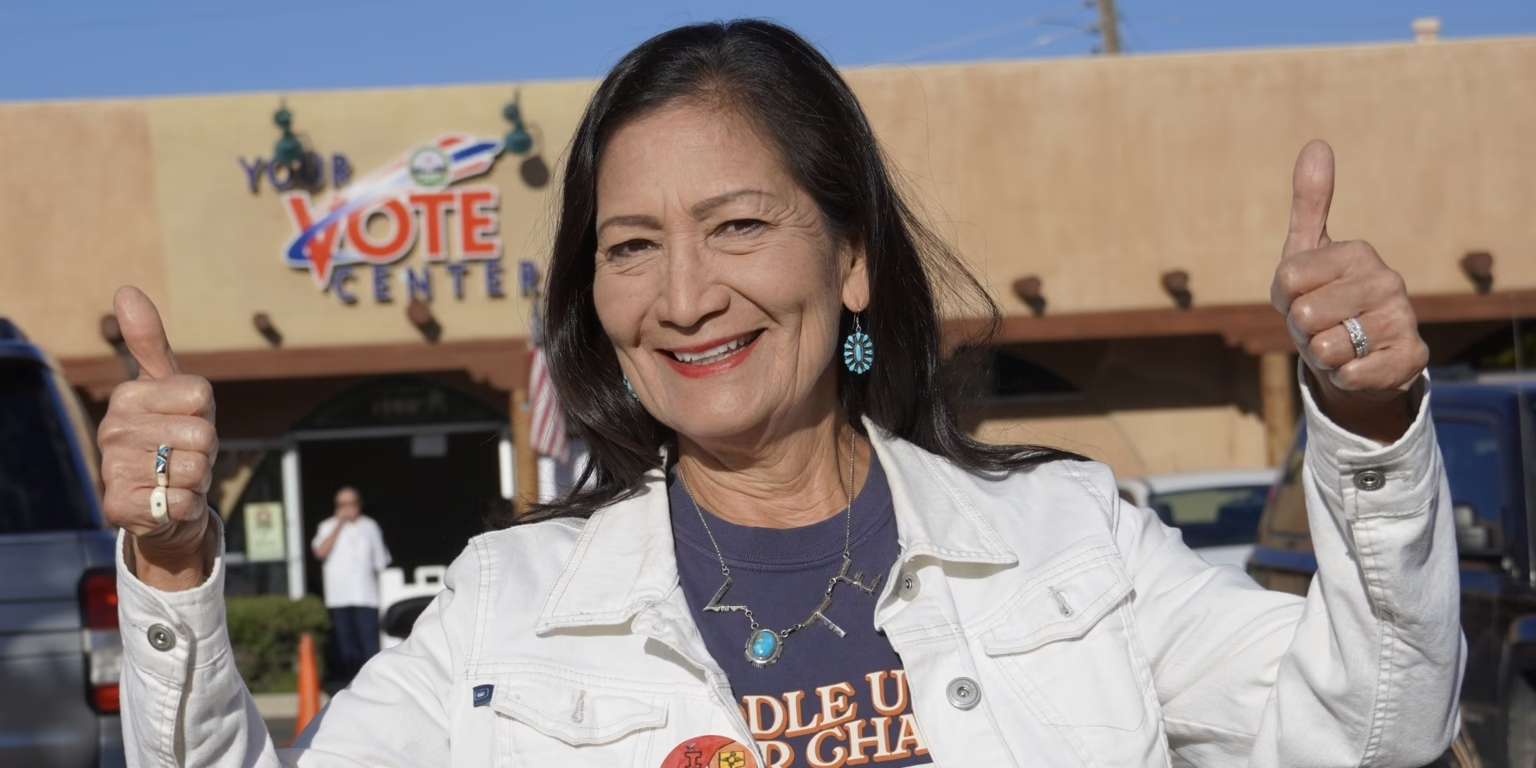
Debra Anne Haaland went from food stamps and homelessness to becoming the first Native American Cabinet secretary in U.S. history. She’s lived a life that challenges everything we think we know about who gets to hold power in America.
And she’s not done yet. The 65-year-old Laguna Pueblo member is now running to become New Mexico’s next governor, aiming to add another historic first to her already groundbreaking resume.
Haaland overcame addiction, poverty, and single motherhood, which makes her accomplishments feel almost impossible. Yet here she is, having served as Interior Secretary for four years, securing a presidential apology for Indigenous boarding schools, and now leading the race for New Mexico’s governorship with nearly $7 million raised.
Deb Haaland Biography
Born on December 2, 1960, in Winslow, Arizona, Debra Anne Haaland came into a world defined by military service and sacrifice. Her father, Major John David “Dutch” Haaland, wasn’t just any Marine; he was a highly decorated 30-year veteran who earned the Silver Star for extraordinary valour in Vietnam. During a fierce battle at Con Thien, he saved six lives, an act of heroism that would earn him two Purple Hearts and 15 total medals throughout his military career. A Norwegian American from New London, Minnesota, he climbed from enlisted ranks at 18 to become a commissioned officer.
Her mother, Mary Toya, was a Navy veteran from the Laguna and Jemez Pueblos. She spent 25 years working for the Bureau of Indian Affairs in the field of Indian education. Mary passed away in October 2021, but her influence shaped everything Deb would become.
As an enrolled member of Laguna Pueblo, Haaland identifies as a “35th generation New Mexican”. Her people have lived on that land since long before anyone called it New Mexico. Her Keresan name translates to “Crushed Turquoise,” and she belongs to the Turquoise Clan.
Young Debra attended 13 different public schools across the country, California, Virginia, you name it. The constant moving was tricky, but summers offered something stable: time with her maternal grandparents, Helen and Antonio Toya, in their one-room home in Mesita village on Laguna Pueblo.
During her father’s deployment to Vietnam, she wrote him letters almost daily. When he returned, she witnessed firsthand the invisible wounds of war. He’d cry watching evening news broadcasts about the conflict, a grown man and decorated hero undone by memories. The family eventually settled permanently in Albuquerque to be closer to their Pueblo relatives, where Deb graduated from Highland High School in 1978.
Haaland’s grandparents met at St. Catherine’s Industrial Indian School in Santa Fe, a Catholic boarding school. These weren’t schools in any normal sense; they were institutions designed to “kill the Indian, save the man,” as the saying went. Her grandmother’s stories of forced removal and cultural erasure left deep wounds that passed through generations.
That personal connection to trauma would eventually drive one of Haaland’s most significant achievements as Interior Secretary.
After high school, things got dark. Haaland describes this period as “aimless and self-destructive years.” She worked as a baker while battling alcoholism, collecting two DUI arrests in her early twenties. These weren’t her finest moments, and she doesn’t pretend they were.
But 1988 changed everything. At 28, she got sober, a decision she’s maintained for more than 37 years now. That same year, she enrolled at the University of New Mexico. “I wanted folks to realize that addiction is an important issue for me,” she later told reporters. “That’s something that we need to solve as a society.”
At UNM, Haaland studied under Joy Harjo, who would later become U.S. Poet Laureate. Harjo thought enough of Haaland’s poetry to publish it in a 1997 anthology. That’s the kind of detail that shows who Deb Haaland was before politics found her.
She earned her Bachelor of Arts in English in 1994 at age 34. Four days later, after graduation, she gave birth to her daughter, Somáh.
Single Motherhood
While broke and a single mom, Haaland experienced severe housing instability. They stayed with friends, sharing a single bedroom, because “we just didn’t have any money.”
To make ends meet, Haaland started Pueblo Salsa, delivering salsa to stores across New Mexico. The flexible hours worked in childcare, but the income didn’t cover housing. One Thanksgiving around 2004-2005, her cupboard held only pinto beans and flour for tortillas. She applied for emergency food stamps but was denied because she had “too many assets.” She broke down crying in the counsellor’s office, unable to provide a traditional Thanksgiving for her daughter.
She volunteered at Somáh’s preschool, cleaning toilets, sweeping floors, to earn discounted tuition. Throughout it all, Pell Grants kept her education dreams alive. “I would have never gotten through college if it weren’t for Pell Grants,” she’d later say.
In 2006, she earned her Juris Doctor in Indian law from UNM School of Law at age 46.
Deb Haaland Career
Haaland’s political career started in the grassroots trenches, not in boardrooms or family dynasties. She cut her teeth as a volunteer organiser and tribal administrator, building the kind of ground-level experience that would later make her a formidable political force.
From January 2013 to November 2015, she served as tribal administrator for San Felipe Pueblo. She also became the first woman elected to chair the Laguna Development Corporation Board of Directors.
In April 2015, Haaland was elected chair of the Democratic Party of New Mexico for a two-year term. The party was in rough shape after the devastating 2014 defeats. She took over an organisation drowning in debt and lacking direction.
What she did next was impressive. During her tenure, New Mexico Democrats regained control of the state House of Representatives and the secretary of state’s office. She raised enough money to pay off seven years of accumulated debt. When political analysts talk about “rebuilding,” this is what it actually looks like.
After her term as state party chair ended, Haaland set her sights higher. She announced her candidacy for New Mexico’s 1st congressional district in 2018, competing to succeed Michelle Lujan Grisham (who was running for governor). The Democratic primary was crowded, but Haaland defeated Damon Martinez and Antoinette Sedillo Lopez with 40.5% of the vote, winning every county in the district.
On January 3, 2019, she made history alongside Sharice Davids of Kansas. They became the first two Native American women ever elected to Congress. Haaland wore a traditional Pueblo dress, necklace, and boots to the swearing-in ceremony, a powerful statement about bringing her whole self to Washington.
Two months later, on March 7, 2019, she became the first Native American woman to preside over the House of Representatives during a debate on voting rights and campaign finance. According to The New Yorker, she “co-sponsored more bills than any other freshman in Congress” and compiled one of the most progressive voting records in the chamber.
She served as one of three co-chairs for Elizabeth Warren’s 2020 presidential campaign, raising her national profile considerably.
On December 17, 2020, President-elect Joe Biden announced his intention to nominate Haaland as Secretary of the Interior. The Senate confirmed her on March 15, 2021, by a vote of 51-40. She became the first Native American Cabinet secretary in U.S. history, overseeing the very department that once implemented devastating policies against Indigenous peoples.
The irony wasn’t lost on anyone. For more than a century, the Interior Department helped enforce the boarding school system that traumatised her own grandparents. Now their granddaughter would lead it.
2026 Gubernatorial Race
On February 11, 2025, just weeks after leaving the Cabinet when the Trump administration began, Haaland announced her candidacy for New Mexico governor. Current Governor Michelle Lujan Grisham is term-limited, creating an open race for the state’s top job.
Senator Martin Heinrich had announced in January 2025 that he’d stay in the Senate rather than run for governor, eliminating her most competitive potential opponent. Lieutenant Governor Howie Morales and Attorney General Raúl Torrez also declined to run, leaving Haaland as the first major Democrat to enter the race.
By October 2025, Haaland had raised nearly $7 million from donors in all 50 states and every New Mexico county, the highest amount ever raised in a New Mexico gubernatorial race at this stage. Her first reporting period (February-March 2025) brought in almost $3 million. The second period (April-October 2025) added over $4 million more.
The numbers tell the story: over 51,000 contributions averaging $30.89 per donation, with 97.5-98% of online donations under $100. More than 2,900 individuals have pledged recurring contributions totalling over $45,000. She collected the 2,500 nominating signatures needed for ballot access within just 24 hours of launching. By October 2025, over 10,000 volunteers had registered with her campaign.
Her cash on hand sits at approximately $2.8 million after spending about $4.1 million on campaign operations, advertising, and staff. For context, the 2022 gubernatorial race saw Governor Lujan Grisham raise about $13 million. Haaland’s early pace suggests 2026 will shatter those records.
Haaland faces Democratic primary challenges from Sam Bregman (Bernalillo County District Attorney and former Albuquerque City Councillor) and Ken Miyagishima (former four-term Las Cruces Mayor). Bregman raised $2.4+ million in the April-October period and has secured several labour union endorsements. Miyagishima raised just over $19,000 while loaning his campaign more than $50,000.
On the Republican side, Rio Rancho Mayor Greggory Hull officially launched in October 2025, with Farmington resident Brian Cillessen and cannabis CEO Duke Rodriguez also exploring runs.
If elected on November 3, 2026, Haaland would become the first Native American woman elected governor of any U.S. state in American history. It’s a distinction that carries weight, especially given her unprecedented path to prominence.
She spoke at the 2024 Democratic National Convention during prime time on the final night before Vice President Harris’s acceptance speech. Introducing herself in Keres—”Gu’wha’tzi”—and giving her Keres name “Crushed Turquoise,” she told the nation: “Thirty-five generations ago, my ancestors built lives in the high desert of New Mexico. I am on this stage tonight because of them.”
Political analyst Brian Sanderoff noted her strategic positioning: “It was a good strategic move to get into the race relatively early to try to dissuade other potential candidates from getting in the race.” As of October 2025, she remains the front-runner in the Democratic primary.
Deb Haaland’s Personal Life
Deb Haaland’s daughter, Somáh Haaland, was born just four days after Deb’s college graduation in 1994. She earned her bachelor’s degree from the University of New Mexico and joined the Tricklock Company as a satellite member in 2019. Before the COVID-19 pandemic, she worked in New York as a production assistant on a Netflix show. She’s now a performer, writer, and activist bearing her mother’s commitment to social justice in her own way.
Haaland frequently credits her struggles as a single mother for shaping her political priorities. “I wanted folks to understand these issues because I lived them,” she’s said. When you’ve been denied food stamps while your cupboard is empty, you don’t forget what that feels like.
Haaland was briefly married in her twenties, though details about that relationship remain private. Years later, on August 28, 2021, she married her longtime partner, Skip Sayre, in a ceremony at Santa Ana Pueblo, New Mexico.
However, the marriage didn’t last. In February 2025, Haaland filed for divorce, citing incompatibility. The timing, just weeks before announcing her gubernatorial run, suggests she was clearing the decks for a demanding campaign ahead.
Her daughter Somáh has mentioned a stepfather on social media, indicating there were relationships between Haaland’s first marriage and her union with Sayre, though details remain private.
Haaland is Catholic, balancing her Indigenous spiritual traditions with her Christian faith. It’s a duality many Native Americans navigate, honouring both their ancestral practices and the religions that arrived with colonisation.
She’s an avid marathon runner and enjoys gourmet cooking, two hobbies that require discipline and patience. Both stand in stark contrast to her chaotic early years. In July 2022, while hiking in Shenandoah National Park, she broke her left fibula.
Sobriety and Advocacy
More than 37 years sober, Haaland speaks openly about her recovery from alcoholism. She’s used her platform to advocate for better addiction treatment and support services, drawing from her own experience getting sober at 28.
“Addiction is an important issue for me,” she’s said. “That’s something that we need to solve as a society.” Coming from someone who’s lived it, that statement carries weight.
Deb Haaland Net Worth
When Haaland became Interior Secretary in 2021, her estimated net worth was around $800,000 according to various reports. However, financial disclosure forms from her time in Congress showed something puzzling: a net worth of essentially zero dollars.
In 2021, one disclosure reported no bank account and essentially zero assets, despite her $174,000 congressional salary and residence in a million-dollar home.
This apparent discrepancy raised eyebrows. Government watchdog group Protect the Public’s Trust filed a complaint with the Interior Department’s Inspector General, noting that the numbers “strain credulity.” How coud someone making six figures and living in an expensive home report zero net worth?
The explanation likely involves technical definitions of assets and liabilities. As a single mother who spent years struggling financially, Haaland carried significant debt, student loans from her undergraduate and law school education, credit card debt, and a mortgage on her home. If liabilities exceed assets, the net result is zero or negative net worth on paper, even while living what appears to be a comfortable middle-class life.
More recent estimates place Haaland’s net worth between $817,000 and $1.8 million as of 2024, according to financial disclosure analysis. As Interior Secretary, her annual salary was approximately $221,400, a significant increase from her congressional salary of $174,000.
Her assets include a home in New Mexico, a car, and some investments. Her liabilities still include student loans, credit card debt, and her mortgage. When she married Skip Sayre in 2021, his reported assets ($970,000 to $2.125 million) improved their combined financial picture, though they’ve since divorced.