

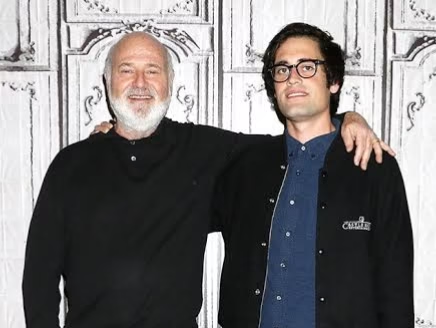
The charges against Nick Reiner couldn’t be more serious. Following the December 14, 2025 deaths of his parents, legendary filmmaker Rob Reiner and producer Michele Singer Reiner, the 32-year-old faces two counts of first-degree murder. But what exactly awaits him if he’s convicted? The answer involves life-altering criminal penalties and a financial twist that could cost him hundreds of millions.
Life Without Parole or Death Penalty
Los Angeles County District Attorney Nathan Hochman didn’t mince words when announcing the charges. Nick faces the most severe punishment California law allows. If convicted, he’s looking at either life imprisonment without the possibility of parole or the death penalty.
The charges include special circumstances for multiple murders and a special allegation for using a deadly weapon (a knife).
Hochman hasn’t yet decided whether to seek the death penalty, stating that the family’s wishes will be considered. However, in a telling detail, Nick’s siblings Jake and Romy released a public statement mourning their parents without mentioning their brother at all.
A $200 Million Inheritance at Stake
Beyond the criminal consequences, there’s a massive financial dimension to this case. Rob Reiner amassed an estimated $200 million fortune through decades of Hollywood success, including directing classics like “When Harry Met Sally” and “The Princess Bride,” and co-founding Castle Rock Entertainment (which he sold in 1993 for $160 million).
Under normal circumstances, Nick would likely inherit a quarter of this estate alongside his siblings. But California has a law that changes everything. It’s called the slayer statute, and it’s brutally straightforward.
“California has what’s called a slayer statute, which says if you kill someone that you’re going to inherit from, you lose your inheritance and any right to serve as a fiduciary of their estate,” estate attorney Sean Weissbart explained to People magazine. “So assuming he’s convicted of this murder, he’s out as beneficiary.”
The California Probate Code Section 250 prevents anyone who “feloniously and intentionally” kills someone from profiting from their victim’s estate. This applies to wills, trusts, life insurance, retirement benefits, and any other property. If Nick is convicted, his share would be redistributed among his siblings: Jake (34), Romy (28), and half-sister Tracy (61), Rob’s adopted daughter from his marriage to director Penny Marshall.
Here’s the kicker. Even without a criminal conviction, a probate court can separately determine whether the killing was intentional and felonious. That civil finding, using a lower “preponderance of evidence” standard, would be enough to bar Nick from inheriting.
The Insanity Defense Faces Steep Odds
Given Nick’s documented history with schizophrenia, many legal observers expect an insanity plea. But multiple criminal defense attorneys not connected to the case say this defence faces extraordinarily long odds in California.
California uses the McNaughton Rule, which requires proving the defendant didn’t understand “the nature and quality of their acts” or that the acts were wrong at the time of the crime. It’s a tough standard to meet.
“To be found not guilty by reason of insanity, that is a very difficult legal hurdle to overcome in California,” attorney Neama Rahmani told People. “Jurors almost always reject this defence. It only works a very small percentage of the time.”
Nick’s actions after the alleged killings could seriously undermine an insanity claim. He checked into a Santa Monica hotel around 4:00 a.m., leaving a trail of blood. Hours later, surveillance footage captured him at a gas station convenience store purchasing a drink. Legal experts point to this behaviour as evidence of awareness and functioning.
“If you are coherent and capable enough to have an argument with your parents, that’s not legal insanity,” Rahmani explained, referencing the heated confrontation between Nick and Rob at Conan O’Brien’s Christmas party the night before the murders.
Still, Nick’s schizophrenia diagnosis introduces genuine complexity. According to TMZ and NBC News, he was being treated at a high-end Los Angeles facility specialising in dual diagnosis for mental illness and substance abuse, reportedly costing approximately $70,000 per month.
Critically, his schizophrenia medication was changed or adjusted three to four weeks before the killings. Sources told TMZ that after the medication change, Nick became “erratic and dangerous” and was “out of his head.” Combined with ongoing substance abuse issues, this created what one source described as a dangerous deterioration.
Even if an insanity plea fails, Nick’s mental health history might support arguments that he lacked premeditation. This could potentially reduce charges from first-degree to second-degree murder, avoiding the death penalty and life without parole.
There’s also the question of competency to stand trial, which is separate from criminal responsibility. Nick wasn’t “medically cleared” for his initial court appearance, according to his defence attorney Alan Jackson. If deemed incompetent to stand trial, he’d require treatment before proceedings could continue, potentially delaying the case significantly.
Not Guilty by Reason of Insanity Isn’t Freedom
A common misconception needs clearing up. If Nick were found not guilty by reason of insanity, he wouldn’t walk free. In California, an NGRI verdict leads to mandatory commitment to a state psychiatric hospital.
The commitment would be for an initial period equal to the maximum sentence he could have received if convicted. For a double homicide, that could mean lifetime commitment. Release would depend on recommendations from the hospital’s medical director and wouldn’t be automatic.
Interestingly, an NGRI verdict might affect the slayer rule’s application. California appellate courts have suggested that such a verdict could mean a probate court wouldn’t deem the killing “intentional” for slayer statute purposes, though this remains an unsettled area of law.
What Happens Next
Nick remains held without bail at Twin Towers Correctional Facility on suicide watch, with wellness checks every 15 minutes. A sealed medical order was signed by the judge on December 19, its contents undisclosed.
His arraignment is scheduled for January 7, 2026. That hearing will reveal whether he enters a not guilty plea or not guilty by reason of insanity. It’ll also indicate how his defence attorney, Alan Jackson (known for representing Karen Read, Harvey Weinstein, and Kevin Spacey), plans to navigate these extraordinarily complex challenges.
The murder weapon, a knife, has not been recovered. However, sources told NBC that it’s of “limited investigative value” given other evidence and statements to authorities.
Whatever the outcome, the entertainment world continues mourning a filmmaker whose work shaped American cinema for four decades, while grappling with the unthinkable circumstances of his death.
