
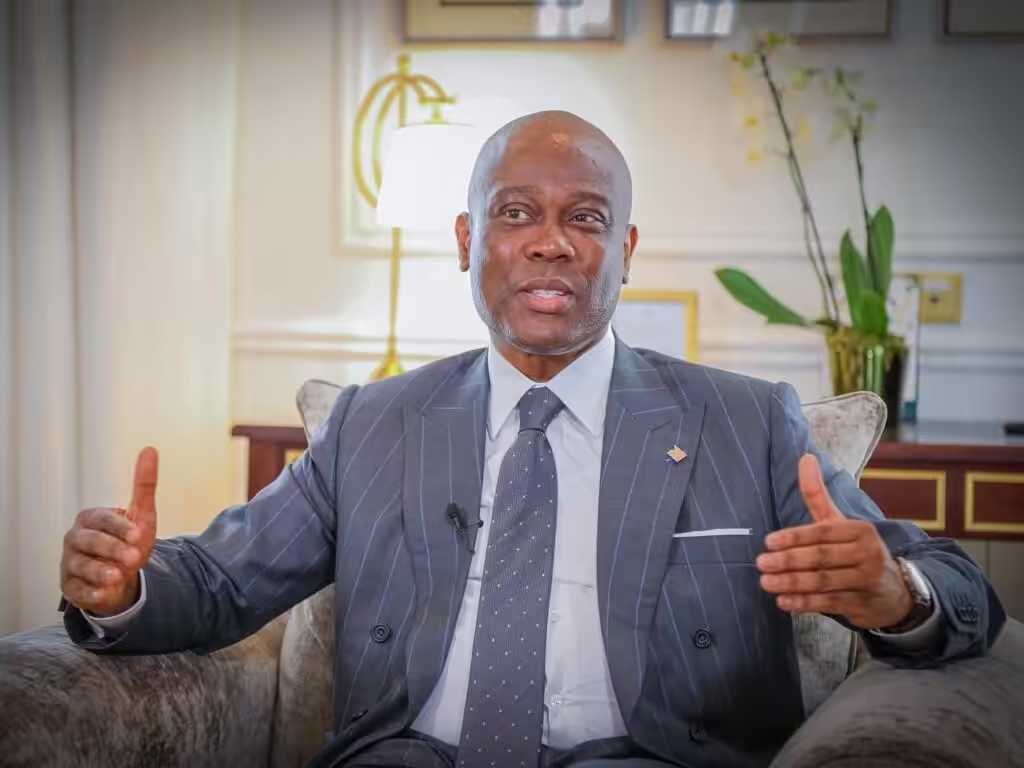
Herbert Onyewumbu Wigwe was one of the most influential figures in modern African banking. From his teenage years, he knew finance was his calling, and he pursued that vision with an intensity that would eventually reshape Nigeria’s banking landscape. He co-acquired a small, struggling commercial bank and spent two decades building it into the continent’s largest retail bank by customer base. His death at 57 in a helicopter crash on February 9, 2024, alongside his wife and eldest son, sent shockwaves through Nigeria’s financial world and beyond.
Biography
Herbert Wigwe was born on August 15, 1966, in Ibadan, Oyo State, although his family roots trace back to Omueke Isiokpo in Ikwerre Local Government Area, Rivers State. His father, Pastor Shyngle Wigwe, had a varied career that took him from the Nigerian Army to the role of Director-General of the Nigerian Television Authority (NTA) before becoming a Pentecostal pastor at the Redeemed Christian Church of God. His mother, Stella Wigwe, was a senior UK-trained nurse who also later joined the ministry.
Growing up in an upper-middle-class household, Herbert was one of six children. His family moved frequently because of his father’s career, and those early experiences shaped his adaptability and drive. Even as a child, he had a remarkable head for numbers. His younger brother Emeka nicknamed him “ACG” (Accountant-General), fully convinced Herbert would one day hold that position. By age 16, Wigwe had already set his sights on a career in finance, reportedly turning down an offer to study actuarial science without hesitation.
Wigwe attended Federal Government College Sokoto before transferring to Federal Government College Warri, where he completed his secondary education in 1982. He wasn’t just an outstanding student, he was also a skilled cricket player. After failing his first attempt at the Joint Admissions and Matriculation Board (JAMB) examination, he secured admission to the University of Nigeria, Nsukka, graduating in 1987 with a B.Sc. in Accountancy (Second Class Upper Honours).
His academic journey didn’t stop there. In 1990, he won a British Council Scholarship to pursue an MA in Banking and Finance at the University College of North Wales (now Bangor University), completing it in 1991. He later earned an MSc in Financial Economics from the University of London in 1996 and attended the Harvard Business School Executive Management Programme. By May 2023, Wigwe announced he was pursuing a law degree, proving his appetite for learning never faded. He became a Fellow of the Institute of Chartered Accountants of Nigeria (ICAN) and an Honorary Member of the Chartered Institute of Bankers of Nigeria.
Career
Wigwe’s professional life kicked off at Coopers & Lybrand Associates (now PricewaterhouseCoopers) in Lagos, where he qualified as a chartered accountant in 1989. After a brief period at Capital Bank as a senior treasury manager, he joined Guaranty Trust Bank around 1991 and spent over a decade there, rising to Executive Director at the age of 32. Remarkably, he reached that position on the same day as his close friend and future business partner, Aigboje Aig-Imoukhuede.
The defining chapter of Wigwe’s career began in March 2002. He and Aig-Imoukhuede, both 36 at the time, left GTBank to acquire Access Bank, a small commercial bank with fewer than 10 branches, ranked 65th out of 89 banks in Nigeria. The Central Bank of Nigeria initially hesitated, reportedly deeming them “too young to own a bank.” Undeterred, the pair pressed forward, with Aig-Imoukhuede serving as Managing Director and Wigwe as Deputy Managing Director.
Their partnership delivered extraordinary results. In 2003, Access Bank raised over N14.5 billion in a public offering that was 133% oversubscribed. By 2008, a third public offering raised more than $1 billion. A major turning point came in October 2011 when Access Bank recapitalized the distressed Intercontinental Bank through a N50 billion capital injection, completing the merger in January 2012. This single move vaulted Access Bank into Nigeria’s top four commercial banks, adding 5.7 million customers and 309 branches.
When Wigwe took over as Group Managing Director and CEO on January 1, 2014, he stepped on the accelerator. His crowning achievement was the December 2018 merger with Diamond Bank, completed on April 1, 2019, for approximately $235 million. Diamond Bank’s 17 million retail customers and leading mobile banking platform combined with Access Bank’s 10 million customers to create Africa’s largest retail bank by customer numbers. The merged entity boasted roughly 27 million customers (later growing to over 60 million), 700+ branches, and operations in more than 20 countries across three continents.
Under Wigwe, Access Bank also listed Africa’s first certified corporate Green Bond in April 2019 and expanded aggressively across the continent, acquiring subsidiaries in Kenya, South Africa, Botswana, and multiple West African markets. In 2023, the bank signed agreements to acquire Standard Chartered Bank’s subsidiaries in five African countries. In March 2022, Wigwe oversaw the restructuring of Access Bank into Access Holdings Plc, a non-operating financial holding company with subsidiaries spanning payments, pensions, insurance, and digital lending. He moved from Group MD/CEO of Access Bank to Group Chief Executive Officer of Access Holdings, the role he held until his death.
His guiding philosophy? Always “stay on day one mode,” approaching each challenge with the hunger and curiosity of someone just getting started.
Personal Life

Wigwe married Doreen Chizoba Wigwe (née Nwuba) in 1994 after a whirlwind courtship of just four to five months. Doreen, from Achina in Anambra State, was a lawyer who studied at the University of Nigeria and earned a master’s in International Law from the University of London. She founded Craneburg Construction Company, which grew into one of Nigeria’s largest private construction groups with over 7,000 employees and major infrastructure contracts across the country. Herbert reportedly said his wife “probably has more money than he does.”
The couple had five children: Chizi, Tochi, Hannah, David, and Okachi (who was approximately two years old at the time of the crash). The family were devout members of the Redeemed Christian Church of God, and Wigwe built the main church at RCCG Lion of Judah Parish in Isiokpo. Beyond the boardroom, Wigwe was known as a runner and avid reader who loved polo and had a particular fondness for amala with okra. He once described himself as “absolutely petrified of failure,” a fear that clearly fuelled rather than hindered him.
His partnership with Aig-Imoukhuede, often described as a “corporate bromance,” was one of Nigerian business’s most storied relationships. Together they held a $64.5 million joint stake in Access Holdings through four corporate entities.
Philanthropy and Legacy Projects
Wigwe was a an advocate for the United Nations Sustainable Development Goals and became the first African sponsor of the United Nations Global Compact Initiative. He served on the board of the Nigerian Business Coalition Against AIDS, championing the fight against HIV and AIDS across the health system and private sector. He also partnered with the Corporate Alliance on Malaria in Africa to push for malaria eradication across the continent.
In 2016, he launched the HOW Foundation to create positive change beyond the corporate world. Through the foundation, he supported 13,000 Almajiri children in Kaduna, trained 75 doctors in Israel and the US, and revamped 25 primary healthcare centres in Rivers State. Earlier, in 2015, under Access Bank, he introduced the W-initiative, a programme designed to support women entrepreneurs and promote maternal health.
Perhaps his most ambitious legacy project was Wigwe University, a private institution in his hometown of Isiokpo that received NUC approval in June 2023 and opened in September 2024. Wigwe committed $500 million to scaling the university over five years and envisioned it as an African institution capable of rivalling Oxford and Harvard.
“The Wigwe University project is special because it is an opportunity for me to give back to society by providing world-class quality education that will foster the development of Nigeria and Africa,” he said during the university’s planning stages. Though he didn’t live to see its full impact, Wigwe University stands as one of his most personal contributions.
The Helicopter Crash
On the evening of Friday, February 9, 2024, a Eurocopter EC130 helicopter operated by Burbank-based charter company Orbic Air departed Palm Springs International Airport bound for Boulder City, Nevada, near Las Vegas. The passengers were heading to Super Bowl LVIII at Allegiant Stadium. At approximately 10:00 PM Pacific Time, the helicopter crashed near Nipton, California, in the Mojave Desert, roughly 60 miles from Las Vegas.
All six people aboard were killed: Herbert Wigwe (57), his wife Doreen (56), their eldest son Chizi (29), Abimbola Ogunbanjo (61), the former Group Chairman of the Nigerian Exchange Group, and two American pilots. The National Transportation Safety Board determined the probable cause was the pilot’s decision to continue visual flight rules into instrument meteorological conditions, resulting in spatial disorientation and loss of control.
The news triggered an extraordinary wave of grief across Nigeria. President Bola Tinubu called it “an overwhelming tragedy.” Africa’s richest man, Aliko Dangote, broke down in tears at the March 4 memorial and pledged to name the road leading to his $20 billion refinery after Wigwe. A weeklong funeral programme from March 4 to 10, 2024, culminated in burial at the Wigwe family home on the Wigwe University campus in Isiokpo.
Controversies
Wigwe’s career, for all its brilliance, was not without significant controversy. In May 2016, EFCC operatives raided Access Bank’s headquarters and detained Wigwe as part of an investigation into $115 million in election bribes allegedly laundered by former Petroleum Minister Diezani Alison-Madueke. The EFCC recovered $5 million from Access Bank that had been routed through the institution. Wigwe was released after the funds were returned, and no formal criminal charges were filed against him personally.
In 2019, the Special Fraud Unit of the Nigeria Police charged Wigwe, Access Bank, and two others over an alleged N2.5 billion steel billets fraud involving the purported unauthorized sale of steel belonging to BMCE Bank International. The case was reportedly heading toward settlement before Wigwe’s death, and no conviction was recorded. Separately, in 2017, the Independent Corrupt Practices Commission arraigned Wigwe and Access Bank for refusing to obey a lawful order regarding certain account restrictions.
The Intercontinental Bank acquisition also generated lasting controversy. The former bank’s managing director alleged cronyism between Wigwe, Aig-Imoukhuede, and the then-CBN Governor. NDIC testimony revealed that Access Bank and its directors owed Intercontinental Bank N14.2 billion at the time of the special examination, a potential conflict of interest that the CBN nevertheless approved.
Following his death, an investigation by Sahara Reporters revealed that Craneburg Construction received a N50 billion loan from Access Bank to finance Abia State government contracts, raising conflict-of-interest concerns given Wigwe’s position. The family estate has also become the subject of a bitter dispute between Wigwe’s elderly parents and siblings on one side, and eldest daughter Tochi alongside Aig-Imoukhuede on the other. A Lagos High Court upheld the existing will and estate structure in February 2025, though an appeal remains pending.
In March 2026, an investigation by British publication The Londoner revealed Wigwe owned 106 properties in London, ranking him seventh among identified billionaire property owners in the city. The properties, held through offshore shell companies registered in Jersey, are located in prime areas including Oxford Street, Canary Wharf, and Greenwich Peninsula. The publication stated its report “documents ownership and does not allege any wrongdoing.”
Net Worth
Wigwe’s publicly documented wealth centred on his Access Holdings shareholding, approximately 2.59 billion shares worth around N65.3 billion (roughly $54 to $65 million), representing about 7.3% of the group’s issued shares. This made him the largest individual shareholder. His 2021 salary was reported at N120 million (approximately $75,000). He never appeared on Forbes or Bloomberg billionaire lists, and Nigerian media commonly estimated his net worth at $65.2 million.
That figure, however, proved dramatically understated. The 2026 London property investigation suggested a portfolio value estimated between $200 million and $425 million. In Nigeria, shortly before his death, Wigwe had moved into a 20-bedroom mansion on Queens Drive, Ikoyi, Lagos’s most exclusive address, built by Craneburg Construction on 23,000 square metres. The fully automated residence featured a helipad, basketball court, football pitch, dock, cinema, and underground parking, with an estimated value of N10 to 30 billion ($12.5 to $37.5 million).
When his London portfolio, Access Holdings stake, Nigerian properties, and Wigwe University investment are factored together, his true net worth at the time of death likely exceeded $300 million.
Awards and Honours
Wigwe accumulated an impressive collection of recognitions during his career. He was named Banker of the Decade by ThisDay in January 2020 and won multiple Banker of the Year awards from publications including The Sun, Vanguard, and Leadership newspapers. He received the CNBC Africa AABLA Business Leader of the Year for West Africa in 2017, the Forbes Best of Africa Award in 2020, and was named African Banker of the Year multiple times.
The Nigerian government conferred the Commander of the Order of the Federal Republic (CFR) on him in October 2022, one of the country’s highest national honours. He received honorary doctorates from the University of Nigeria Nsukka, Gombe State University, and the University of Port Harcourt. Posthumously, the Africa International Film Festival created the Herbert Wigwe Award for Excellence, and Dangote named a major road at his refinery complex in Wigwe’s honour.
Herbert Wigwe’s life, from a mathematical prodigy in a civil servant’s household to the architect of Africa’s largest retail banking franchise, remains one of the most dramatic ascents in African corporate history. His impact on Access Holdings, now a financial conglomerate spanning banking, payments, pensions, and insurance, endures well beyond his lifetime. Wigwe University stands in Isiokpo as his most personal legacy, a $500 million investment in the belief that education can transform Africa, built on the land where he now rests.