

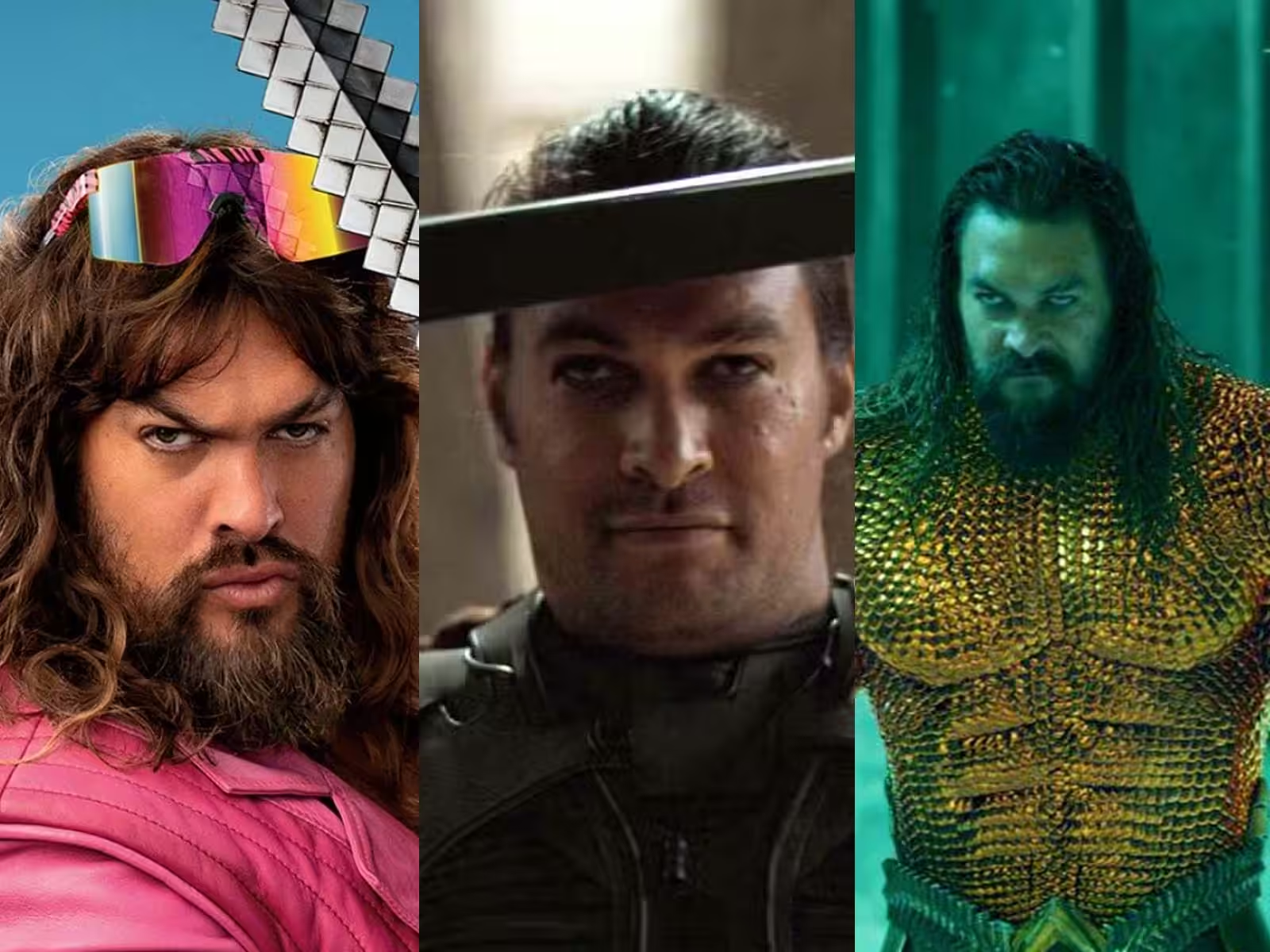
Jason Momoa’s career from struggling actor to blockbuster heavyweight reads like a Hollywood redemption arc you’d actually want to watch. With a net worth sitting at around $40 million and appearances in over 20 feature films that’ve collectively raked in more than $5 billion worldwide, the Hawaii-born actor has transformed himself from television fixture to franchise royalty. His career shows a man who cycled through debt and near-obscurity before finding his footing as Arthur Curry, proving that sometimes the right role doesn’t just change your bank balance, it rewrites your entire story.
His physicality became both his calling card and his limitation before breaking through. Standing at 6’4″ with a build that suggests he could bench-press a small car, he initially found himself typecast in warrior roles that didn’t always pay the bills. His early years included stints on Baywatch: Hawaii, Stargate Atlantis, and that career-defining turn as Khal Drogo in Game of Thrones, but none of these brought the kind of paycheques that would later become his standard. The shift came when DC Studios handed him a trident, and suddenly, the man who’d been grinding through smaller roles was commanding multimillion-dollar salaries.
Today, Momoa reportedly earns between $2 million and $15 million per film, depending on the project’s scale and his involvement. His 2025 slate alone reveals his bankability, with A Minecraft Movie becoming his biggest commercial hit ever at $961 million worldwide. Looking ahead to 2026, he’s got an unprecedented five films releasing, spanning everything from DC superhero tentpoles to prestige sci-fi sequels. Let’s break down the roles that transformed him from cult favourite to genuine box office draw.
Duncan Idaho in Dune: Part One (2021): $2 Million
Momoa’s appearance in Denis Villeneuve’s Dune: Part One proved that sometimes less is more when it comes to making an impression. Playing Duncan Idaho, the loyal swordmaster to House Atreides, he brought warmth and honour to a character who served as both protector to Paul Atreides and tragic hero in the opening chapter of Frank Herbert’s epic. Idaho’s role was brief, clocking in at under fifteen minutes of screen time, but those minutes carried weight. He functioned as Duke Leto’s most trusted enforcer, someone who could navigate both battlefield politics and genuine friendship with Paul during the young heir’s earliest trials.
The character’s death hit harder than you’d expect for someone we’d barely met, which speaks to Momoa’s ability to convey loyalty without drowning it in sentiment. Released during the pandemic in 2021, Dune: Part One faced the challenge of emptier cinemas and cautious audiences. With a production budget of $165 million, it still managed to pull in approximately $410.7 million worldwide, proving that Villeneuve’s vision could translate to commercial success even under difficult circumstances.
For his troubles, Momoa reportedly earned $2 million, a figure that several industry sources have confirmed. Considering how briefly Idaho appeared, that’s substantial compensation, though it, well, thanks to both the film’s scale and Momoa’s growing market value. More importantly, it set him up for a more prominent return in Dune: Part Three, where his character comes back as a ghola, Frank Herbert’s version of a clone with selective memory. That sequel, scheduled for December 2026, will likely see Momoa command significantly more, possibly in the $5 to $10 million range given the franchise’s growth and his expanded role.
Arthur Curry in Aquaman (2018): $7 Million
This was the film that changed everything. When DC Studios bet on Momoa as Arthur Curry, they weren’t just casting an actor, they were recalibrating an entire character who’d long been treated as the Justice League’s punchline. Momoa brought edge and humour to a hero who needed both, playing the half-human heir to Atlantis as someone deeply uncomfortable with destiny but unable to ignore it once Mera dragged him back underwater.
The story followed Arthur’s reluctant return to Atlantis, where his half-brother Orm was attempting to unite the underwater kingdoms and wage war on the surface world. What could’ve been a standard superhero origin story became something more engaging thanks to Momoa’s ability to balance swagger with vulnerability. He made Arthur feel like someone who’d rather be drinking beer on a pier than ruling an ancient civilization, which oddly enough made him more relatable when he finally accepted the crown.
Production estimates for Aquaman varied, with initial reports suggesting a budget around $160 million before later figures pushed that to approximately $200 million. Whatever the actual cost, the gamble paid off spectacularly. The film earned roughly $1.15 billion worldwide, making it the fifth-highest-grossing film of 2018 and, at the time, the biggest earner in the entire DC Extended Universe.
Momoa’s compensation is evident in both his pre-Aquaman status and the studio’s confidence in the property. He received a base salary of $3 million, which industry reports confirm appeared in testimony during the Depp v. Heard trial and was corroborated by outlets including Newsweek and Celebrity Net Worth. With backend participation factored in, his total earnings climbed to approximately $7 million. Not bad for a character people used to mock.
Garrett Garrison in A Minecraft Movie (2025): $12 Million
Nobody saw this coming. Momoa, the man who built his career on brooding warriors and aquatic royalty, showed up in a film about blocky digital landscapes and somehow made it work. Playing Garrett “The Garbage Man” Garrison, he leaned hard into comedy, portraying a character who’s brash, self-important, and convinced his past gaming glories matter more than they actually do. It’s the kind of role that could’ve been insufferable in the wrong hands, but Momoa found the sweet spot between ridiculous and endearing.
The plot, such as it is, involves Garrett and three other misfits getting transported into Minecraft’s Overworld, where pixel-perfect environments and absurd situations force him to reconsider his inflated self-image. Jack Black co-stars in what became a surprisingly effective double act, with both actors carrying the film’s humour whilst navigating a quest that’s equal parts adventure and existential crisis for people who take gaming too seriously.
Warner Bros. backed this project with a $150 million production budget, banking on the game’s massive fanbase translating to cinema seats. That bet paid off in ways that exceeded even optimistic projections. A Minecraft Movie opened in April 2025 to a staggering $162.8 million domestically and $313.7 million globally, the highest opening weekend ever for a video game adaptation. It finished its theatrical run with approximately $961 million worldwide, making it the second-highest-grossing video game film of all time behind The Super Mario Bros. Movie.
According to reports from entertainment outlets, though not confirmed by major trade publications like Variety or Deadline, Momoa earned $12 million for the role. That figure seems plausible given his $15 million payday for Aquaman and the Lost Kingdom and his co-lead status here. If his deal included backend participation tied to box office performance, which is increasingly standard for A-list talent in tentpole releases, his total compensation could’ve surpassed even his Aquaman sequel earnings. A Minecraft 2 sequel is already in pre-production for July 2027, which could make this franchise his most lucrative ongoing property.
Arthur Curry in Aquaman and the Lost Kingdom (2023): $15 Million
Five years after proving the character could work, Momoa returned to Atlantis for a sequel that carried enormous expectations and delivered mixed results. Aquaman and the Lost Kingdom found Arthur balancing his duties as king with surface-world responsibilities, all whilst facing renewed threats from Black Manta, who remained bent on revenge following the events of the first film. The story took an unexpected turn when Arthur sought help from Orm, his half-brother and former antagonist, creating an uneasy alliance that drove much of the film’s tension.
Warner Bros. invested $200 million in production, matching the first film’s reported budget. The marketing campaign positioned it as a worthy successor to the billion-dollar original, but audience appetite had shifted in ways nobody quite anticipated. The film grossed approximately $440.2 million worldwide, making it the highest-grossing DCEU title since the original Aquaman whilst simultaneously earning less than half of its predecessor’s total. For context, that’s a dropoff from $1.148 billion to $440 million, the kind of decline that makes studio executives question their entire slate strategy.
Despite the underwhelming box office performance, Momoa’s compensation wasn’t tied to the film’s commercial reception. He earned a confirmed $15 million to return as Arthur Curry, a figure that Variety reported directly in July 2022 and that’s been corroborated by Screen Rant, FandomWire, WION News, and other industry outlets. This represents his highest confirmed payday for a single film role, nearly double what he’d earned on the original when backend participation is excluded.
Momoa and producing partner Brian Mendoza wrote a 50-page treatment for the sequel that Warner Bros. purchased, suggesting the $15 million encompassed both his acting work and creative contributions. Warner Bros. absorbed the financial disappointment whilst Momoa maintained his momentum, moving directly into an unprecedented five-film slate for 2026 that spans streaming action comedies, animated hybrids, and prestige sci-fi sequels.
What’s Next for Momoa’s Earning Power
Momoa’s salary has grown roughly fivefold from his $3 million Aquaman base to his confirmed $15 million for the sequel, with A Minecraft Movie potentially representing his highest total compensation when backend bonuses from its near-billion-dollar gross are factored in. His 2026 lineup, which includes The Wrecking Crew, Animal Friends, Supergirl: Woman of Tomorrow as Lobo, Street Fighter as Blanka, and Dune: Part Three, is the kind of workload that only truly bankable stars can command.
What makes his career particularly interesting is how he’s managed to pivot between serious dramatic roles and pure entertainment without losing credibility in either lane. He can sell you on the emotional weight of Duncan Idaho’s sacrifice, make you laugh as a delusional gamer in a blocky digital world, and convince you that a guy who talks to fish deserves respect. That versatility, combined with proven box office appeal, positions him for continued salary growth as franchises compete for his availability.
The entertainment industry loves a good redemption story, and Momoa’s transformation from debt-ridden actor cycling through lesser-known roles to $15 million leading man represents exactly that.
