

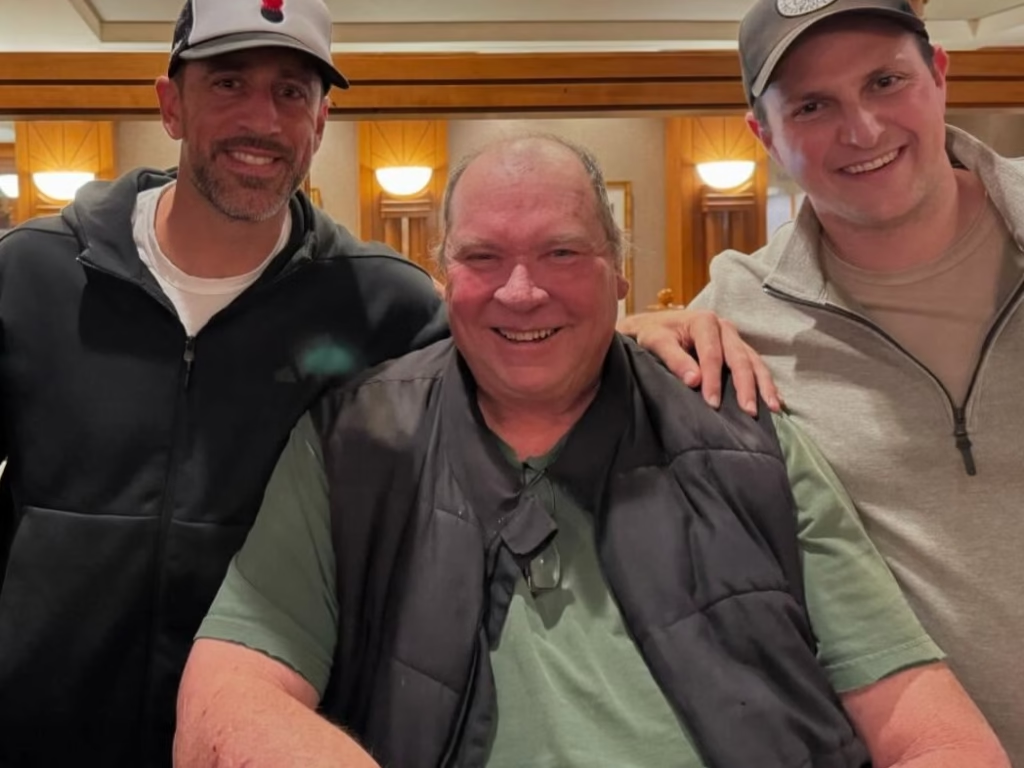
Standing at 6’10”, John Reeves is one of Alaska’s most intriguing personalities. He’s a gold miner, fossil collector, and reality TV personality who’s built a fortune in the Alaskan wilderness. What makes his story interesting isn’t just the gold he’s mined, but the incredible Ice Age treasures he’s unearthed along the way. Since 2007, Reeves has recovered over 300,000 prehistoric fossils, including woolly mammoth tusks, dire wolves, and sabre-toothed cats.
Biography
John Reeves’s obsession with buried treasure started long before Alaska. Growing up in Florida in the 1960s, he and his family unknowingly settled on a Native American burial mound along the St. Johns River. Young John spent his childhood digging through the mound, searching for pottery and artefacts. “I was always captivated by looking for treasure,” he later recalled on the Joe Rogan Experience podcast.
During the 1970s, Reeves earned a swimming scholarship to the University of Florida, where he set the American high school record in the 50-yard freestyle. He was talented enough to earn All-American honours and place seventh at the NCAA Championships during his freshman year. His sophomore year brought a second-place finish, and his coach delivered a fateful warning: “You don’t win this year, I’m going to send you to Alaska.”
The problem was that Reeves wasn’t just struggling in the pool. He was failing academically. When the university registrar suggested he drop out rather than flunk out, Reeves made a decision that would define his life. Inspired by the 1972 film “Jeremiah Johnson,” he taped a note reading “gone fishing” to his dorm door at 6 a.m., grabbed a backpack and shotgun, and hitchhiked north with just $50 from a poker game.
He arrived in Alaska in 1974 with almost nothing. After a brief stint back at university for his junior year, he declined a team captain position and returned permanently to Alaska in the 1980s. The wilderness had claimed him.
Career
Reeves cobbled together income from various jobs when he first arrived, working as a swim coach and film editor at the University of Alaska. His big break came with the Trans-Alaska Pipeline. Together with a diving buddy from Florida, he bought a trucking business for $10,000 and secured the contract for all air freight for the Alyeska Pipeline north of the Alaska Range. At its peak, three Boeing 747 cargo planes landed in Anchorage nightly carrying their freight. Those pipeline years made Reeves wealthy. He once bought dinner for 200 people for $40,000.
After the pipeline’s completion, Reeves tried his hand at various ventures. He drilled for uranium for Exxon and Chevron, attempted coffee farming in Costa Rica, and eventually purchased Gold Dredge No. 8, a historic floating dredge that had produced 7.5 million ounces of gold between 1928 and 1959. He remade it into a tourist attraction that earned listing on the National Register of Historic Places.
In 1996, Reeves made his most consequential business move. He sold the Gold Dredge 8 attraction and purchased Alaska Gold Company, acquiring approximately 10,000 acres of patented mining claims. This made him one of Alaska’s largest private landowners. The deal included 800,000 ounces of proven gold reserves at a time when gold traded between $20 and $30 per ounce (it’s now worth approximately $2,000 per ounce).
In February 2000, Reeves registered Fairbanks Gold Co., LLC, a family company that now encompasses gold mining, real estate, construction debris landfill operations, gravel sales, fossil preservation, and tourism.
The turning point came in 2007. While conducting routine gold exploration on his Fairbanks property, Reeves noticed an unusual smell from the permafrost. After digging a test hole with an excavator, he discovered a complete 12-foot woolly mammoth tusk frozen in the muck layer above the gold-bearing gravel. Switching to a hydraulic water cannon to avoid damaging specimens, he gathered his family. Together, they found the matching tusk and approximately 100 additional Ice Age bones on the first day alone.
That discovery launched what’s now known as the “Boneyard Alaska.” The site has yielded over 300,000 fossils from just 2.1 acres, and Reeves has explored only 4,000 of his 10,000 total acres. The species roster includes woolly mammoths, steppe bison, short-faced bears, American lions, sabre-toothed cats, cave lions, and at least five dire wolf specimens. Remarkably, dire wolves were previously thought not to inhabit the Fairbanks region, prompting Reeves’ characteristically blunt observation: “Dire wolves did not live in the Fairbanks region, but they sure as f*** died there.”
Reeves has become a media personality through his discoveries. He appeared in National Geographic’s five-episode docuseries “Goldfathers” in 2012, Discovery Channel’s “Gold Rush” in 2022-2023, and the award-winning 2019 documentary “Boneyard Alaska.” He’s also been a guest on the Joe Rogan Experience podcast three times: in December 2022, December 2023, and February 2025. His December 2022 appearance sparked international headlines when he claimed the American Museum of Natural History dumped approximately 50 tons of mammoth bones into New York City’s East River around 1940.
Personal Life
Reeves married his wife Ramona at age 28. The couple raised five children, all of whom remain involved in family enterprises. Maria appears in family documentaries, while Lauren has pursued comedy and modelling in New York City, appearing on SNL and The Tonight Show with Jimmy Fallon. Kinzey wrote the “Boneyard Alaska” documentary, and Jordan studied geology at the University of Oregon before co-owning Gold Daughters, a gold panning tourist attraction on Steese Highway. Daughter Ilaura operates a jewellery business using mammoth ivory.
The family reportedly does CrossFit together, and Reeves has shared some unusual experiences with them, including grilling preserved mammoth meat recovered from the permafrost. He described it as tasting like “shoe leather…good with ketchup.”
In late 2024, Reeves faced a health scare when he was hospitalised with double pneumonia. The incident prompted him to quit smoking after more than 50 years, following the doctor’s orders. At over 70 years old, he continues serving on the Alaska Railroad Corporation Board of Directors.
Net Worth
John Reeves’ net worth is estimated at approximately $5 million as of 2025, though this figure likely undervalues his combined holdings. His assets include 10,000+ acres of patented Alaska mining claims, 800,000 ounces of proven gold reserves, valued substantially higher than when acquired, and over 300,000 Ice Age fossils.
The mammoth tusk market commands premium prices. Average tusks sell for approximately $1,295, quality specimens reach $10,000-20,000, and exceptional pairs have sold for up to $625,000. When Reeves was offered $480,000 for his first pair of matching 12-foot tusks, he declined. His fossil collection is insured for $450 million, though carbon dating the entire inventory would cost approximately $100 million.
Beyond fossils, his business operations include gold mining through Fairbanks Gold Co., LLC; a commercial construction-debris landfill; gravel sales; and tourism ventures. His daughters operate Gold Daughters, and fossil sales continue through social media channels.
The man who hitchhiked to Alaska with $50 in his pocket has built an empire worth millions, with potentially billions more buried beneath the permafrost.