
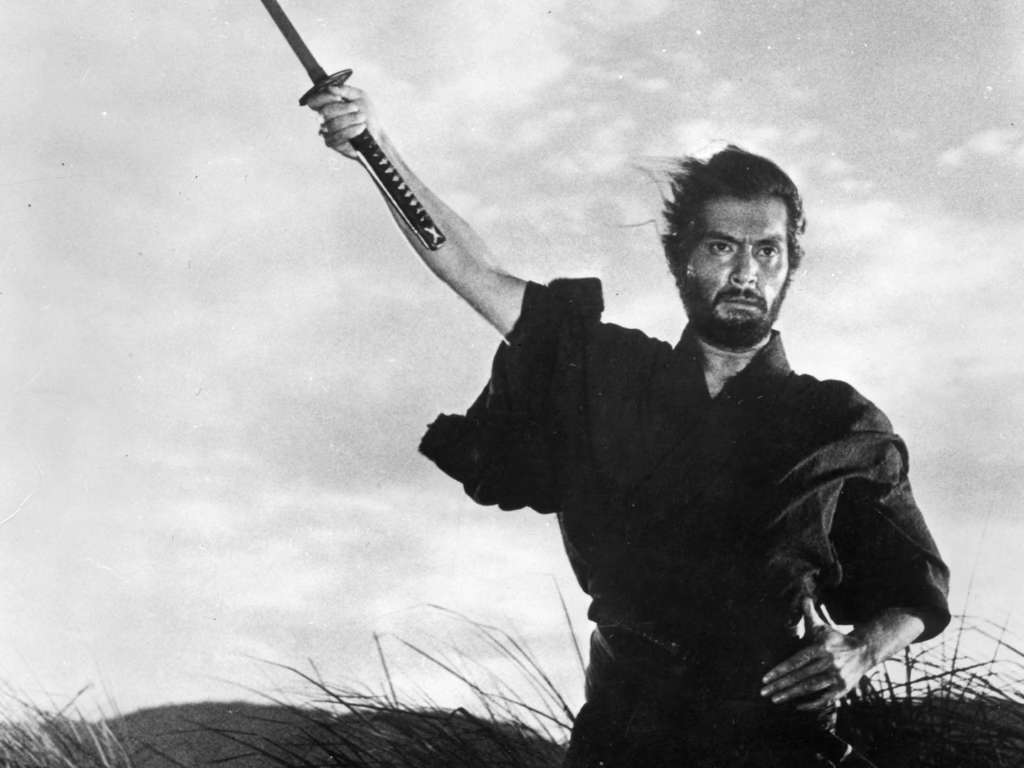
The world of cinema has lost one of its greatest masters. Tatsuya Nakadai, the legendary Japanese actor whose powerful performances in classics such as Ran and Harakiri defined an entire era of filmmaking, has passed away at the age of 92.
His death was announced on Tuesday, November 11, 2025, by a spokesperson from his acting studio Mumeijuku. The cause of death wasn’t disclosed, but for film lovers everywhere, the news marks the end of a remarkable seven-decade career that saw Nakadai work with Japan’s most celebrated directors and establish himself as one of the finest dramatic actors in cinema history.
Born Motohisa Nakadai on December 13, 1932, in Tokyo, his journey to stardom is the stuff of movie legend. While working as a shop clerk, he was discovered by director Masaki Kobayashi, who saw something special in the young man from a struggling family. Unable to afford university, Nakadai had trained at the Haiyuza Training School, where he learned modern theater methods inspired by Western realism rather than traditional Kabuki.
That training proved invaluable. Kobayashi cast him in his first film role, launching one of cinema’s most fruitful partnerships. Over the course of his career, Nakadai collaborated on 11 films with Kobayashi and 5 with the legendary Akira Kurosawa, in addition to notable work with other prominent Japanese filmmakers. His filmography, as noted by the Criterion Collection, became “a snapshot of Japanese cinema in its golden age.”
The Performances That Made Him Immortal
Ask any film scholar about Nakadai’s most significant work, and Ran (1985) inevitably comes up. In Kurosawa’s epic reimagining of King Lear, Nakadai played the ageing warlord Lord Hidetora Ichimonji with devastating power. The scene of his character descending the steps of a burning castle has become one of cinema’s most haunting images. Roger Ebert called it “Tatsuya Nakadai’s best acting in a long, wondrous career.”
But Nakadai himself favored Harakiri (1962). In this existential samurai film directed by Kobayashi, he played an ageing ronin who arrives at a feudal lord’s manor to expose the clan’s hypocritical honour code through a devastating story. The performance earned him his first Blue Ribbon Award for Best Actor and won the Special Jury Prize at Cannes.
Between those masterworks came The Human Condition trilogy (1959-1961), a monumental 9.5-hour epic that followed his character Kaji, a pacifist trying to maintain his humanity during World War II-era Japan. The filming conditions were gruelling. Real contact in fight scenes left his face swollen, and the final sequence required him to lie face down until completely covered in snow. The Criterion Collection described it as “one of the most staggering achievements of Japanese cinema.”
From Villain to Leading Man
Nakadai’s relationship with Kurosawa began with an uncredited cameo in Seven Samurai (1954), but he truly shone playing villains opposite Toshiro Mifune in Yojimbo (1961) and Sanjuro (1962). Kurosawa saw them as perfect contrasts, describing them as “silk to cotton, snake to lion.” Nakadai’s supple, enigmatic menace complemented Mifune’s gruff directness beautifully.
When Mifune and Kurosawa famously fell out in the late 1960s, Nakadai essentially became the director’s principal leading man. He anchored Kurosawa’s late-career epics, including the dual role of warlord and thief in Kagemusha (1980), which earned him a second Blue Ribbon Award.
While Mifune had undeniable star power internationally, critics consistently recognised Nakadai as the more complete and versatile actor. It’s a distinction that would be honoured at the highest levels.
In 2015, Emperor Akihito personally bestowed the Order of Culture upon Nakadai, Japan’s highest honour for contributions to the arts. Only a handful of actors have received this distinction, making Nakadai the fifth actor to be recognised with this prestigious award.
The honour acknowledged not just his film work but his lifelong commitment to theatre. Nakadai always considered himself “primarily a theater actor first.” He performed Shakespeare throughout his career and continued leading stage productions well into his 80s. However, perhaps his most significant contribution came through the founding of Mumeijuku (Studio for Unknown Actors) in 1975, which he established with his wife, producer and playwright Kyoko Miyazaki, who predeceased him.
The school trained young actors at no cost. One student in particular carried on his legacy: Koji Yakusho, who became one of Japan’s most recognisable actors and won Best Actor at Cannes in 2023.
Working Until The Very End
Nakadai never stopped pursuing his craft. His last film, The Pass: Last Days of the Samurai, was released in 2020 when he was 88 years old. In a 2016 interview at age 83, he said, “I’ve never thought about quitting. I still have about 30 plays I want to be in. I will give up when my body doesn’t move, but I want to stay an actor until I die.”
Nakadai’s death marks the loss of one of the last giants from Japan’s golden age of cinema. His international acclaim rivalled Toshiro Mifune’s, though he remained less known to general audiences, perhaps because his chameleonic performances made him harder to pin down as a singular persona.
He’s survived by his daughter, Nao Nakadai.