

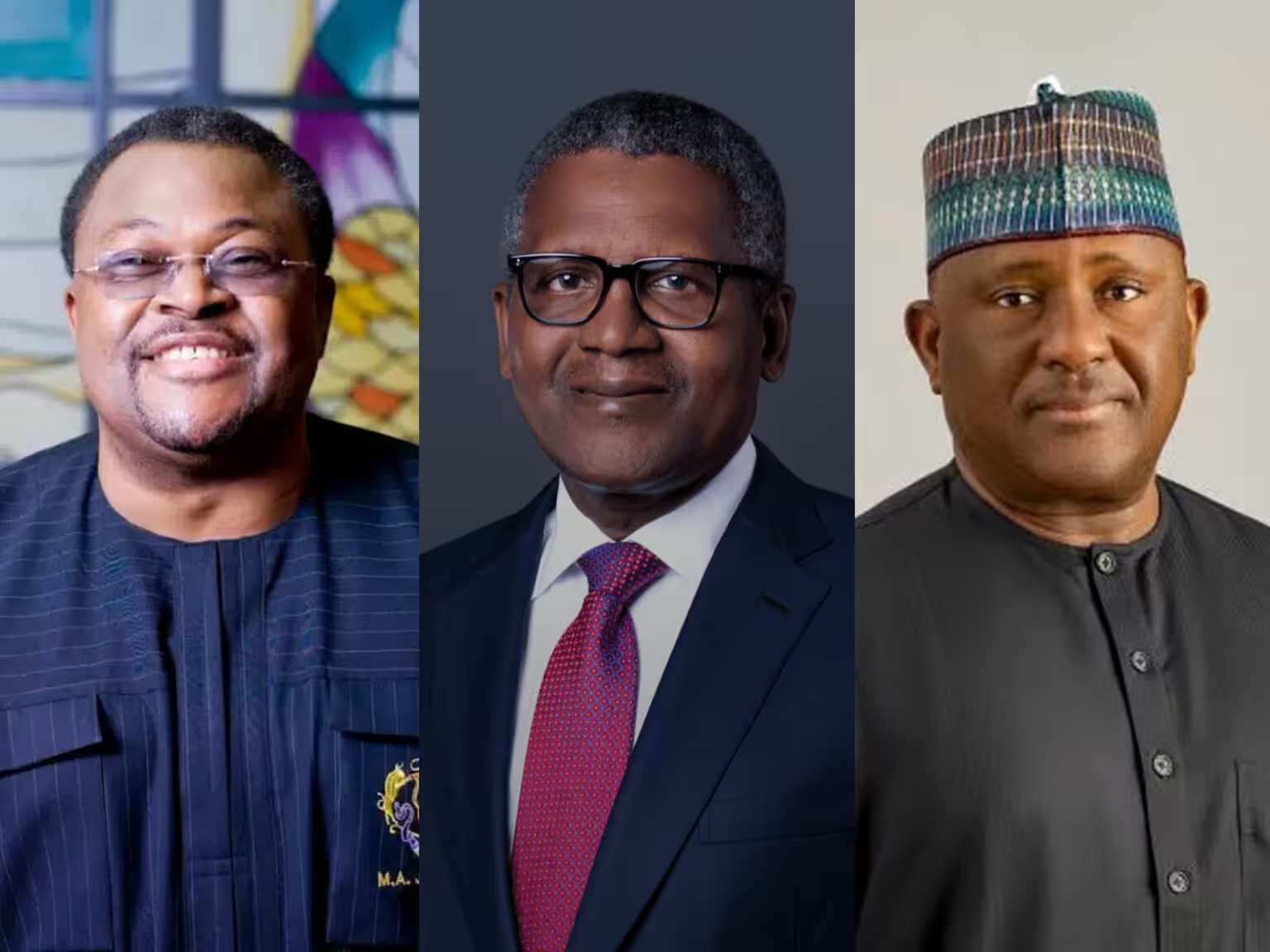
Nigeria has a habit of producing wealth on a scale that surprises even those who follow African business closely. As the continent’s most populous nation and one of its largest economies, it’s home to billionaires whose fortunes span oil, cement, telecoms, banking, and beyond. Some started with almost nothing. Others were born into privilege but still had to build their empires from scratch.
Here’s a look at the ten richest men in Nigeria right now, what they’ve built, and how they got there.
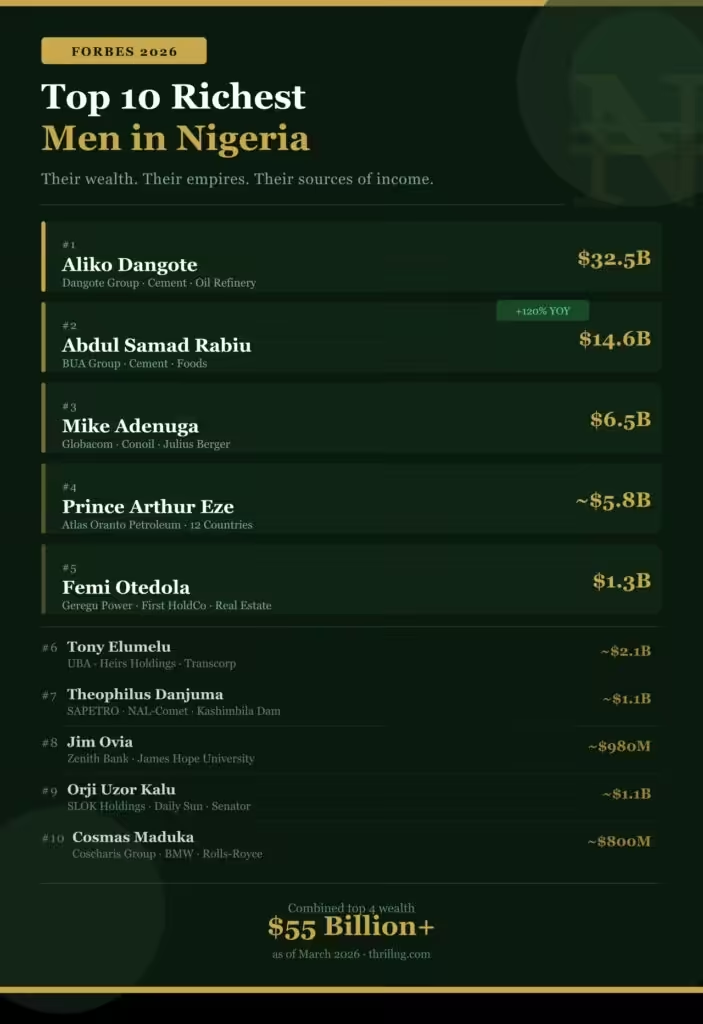
1. Aliko Dangote — $28.5 to $32.5 Billion
There’s really no other place to start. Aliko Dangote has topped Africa’s rich list for 15 consecutive years, and in 2026 he became the first African to breach the $30 billion mark. Bloomberg pegged his fortune at $32.5 billion as of late March 2026, while Forbes listed him at $28.5 billion the same month.
Dangote founded the Dangote Group in 1977, starting as a small trading company before scaling into a continental industrial giant. Today, it spans cement, oil refining, sugar, fertiliser, and salt. Dangote Cement is Africa’s largest producer at roughly 55 million tonnes annual capacity, and its shares surged 69% in 2025 as profits doubled to a record ₦1 trillion.
The bigger story, though, is the Dangote Petroleum Refinery, the world’s largest single-train refinery at 650,000 barrels per day. It reached full capacity in February 2026 and now supplies around 92% of Nigeria’s petrol, with fuel exports already going to five African nations. The refinery cost $19 to $20 billion to build and Dangote owns 92.3% of it. An IPO of 5 to 10% of the refinery on the Nigerian Exchange is planned for 2026.
2. Abdul Samad Rabiu — $11.2 to $14.6 Billion
If Dangote is Nigeria’s undisputed number one, Rabiu is rapidly closing the conversation about everyone else. His wealth surged 120% year-over-year, climbing from Africa’s sixth richest to third in under 12 months. Bloomberg tracked him at $14.6 billion by late March 2026, up $4.47 billion in Q1 alone.
Rabiu founded the BUA Group in 1988, initially importing iron, steel, and chemicals. Today it’s built around two publicly listed pillars. BUA Cement, in which he holds roughly 98%, saw its shares climb 135% in 2025 with revenue hitting ₦1.18 trillion. BUA Foods, 93 to 95% owned by Rabiu, reported a 91% profit increase in FY2025 and is Nigeria’s second-largest pasta producer.
The group’s ambitions don’t stop there. In January 2026, Rabiu met with China’s SINOMA to commission a new cement line targeting 20 million tonnes annually. BUA Foods has also inked deals with partners in Switzerland, Italy, and Turkey to expand rice processing, pasta production, and animal feed. Meanwhile, his son Isyaku Rabiu was appointed Chief Officer of Global Procurement at BUA Foods, signalling a generational handover is quietly underway.
3. Mike Adenuga — $6.5 Billion
Mike Adenuga is famously private for a man of his stature. Africa’s most secretive billionaire built his fortune through telecoms and oil, and he’s rarely far from the top of Nigeria’s wealth rankings. Forbes listed him at $6.5 billion in 2026, slightly down from $6.8 billion the previous year, largely because Conoil shares fell around 52%.
His flagship is Globacom, Nigeria’s second-largest telecom operator with over 60 million subscribers. Adenuga built the Glo-1 submarine cable, a 6,100-mile fibre optic link connecting West Africa to Europe. He also controls Conoil across upstream and downstream oil operations, holds a 25.1% stake in construction giant Julius Berger Nigeria, and runs Cobblestone Properties in real estate. His fintech arm, MoneyMaster Payment Service Bank, operates through 100,000 agents nationwide.
Born on 29 April 1953 in Ogun State, Adenuga studied Business Administration at Northwestern Oklahoma State University before earning an MBA from Pace University in New York. He’s credited with pioneering several firsts in Nigerian business, including Consolidated Oil becoming the first Nigerian company to drill oil in commercial quantities in 1991.
4. Prince Arthur Eze — Estimated $5.8 Billion
Arthur Eze doesn’t show up on Forbes or Bloomberg, because his entire empire is privately held with no public financial disclosures. That means estimates from African business publications put him anywhere between $2.6 billion and $5.8 billion. Still, few dispute his position as one of Nigeria’s wealthiest men.
Born in Anambra State on 27 November 1948 into a royal family, he studied chemical and mechanical engineering at California State University before founding Atlas Oranto Petroleum in 1991. The company now holds 22 oil and gas licences across more than 12 African countries, and the BBC has described it as the largest holder of oil exploration blocks in Africa.
Recent moves suggest the empire is still expanding. In September 2025, Atlas Oranto signed four Production Sharing Contracts for offshore blocks in Liberia, committing around $800 million in planned investment. In August 2024, the company entered Venezuela, its first step into the Americas. A well-known deal from his past: he bought three Liberian oil blocks in 2010 for $200,000 each, then sold them to Chevron for over $250 million.
5. Femi Otedola — $1.3 Billion
Femi Otedola’s wealth has moved around quite a bit lately. Forbes listed him at $1.3 billion in 2026, down from $1.7 billion after he sold a substantial Geregu Power stake at a discount in late December 2025. It also emerged through his August 2025 memoir, Making It Big, that he never actually completed a university degree, a revelation that made headlines but hardly diminished his standing.
His main asset is Geregu Power Plc, one of Nigeria’s key electricity generation companies at 435 MW capacity, where he holds around 78% as Executive Chairman. He also chairs First HoldCo Plc, the parent of First Bank of Nigeria, with a 16.1% stake. Zenon Petroleum and Gas, Swift Insurance, and FO Properties, which covers real estate across Lagos, London, Monaco, Dubai, and New York, round out his portfolio.
The son of former Lagos State Governor Michael Otedola, Femi has also made his philanthropic mark through a scholarship scheme linked to Michael Otedola University and a ₦300 million contribution to the National Ecumenical Centre in Abuja.
6. Tony Elumelu — Estimated $1 to $2.1 Billion
Tony Elumelu’s exact net worth is genuinely contested. MoneyCentral put him at $2.15 billion in early 2025 based on aggregate asset valuations, while Billionaires.Africa estimated just $700 million after accounting for reported debt obligations. The truth is probably somewhere between those two figures.
What’s less contested is his influence. Elumelu chairs United Bank for Africa, a pan-African bank operating in over 20 countries. He increased his personal stake to 10.63% in May 2025 by acquiring 1.27 billion shares worth ₦43.9 billion. His family holds 35.93% of Transcorp, whose revenue grew 107% to ₦407.9 billion in 2024. Heirs Energies, his oil and gas arm, is reportedly his largest single asset by value.
Born in Delta State on 22 March 1963, Elumelu studied Economics at Ambrose Alli University and the University of Lagos, later completing an Advanced Management Programme at Harvard. His Tony Elumelu Foundation is deploying $16 million in seed capital to 3,200 African entrepreneurs in 2026, and Emmanuel Macron appointed him to lead France’s new Africa Impact Coalition in 2025.
7. Theophilus Danjuma — Estimated $1.1 Billion
Theophilus Danjuma’s career is one of the more unusual paths to billionaire status in Nigerian history. A retired military general who served as Chief of Army Staff and later as Minister of Defence under President Obasanjo, he made his defining wealth move in 2006 when he sold contractor rights in deepwater block OPL 246 to China’s CNOOC for $1.8 billion, a return of roughly 7,100% on his original investment.
His primary vehicle is South Atlantic Petroleum (SAPETRO), which he founded in 1995 and which discovered the Akpo condensate field. He also controls the NAL-Comet Group in shipping and logistics and recently secured a concession to manage the Kashimbila Dam, a 40-megawatt hydroelectric plant in Taraba State. At 87, he’s not exactly winding down. His TY Danjuma Foundation, endowed with $100 million of personal wealth, launched a $10 million healthcare innovation initiative in 2025.
8. Jim Ovia — Estimated $980 Million
Jim Ovia founded Zenith Bank in 1990 and turned it into one of Nigeria’s most profitable financial institutions. The bank reported ₦532 billion in profit in H1 2025 alone and holds over $16.5 billion in total assets. Ovia retains a 16.2% stake as Chairman, which generated ₦20.33 billion in dividends in March 2025.
Beyond banking, he founded Visafone Communications, which MTN acquired around 2015 to 2016. He also runs Cyberspace Network in internet services, chairs Zenith General Insurance, and built Civic Towers, a 15-story Lagos office complex. He founded James Hope University in Lagos, approved in 2021. In March 2025, he received the Freedom of the City of London for his contributions to global finance.
Born 4 November 1951 in Agbor, Delta State, Ovia holds degrees from Southern University in Louisiana and the University of Louisiana, and is an alumnus of Harvard Business School.
9. Orji Uzor Kalu — Estimated $1.1 Billion
Orji Uzor Kalu’s story comes with legal baggage that most Nigerian business profiles gloss over. He was convicted in 2019 and sentenced to 12 years for ₦7.65 billion in fraud during his time as Abia State Governor. The Supreme Court overturned the conviction in May 2020 on procedural grounds and ordered a retrial, which remains ongoing.
Setting that aside, his SLOK Holdings is a West African conglomerate spanning oil and gas trading, shipping, manufacturing, media, real estate, and insurance, with operations across Nigeria, Ghana, Togo, South Africa, and South Korea. He chairs both the Daily Sun and New Telegraph newspapers and currently serves as Senator for Abia North. He started his business career by selling palm oil in Northern Nigeria with a loan from his mother, scaled into furniture, and eventually became CEO of First International Bank at just 33. Local net worth estimates for Kalu range widely, from $1 billion to $3.7 billion, so any specific figure should be treated cautiously.
10. Cosmas Maduka — Estimated $500 to $800 Million
If you want a story of genuine grit, Cosmas Maduka’s is hard to beat. He lost his father at age four, dropped out of primary school, and sold akara on the street to support his mother. He started Coscharis Motors with ₦300, which was less than $1. Today he runs a conglomerate operating across more than 10 countries.
Coscharis Motors is the sole Nigerian franchise distributor for BMW, MINI, Rolls-Royce, Jaguar Land Rover, and Ford, and it built Nigeria’s first Ford Ranger assembly plant in 2015. Coscharis Farms cultivates over 5,000 hectares in Anambra State for rice production. The group also operates in beverages, petrochemicals, auto components, and ICT.
Born 24 December 1958 in Jos, Maduka holds an honorary PhD from the University of Nigeria and completed executive education at Harvard. He was named Nigeria’s Person of Integrity in Business for 2024. He’s said publicly that if Coscharis were listed on the stock exchange, he’d be worth $5 billion. Whether or not that’s accurate, the journey from ₦300 to a multi-billion-naira group remains extraordinary.
What’s Driving Nigeria’s Wealth Boom
The collective fortune of Nigeria’s top four billionaires nearly doubled in 15 months, from roughly $25 billion in early 2025 to an estimated $55 billion by late March 2026. Three forces explain this surge: the Nigerian Exchange rallied approximately 81%, lifting every listed billionaire’s paper wealth; the Dangote Refinery reaching full capacity fundamentally revalued his industrial empire; and surging cement demand across Africa drove record profits for both Dangote Cement and BUA Cement.
Worth noting are two Nigerian-born billionaires not included in this ranking because they’re based in the United States. Adebayo Ogunlesi ($2.5 billion), co-founder of Global Infrastructure Partners, joined OpenAI’s board in January 2025 after BlackRock acquired his firm for $12.5 billion in 2024. Tope Awotona ($1.4 billion), founder of scheduling platform Calendly, continues building his tech fortune from Atlanta. Forbes excludes both from its Africa list due to their U.S. residency.
Nigeria’s wealth in 2026 is increasingly concentrated at the top, but the variety of paths these men have taken, from military service to market trading, from oil exploration to banking, shows that the country’s billionaire class is anything but one-dimensional.
1 Comment
We are just in Nigeria