
Africa’s wealthiest women are reshaping the continent’s economic landscape in entrepreneurship and investments. From oil tycoons to healthcare moguls, these powerhouses have built empires that span multiple sectors and continents.
Tthe figures below is the most recent and methodologically rigorous estimates available.
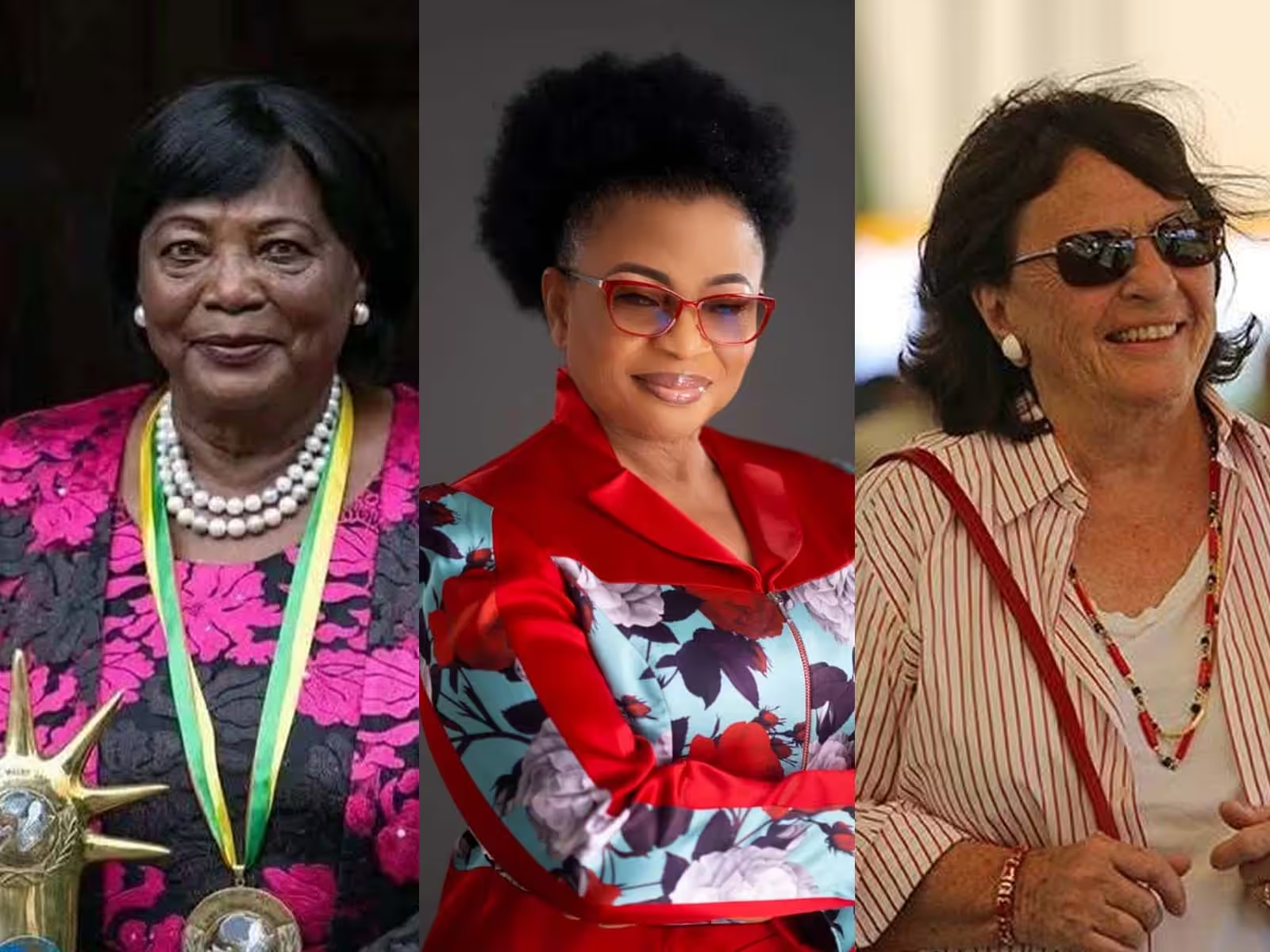
The 10 Richest Women in Africa
| Name | Net Worth | Country |
|---|---|---|
| Folorunsho Alakija | $900 million–$1.2 billion | Nigeria |
| Daisy Danjuma | $900 Million | Nigeria |
| Hajia Bola Shagaya | $600 Million | Nigeria |
| Lynette Saltzman | ~$500 million | South Africa |
| Ngina “Mama Ngina” Kenyatta | $210–$250 Million | Kenya |
| Zarin Merali | ~$220 million | Kenya |
| Sue Youcef Nabi | ~$180 million | Algeria/France |
| Wendy Appelbaum | $150–$260 million | South Africa |
| Patricia Poku-Diaby | ~$115 million | Ghana |
| Azza El-Sewedy | ~$110 million | Egypt |
1. Folorunsho Alakija: $900 Million–$1.2 Billion
Folorunsho Alakija’s journey to becoming Africa’s richest woman is nothing short of extraordinary. Born in July 1951 into a prominent Yoruba family (her father had 52 children), she was sent to boarding school in Wales at just seven years old.
After studying fashion design in London, she returned to Nigeria and spent over a decade in banking before launching her fashion label, Supreme Stitches, in the mid-1980s. But the real game-changer came in May 1993 when she applied for an Oil Prospecting License. Her company, Famfa Oil, received a 617,000-acre deepwater block roughly 100 kilometres offshore.
She brought in Texaco (later acquired by Chevron) as a technical partner but retained a commanding 60% stake. The first exploratory well struck oil at 4,700 feet, leading to the discovery of the Agbami field—one of Nigeria’s largest deepwater assets with estimated recoverable reserves of one billion barrels.
The Nigerian government tried to seize half her stake, but Alakija fought through every level of the judiciary. In May 2012, Nigeria’s Supreme Court ruled the government’s acquisition “illegal, null and void,” reinstating Famfa’s 60% interest. At peak production of 250,000 barrels per day, this entitled Famfa to roughly 6% of Nigeria’s total output.
Beyond oil, her empire includes DaySpring Property Development (luxury real estate across Lagos, Abuja, London, and Dubai), Digital Reality Prints, and her original fashion brand. She’s also donated approximately ₦70 billion (about $45 million) to build a state-of-the-art medical and teaching hospital at Osun State University.
2. Daisy Danjuma: $900 Million
Senator Daisy Danjuma assumed the role of Executive Chairman of South Atlantic Petroleum (SAPETRO) in December 2023 when her husband, Lt. Gen. Theophilus Danjuma, stepped down. SAPETRO holds significant stakes in Nigeria’s deepwater Akpo, Egina, and Preowei oil fields—operated by TotalEnergies—and has expanded across West and Central Africa.
A trained lawyer from Ahmadu Bello University, she previously served as a senator representing Edo South from 2003 to 2007, chairing the Senate Committee on Women Affairs and Youth Development.
3. Hajia Bola Shagaya: $600 Million
Bola Shagaya left the Central Bank of Nigeria’s audit department at age 24 in 1983 and built a conglomerate spanning oil, real estate, photography, and banking.
Her first venture, Bolmus International Limited (combining “Bola” and “Muinat”), began importing Konica photographic materials. She became the sole West African agent and eventually operated over 30 photo laboratories across Nigeria. During the late 1980s, she secured oil block allocations and founded Practoil Limited, now one of Nigeria’s largest importers of base oil for lubricant blending plants.
Her Bolmus Group International conglomerate now encompasses oil and gas, over 100 properties extending to Europe and the United States, and banking interests. She holds the traditional title of Sarauniya (Queen) of the Ilorin Emirate.
4. Lynette Saltzman: ~$500 Million
Lynette Saltzman is the most significant new entrant to Africa’s richest women rankings. She co-founded Dis-Chem Pharmacies alongside her husband Ivan, upgrading what began as a single pharmacy into a publicly traded powerhouse.
Today, Dis-Chem operates over 300 stores with more than 20,000 employees across South Africa. The company’s market capitalisation sits at approximately R28 billion ($1.52 billion). The Saltzmans hold a combined 35.12% stake, with Lynette’s individual share estimated at roughly $500 million.
Her emergence on these rankings is both Dis-Chem’s strong stock performance and a shift towards more data-driven analysis of women’s wealth in Africa. She’d been largely absent from previous lists, which tended to focus on Nigerian and Kenyan dynastic wealth.
5. Mama Ngina Kenyatta: $210 Million–$250 Million
At 92, Ngina Kenyatta—universally known as “Mama Ngina”—remains the matriarch of Kenya’s wealthiest and most politically connected family. As the fourth wife of founding president Jomo Kenyatta and mother of former president Uhuru Kenyatta, she sits atop an empire that’s truly staggering in scope.
The family controls an estimated 500,000 acres of Kenyan land, making them the country’s largest private landowners. Their fortune traces back to the independence era when government officials acquired vast tracts from departing British colonists at deeply discounted prices.
Her empire now spans multiple sectors: a 13.2% stake in NCBA Group (valued at over $103 million in mid-2025), controlling stake in Brookside Dairy (East Africa’s largest dairy processor commanding 40–60% of Kenya’s dairy market), Mediamax Network (owner of K24 TV and several radio stations), Heritage Hotels, and the planned Northlands City development outside Nairobi.
The 2021 Pandora Papers revealed 11 offshore companies and foundations linked to the family, though nothing technically illegal was uncovered. Net worth estimates vary dramatically—from a conservative $210 million to claims of $1 billion. The BBC has stated there’s simply no reliable estimate of the Kenyatta family’s net worth.
6. Zarin Merali: ~$220 Million
Zarin Merali oversees the estate of her late husband Naushad Merali, who died in 2021. Key assets include a 74% stake in Sameer Africa, 65% in Sasini Tea, and 5.2% in NCBA Group, all managed through Legend Investments Ltd.
Her husband’s fortune was estimated at $370 million in 2015, and she’s successfully maintained and managed these diverse holdings across manufacturing, agriculture, and financial services.
7. Sue Youcef Nabi: ~$180 Million
Sue Youcef Nabi is the first Algerian woman to appear on Africa’s richest women rankings. As CEO of Coty Inc.—the world’s second-largest hair colour brand and third-largest colour cosmetics company with $5.55 billion in revenue—she holds a 3.7% stake worth approximately $180 million.
She received $149.43 million in compensation in 2023 alone. Previously, she led Lancôme and L’Oréal Paris, where she was one of the company’s most senior executives.
8. Wendy Appelbaum: $150–$260 Million
Wendy Appelbaum inherited exceptional business acumen from her father, Sir Donald Gordon, founder of the Liberty Group. She co-founded Wiphold in 1994—the first women-controlled company listed on the Johannesburg Stock Exchange—turning a $60,000 investment into a $120 million debt-free enterprise in just four years.
Today, she’s best known for De Morgenzon Wine Estate in Stellenbosch, purchased in 2003. She pioneered the unusual practice of playing Baroque music throughout the vineyards. The estate’s first Chenin Blanc vintage became the first wine ever to receive five stars in Platter’s Wine Guide, and it’s been named among the Top 100 Wineries globally twice. They produce approximately 750,000 bottles annually, with 75% exported.
Through her foundation and her father’s foundation, she’s donated over $23 million to healthcare and education.
9. Patricia Poku-Diaby: $115 Million
Patricia Poku-Diaby stands out as the only African woman to build a large-scale cocoa processing facility. Her Plot Enterprise Group operates 48,000 metric tonnes of annual processing capacity across Ghana and Côte d’Ivoire.
She competes directly with European multinationals in a sector that’s been historically dominated by foreign companies—no small feat in the global commodities market.
10. Azza El-Sewedy: $110 Million
Azza El-Sewedy holds a 3.03% stake in Elsewedy Electric, which delivered 212% returns in 2024 and commands a $3.6 billion market capitalisation. Her fortune grew by $11.4 million in just 22 days during January 2025 – a sign of the volatility and opportunity in African equity markets.
What Happened to Isabel dos Santos?
No discussion of Africa’s wealthiest women would be complete without addressing Isabel dos Santos, who experienced the continent’s most dramatic wealth collapse. Once Africa’s richest woman with an estimated fortune of up to $3.5 billion, the daughter of former Angolan President José Eduardo dos Santos has seen her empire crumble.
The 2020 Luanda Leaks investigation exposed how she allegedly siphoned hundreds of millions from Angolan state companies. Since then, she’s faced criminal charges, an Interpol Red Notice, and over $1.5 billion in frozen assets across four jurisdictions. In November 2024, the UK government formally sanctioned her as a “notorious kleptocrat.” She now lives in Dubai, effectively confined there by sanctions, travel bans, and arrest warrants.