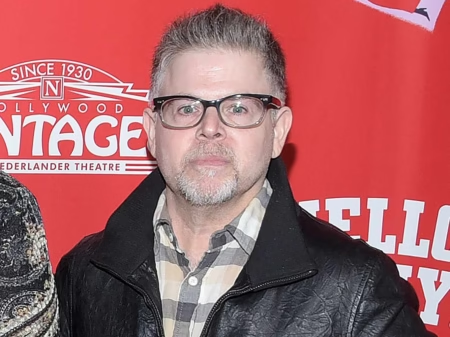


Scoey Mitchell didn’t just act on television. He overcame barriers, created opportunities, and paved the way for Black professionals in entertainment at a time when those doors were firmly shut. From starring in groundbreaking sitcoms to directing his own NBC series, Mitchell’s five-decade career is a masterclass.
Biography
Born as Roscoe Mitchlll Jr. on March 12, 1930, in Newburgh, New York, Scoey Mitchell came into a family that valued both faith and activism. His father served as a Baptist minister and community activist, raising young Roscoe and his siblings in Buffalo, New York, where the family eventually settled.
The Mitchlll surname had an unusual spelling with three L’s and no E, which explains why Mitchell’s name was frequently misspelled in television credits throughout his career. He grew up alongside two siblings who’d each carve their own paths: his brother Billy Mitchell became a respected jazz pianist, while his sister Mary Warren built her own life away from the spotlight.
Before entertainment called his name, Mitchell played professional baseball. However, specific details about his teams and leagues remain scarce.
Career
Mitchell’s career kicked off in 1967 when he made his debut on The Smothers Brothers Comedy Hour as a stand-up comedian. In one memorable sketch, he and Tommy Smothers actually kissed on the lips, a bold move that helped break down racial barriers on television during a turbulent era in American history.
That debut opened doors, and Mitchell wasted no time walking through them. In 1970, he landed the lead role of attorney Paul Bratter in the television adaptation of Barefoot in the Park. Starring opposite Tracy Reed across 12 episodes, Mitchell made history. The show marked the first American sitcom since Amos ‘n’ Andy to feature a predominantly Black ensemble cast, filling a 17-year gap in Black television representation.
The achievement came with a price, though. When ABC executives consulted the Watts Drama Workshop members about Black relationships rather than hiring Black writers, Mitchell spoke up. His “differences of opinion” with executive Douglas S. Cramer led to his firing, and ABC cancelled the series rather than recasting his role.
Television Roles and Guest Appearances
Mitchell’s television presence extended far beyond that one series. From 1974 to 1976, he played Justin Culp, a field employee at Joe Gerard’s wrecking company, in nine episodes of Rhoda. His guest appearances read like a who’s who of 1970s television: The Odd Couple, The Six Million Dollar Man, Taxi, Here Come the Brides, Police Story, and Baretta.
He also appeared on The Ed Sullivan Show in 1969, on That Girl, The Mothers-in-Law, Lou Grant, and several other shows.
His film work included a significant role in 1986’s Jo Jo Dancer, Your Life Is Calling, where he portrayed Richard Pryor’s father in the semi-autobiographical film. Television movies became another avenue for his talent, with roles in Voyage of the Yes (1973) alongside Desi Arnaz Jr., the all-Black Cinderella adaptation Cindy (1978), and several others throughout the 1980s.
After nearly three decades away from acting, Mitchell returned for one final role in 2017’s short film A Kindred Soul, playing Grandfather.
Behind the Scenes
Mitchell’s real passion, however, lay behind the camera. In 1972, he wrote and hosted The Scoey Mitchell Show, a one-hour variety special featuring heavyweights like Sammy Davis Jr., Buddy Hackett, Nancy Wilson, and Denise Nicholas.
His production work truly flourished in the 1980s. Me & Mrs. C. started as a TV movie in 1984 that Mitchell wrote and co-directed, exploring an interracial friendship between a young Black ex-convict and an elderly white widow. The concept resonated enough that NBC adapted it into a series running from 1986 to 1987, with Mitchell serving as creator, writer, director of four episodes, and executive producer.
He followed that success with 13 East (1989-1990), an NBC hospital sitcom he co-created with Anne Convy and Mara Lideks. Mitchell directed 12 episodes and executive-produced 10, with his wife Claire working in employee relations on the show.
His production credits also included Just a Little More Love (1983), a family drama about adoption difficulties starring a young Jason Bateman, as well as several other TV movies throughout the late 1980s. Mitchell was one of the few Black entertainers of his era to succeed as creator, writer, director, and producer.
For many viewers, Mitchell became a familiar face through game shows. He appeared on Match Game an impressive 57 times between 1974 and 1979, plus eight additional episodes on the evening Match Game PM. As a semi-regular panellist alongside Brett Somers, Charles Nelson Reilly, and Richard Dawson, he brought his quick wit to countless episodes.
Mitchell and his wife, Claire, also became Tattletales regulars, appearing as a celebrity couple in approximately 39 episodes across the show’s two runs between 1974 and 1984. He popped up on Hollywood Squares, Super Password, and Password Plus, always ready with a clever quip or unexpected answer.
Personal Life
Mitchell married Claire T. Thomas on April 7, 1973, beginning a partnership that would last 49 years until his death. The couple didn’t have children, but their bond was evident to anyone who watched them together on Tattletales.
In his later years, Mitchell developed a passion for collecting and restoring classic cars, a hobby that kept him busy and engaged outside the entertainment world.
Net Worth
At the time of his death, Scoey Mitchell’s net worth was estimated at $400,000. While celebrity net worth figures should always be taken with a grain of salt since they’re not based on verified financial disclosures, this figure seems plausible for someone who spent over five decades working steadily in television as an actor, writer, director, and producer.
Death
Mitchell died on March 19, 2022, just one week after his 92nd birthday. He passed away from kidney failure at a hospice care facility in Torrance, California. His brother Billy announced the death on Facebook four days later, and Mitchell was cremated with his ashes given to his wife Claire.