
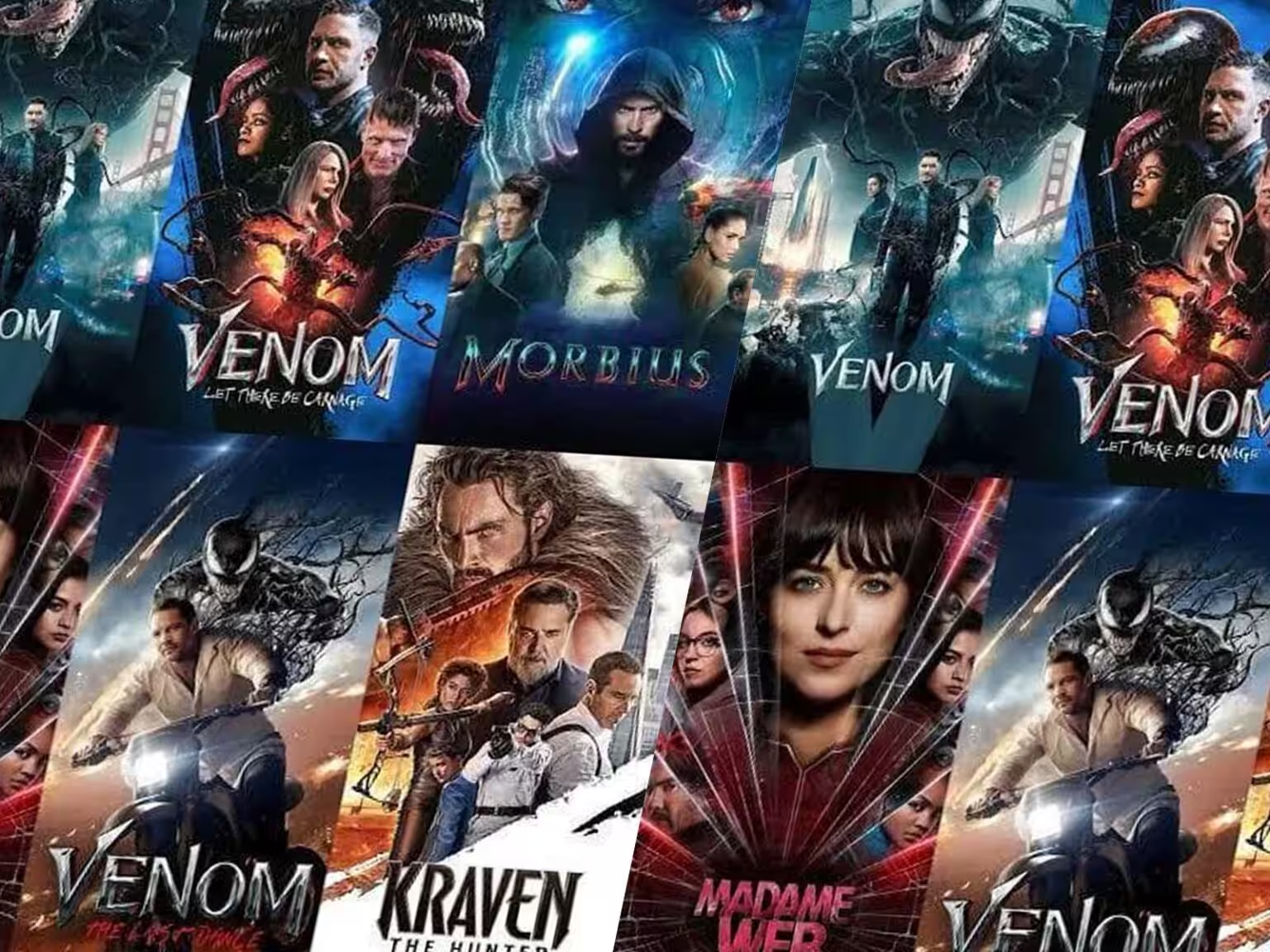
Sony has officially pulled the plug on its Spider-Man Universe. On February 24, 2026, Sony CEO Tom Rothman confirmed on The Town podcast that the Sony Spider-Man Universe (SSU) is getting a full reboot “with new people,” drawing a definitive line under a franchise that spent six films struggling to justify its own existence.
So what went wrong, and more importantly, where does Spider-Man go from here?
Sony’s Spider-Man Universe By The Numbers
Before looking forward, it’s worth understanding just how badly things went sideways. The SSU ran six films between 2018 and 2024, generating roughly $2.15 billion in worldwide box office. That sounds decent until you notice who carried almost all of it.
| Film | Year | Worldwide Gross | Budget | Rotten Tomatoes |
|---|---|---|---|---|
| Venom | 2018 | $856M | ~$108M | 30% |
| Venom: Let There Be Carnage | 2021 | $507M | $110M | 57% |
| Morbius | 2022 | $167M | ~$88M | 15% |
| Madame Web | 2024 | $100M | $80M | 11% |
| Venom: The Last Dance | 2024 | $479M | $120M | 40% |
| Kraven the Hunter | 2024 | $62M | ~$120M | 15% |
The Venom trilogy alone accounts for $1.84 billion of that total. Strip those three films out and the remaining three, Morbius, Madame Web, and Kraven, scraped together a combined $329 million. That’s less than many single MCU films make in their opening weekend.
Kraven’s $11 million domestic debut was the worst opening ever for a Sony Marvel film. Madame Web won three Razzie Awards, including Worst Picture. Star Dakota Johnson publicly said she was “just sort of along for the ride.” And Morbius became such an internet punchline that Sony misread ironic meme buzz as real demand and re-released it, only to watch it collapse with a 74% second-weekend drop.
Former Sony CEO Tony Vinciquerra summed it up plainly, calling Kraven “the worst launch we had in 7½ years.”
What Rothman Actually Said
Speaking with journalist Matt Belloni, Rothman’s confirmation came in a rapid-fire exchange that’s already the most-quoted Spider-Man interview of 2026. Asked whether the SSU was dead, he said no. Would Sony return? Yes. A fresh reboot? Yes. With new people? “Yes.”
His philosophy going forward was just as direct: “Scarcity has value. You got to make the audience miss you.”
Rothman was candid about the SSU’s failures but notably upbeat about the MCU partnership, calling it “one of the great deals for both companies ever.” He praised Marvel Studios president Kevin Feige, putting him in the same company as James Cameron when it comes to reliable bets. He also revealed that Spider-Man: No Way Home missed the $2 billion mark partly because China banned the film over its Statue of Liberty climax. Chinese authorities asked Sony to remove the sequence, and Rothman flatly refused, saying he wasn’t keen on explaining to Congress why he’d cut it out “at the request of the Chinese Communist Party.”
Why The SSU Never Worked
The SSU’s core problem was baked into its concept from the start. Sony built an entire cinematic universe around Spider-Man’s supporting cast and villains while Spider-Man himself was over in the MCU. Tom Holland never appeared in a single SSU film despite years of vague crossover discussions. You can’t build a web without the spider.
Sony also kept reaching for deeply obscure characters as franchise leads. El Muerto had fewer than five comic book appearances in history. Industry analyst David A. Gross put it bluntly, telling Variety that “as the superhero genre has declined over the last five years, Morbius, Madame Web and Kraven have led the race to the bottom.”
Then there’s the quality issue. Each film followed the same origin-story template, turning iconic Spider-Man villains into generic antiheroes. Kraven became an “animal-loving environmentalist.” The grit and menace that made these characters compelling antagonists was sanded off, removing any path toward the long-promised Sinister Six team-up that fans actually wanted.
A source quoted in The Wrap didn’t mince words: “The biggest issue with the Sony Spider-Man spinoffs seems to be the lack of quality control. The movies just aren’t good.” Sony privately admitted to Variety that Kraven, Madame Web, and Morbius were “creative and critical failures.” By the time Kraven hit cinemas in December 2024, the SSU brand itself had become a liability. One insider admitted that “any new SSU film would be ripped to shreds” regardless of its actual quality.
Spider-Man: Brand New Day Is Sony’s Best Bet Right Now
With the SSU in the ground, Sony’s most immediate priority is the MCU collaboration. Spider-Man: Brand New Day opens July 31, 2026, directed by Destin Daniel Cretton (Shang-Chi), with returning writers Chris McKenna and Erik Sommers. Filming wrapped in December 2025 at Pinewood Studios and on location in Glasgow, Scotland.
The confirmed cast features Tom Holland back as Peter Parker, Zendaya as MJ, Jacob Batalon as Ned Leeds, Jon Bernthal as the Punisher, Mark Ruffalo as Hulk, Sadie Sink in a significant undisclosed role, Michael Mando as Scorpion, and Marvin Jones III as Tombstone. Charlie Cox is widely expected to return as Daredevil.
Kevin Feige described the film as the beginning of a “proper Spider-Man” era, telling Collider: “We are seeing for the first time in the Tom Holland Spider-Man stories him being a proper Spider-Man, him being by himself, dedicated to saving the city.” The official synopsis places Peter Parker four years after No Way Home, his identity erased from global memory, working anonymously as he uncovers a web of crime.
Holland himself has called it “a rebirth… something completely new” and “the first movie in the next chapter,” which strongly hints at more to come. Unverified reports suggest a new deal covers three additional solo films plus MCU ensemble appearances in Avengers: Doomsday and Secret Wars, though neither studio has officially confirmed those terms.
The Spider-Verse Remains Sony’s Creative Crown Jewel
While the live-action SSU was burning down, Sony’s animated division was quietly building the most acclaimed superhero franchise of the decade. Spider-Man: Beyond the Spider-Verse arrives June 18, 2027, directed by Bob Persichetti and Justin K. Thompson, with a script from Phil Lord, Christopher Miller, and David Callaham.
The film picks up immediately after Across the Spider-Verse‘s cliffhanger, with Miles Morales as a fugitive hunted by Spider-People across the multiverse. Voice recording has been underway since late 2024, with Shameik Moore confirming his sessions in August 2025. Phil Lord has acknowledged the pressure candidly, saying the team is actively working to avoid “the mistakes of third installments.”
Sony is also expanding its animation pipeline with an animated Venom film announced on February 20, 2026, directed by Zach Lipovsky and Adam B. Stein, with Tom Hardy and Kelly Marcel involved as producers. Standalone animated films for Spider-Punk and Spider-Gwen are reportedly in development too, with Daniel Kaluuya and Hailee Steinfeld attached respectively.
On television, Spider-Noir starring Nicolas Cage premieres May 25, 2026 on MGM+, an eight-episode series set in 1930s New York. And Your Friendly Neighborhood Spider-Man on Disney+ earned a 97% Rotten Tomatoes score in its first season, with Season 2 confirmed for Fall 2026.
The Reboot Has No Details Yet, And That’s Fine
Here’s the honest reality about Sony’s announced SSU reboot: there are no confirmed writers, directors, cast members, characters, or release dates. The reboot is essentially a statement of intent, not a plan.
Rothman’s “scarcity has value” framing suggests Sony is deliberately hitting pause before launching anything new. Given how badly overexposure damaged the SSU brand, that patience might be exactly what the franchise needs.
One unresolved question is whether the rebooted universe will finally put Spider-Man front and centre. Feige’s July 2025 comments on live-action Miles Morales were telling: “That is nowhere. We’ve been told to stay away,” suggesting Sony is holding that card close while the animated Spider-Verse trilogy runs its course. Sony reportedly has no intention of selling the Spider-Man rights back to Disney, and the studio’s contractual obligation to keep producing Spider-Man content ensures the franchise will continue in some form regardless.
The SSU’s six-film run is over and honestly, the franchise is better off for it. Sony now has a clear road ahead: the MCU partnership delivering blockbusters, the Spider-Verse delivering critical acclaim, and eventually, a rebooted live-action spinoff universe built with the quality control the first one desperately lacked.