
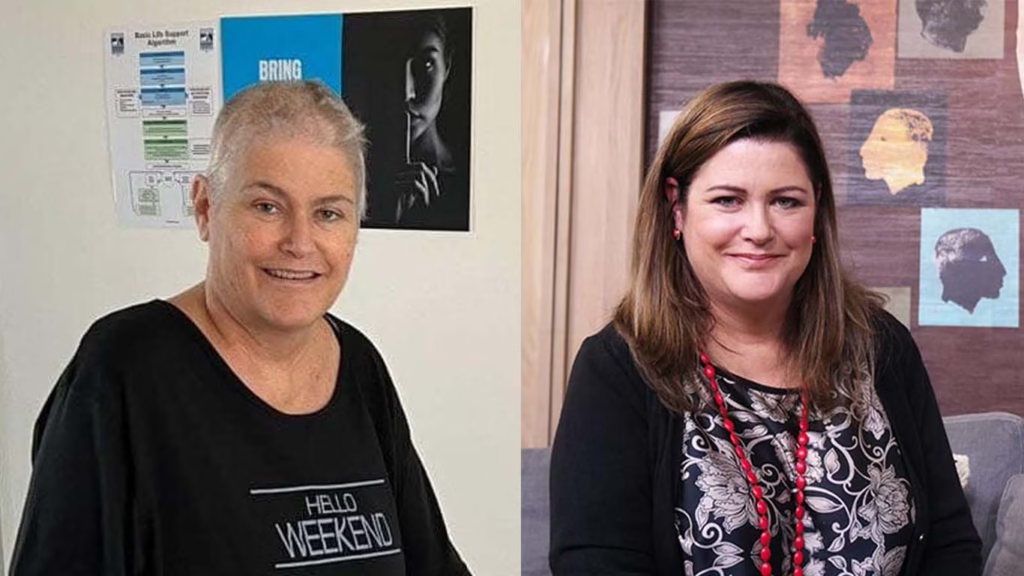
Some stories defy belief. Alison Botha is one of them. Hers is a tale of unimaginable horror transformed into a powerful message of hope that’s inspired millions worldwide. From the brink of death to becoming one of the world’s most sought-after motivational speakers, she proves that the human spirit can triumph over even the darkest circumstances.
Who is Alison Botha?
Alison Botha is a South African motivational speaker, author, and survivor whose life changed forever on December 18, 1994. She endured a brutal attack that medical professionals believed no one could survive. Yet not only did she live – she chose to transform her trauma into a force for good, helping countless others find courage in their own struggles.
Today, she’s renowned globally for her inspiring talks about resilience, choice, and the power of the human spirit.
Quick Facts About Alison Botha:
Full Name: Alison Botha
Date of Birth: September 22, 1967
Age: 57 years old
Birthplace: Port Elizabeth, South Africa
Profession: Motivational speaker, author, survivor advocate
Nationality: South African
Husband: Tienie Botha
Children: Two sons, Daniel and Matthew
Notable Works: “I Have Life” (book), “Alison” (2016 documentary)
Estimated Net Worth: $800,000
Alison Botha Biography
Born on September 22, 1967, in Port Elizabeth, situated in South Africa’s Eastern Cape province, Alison enjoyed a relatively normal childhood, at least until her parents, Brian and Claire, divorced when she was ten.
Following the separation, Alison and her brother, Neale, were primarily raised by their mother.
Despite the family upheaval, Alison thrived academically. She attended Collegiate Girls’ High School in Port Elizabeth, where she distinguished herself as Head Girl. After matriculating in 1985, she studied briefly at the former Port Elizabeth Technikon before entering the workforce.
At 21, Alison travelled overseas. She spent four years travelling and experiencing life beyond South Africa’s borders. Upon returning home, she settled into a career as an insurance broker. Her life seemed ordinary and unremarkable. But everything changed on one December night in 1994.
The Night That Changed Everything
The evening of December 18, 1994, started like any other. Alison spent time with friends at the beach before returning to her flat for pizza and games. When the gathering wound down, she drove her last friend home and headed back to her apartment in Port Elizabeth. It was routine, uneventful, or so she thought.
As she parked her car and reached for her bag of clean laundry on the passenger seat, a sudden gust of warm air alerted her to danger. A man with a knife had wrenched open her driver’s door.
“Move over, or I’ll kill you,” he commanded.
The attacker, who called himself “Clinton” (later identified as Frans du Toit), forced Alison into the passenger seat and drove to collect an accomplice, Theuns Kruger. The two men who would later become known as the “Ripper Rapists” took her to a deserted area on the outskirts of Port Elizabeth, near what is now Nelson Mandela Metropolitan University’s South campus.
What happened next was truly horrific. Both men violently raped Alison before deciding to kill her to prevent her from identifying them. They attempted to suffocate her first, but even after losing consciousness, she clung to life.
Frustrated by her resilience, the attackers escalated their brutality. They stabbed her more than 30 times in the abdomen, with du Toit specifically targeting her reproductive organs. When her leg twitched, signalling she was still alive, they slashed her throat 16 times, nearly decapitating her.
“All I could see was an arm moving above my face,” Alison later recalled. “Left and right and left and right. It was the sound of my flesh being slashed open.”
The attackers, believing their work was done, discussed their handiwork in Afrikaans. “Do you think she’s dead?” one asked. “No one can survive that,” the other replied with chilling certainty. Then they left her, disembowelled, nearly decapitated, and presumed dead in a clearing surrounded by bushes.
But they were wrong.
Miraculous Survival
As Alison lay there, broken and bleeding, she made a decision. “I realised my life was too valuable to let go of,” she said. “And that gave me the courage to survive.”
With extraordinary presence of mind, she wrote her attackers’ names in the sand; she’d memorised “Frans” after Kruger accidentally shouted it during the assault. Beneath the names, she scratched out three words: “I love Mom.”
Then she noticed something with headlights flickering through the bushes. There was a road nearby. If she could reach it, someone might find her.
But that wasn’t easy. As she attempted to move, her head flopped backwards—she’d been cut so deeply her head nearly rested between her shoulder blades. When she touched her stomach, she felt something warm and slimy: her intestines were spilling from her body.
Using one hand to hold her head forward and the other to keep her intestines from falling out, Alison crawled through broken glass and debris towards the road. When she finally reached it, she positioned herself horizontally across the white line, knowing this would force drivers to come to a stop.
The first car swerved around her. But the second stopped.
Alison Botha’s Rescue and Recovery
By the time Alison was discovered at 2:45 AM, only an hour and a half had passed since her abduction. Tiaan Eilerd, a veterinary student from Johannesburg visiting Port Elizabeth, was the young man who found her. He immediately assessed her injuries and, using his veterinary training, repositioned her thyroid back into its normal position in her throat. A quick-thinking move that likely saved her life.
“God put me on that road that night for a reason,” Eilerd later reflected.
Emergency services rushed Alison to the hospital, where medical staff were stunned she’d survived. Dr Alexander Angelov, who treated her, admitted he’d never seen such severe injuries in his 16 years of medical practice. Doctors couldn’t even count all her wounds; there were too many.
Despite catastrophic injuries, Alison’s memory remained intact. Whilst still in hospital, she identified her attackers from police photographs, leading to their swift arrest.
Justice Served
The subsequent “Noordhoek Ripper Trial” captivated South Africa. Frans du Toit and Theuns Kruger, who identified themselves as Satanists, pleaded guilty to kidnapping, rape, and attempted murder. Du Toit even admitted to raping another woman but claimed he’d lost the “desire to kill her” after the assault.
In August 1995, both men received life sentences without the possibility of parole. Alison’s ordeal hadn’t been in vain; justice was served, and two dangerous criminals were locked away.
Or so everyone thought.
In July 2023, after serving just 28 years, du Toit and Kruger were released on parole without Alison being informed. She shared her shock on Facebook: “The day I hoped and prayed would never come. When I was asked, ‘How will you feel if they ever get parole?’—my immediate answer was always—’I’m hoping I’ll never find out.'”
However, following public outcry and a thorough legal review, Minister of Correctional Services Dr Pieter Groenewald cancelled their parole in February 2025. Both men were reincarcerated and remain in custody.
Life After Survival
During her recovery, Alison found love with Tienie Botha. They married while she was still healing physically and emotionally. Tienie understood her trauma on a deep level, as he’d battled depression stemming from his own unresolved childhood trauma.
This shared understanding of pain created a strong foundation for their relationship.
Together, they built a family. Alison gave birth to two sons, Daniel and Matthew. A miracle considering du Toit had deliberately tried to destroy her reproductive organs during the attack.
“That was his intention,” Alison said after her first son’s birth in 2003. “Which is what makes this news so positive.”
For Alison, being a mother became her most important role. She’s described raising her boys as “by far the most important ‘job'” she has.
Motivational Speaking
Rather than retreating into victimhood, Alison chose a different path. She became one of the first South African women to speak publicly about rape, both at home and internationally.
Her message was simple yet profound: attitude, belief, and choice can help anyone survive life’s darkest moments.
She’s since travelled to at least 35 countries, addressing hundreds of thousands of people. Her talks inspire survivors of trauma, violence, and adversity to reclaim their power and refuse to be defined by what happened to them.
Her impact extends beyond speaking engagements. She’s championed GBV (gender-based violence) victims and inspired initiatives like WomanInpowered, which helps women learn self-protection techniques.
Alison’s courage hasn’t gone unnoticed. Her accolades include:
- Rotarian Paul Harris Award for “Courage Beyond the Norm” (1995)
- Femina Magazine’s inaugural “Woman of Courage” award (1995)
- Port Elizabeth’s Citizen of the Year (1995)
Alison Botha Book
Alison’s autobiography, “I Have Life: Alison’s Journey,” written with ghostwriter Marianne Thamm and published by Penguin Random House, became a bestseller. The book offers an unflinchingly honest account of her ordeal whilst emphasising her philosophy of choice and resilience.
Rather than dwelling on victimhood, the book presents a triumphant narrative, a roadmap for anyone facing seemingly insurmountable challenges. It’s available on various platforms, including Amazon Kindle, and continues to inspire readers worldwide.
Alison Botha Documentary
In 2016, Alison’s story reached an even wider audience through the documentary film “Alison,” directed, written, and produced by Uga Carlini. The 80-minute film, based on Thamm’s book, features Alison as her older self, whilst actress Christia Visser portrays young Alison.
The documentary premiered at the Dances with Films Festival in 2016 and won multiple awards, including Best Documentary Film at the Asia-Pacific Film Festival (2016) and Best Documentary Feature at the Africa Magic Viewers’ Choice Awards (2017)
It also received nominations at the South African Film and Television Awards for Best Documentary Feature, Best Achievement in Directing, Cinematography, and Editing.
“I have always hoped that by sharing my own journey with others, it would give them hope and courage for their own,” Alison said upon the film’s release. “To have my story and ultimate triumph shared on screen would mean that so many more people would see the power of choice that we each have.”
Brain Aneurysm
Life’s challenges didn’t end for Alison in 1994. In late September 2024, thirty years after her initial ordeal, she suffered a brain aneurysm. She underwent emergency surgery in Cape Town to stop the bleeding and subsequently needed additional brain surgery to address fluid accumulation.
For someone who’d spent decades inspiring others, this new vulnerability proved particularly challenging. “As a positive person and an inspirational speaker, I find this hard to admit—I can’t even inspire myself at the moment, which is very frightening,” she shared candidly on Facebook.
It remains unclear whether the aneurysm developed as a consequence of her 1994 injuries. What is clear is that South Africa rallied behind her once again. Her legal team established a trust fund to cover surgical costs, and contributions poured in from around the world.
Alison Botha Net Worth
Through her speaking engagements, book sales, and documentary work, Alison has built a career from sharing her story. Her estimated net worth sits at approximately $800,000.
However, for Alison, the true wealth lies not in money, but in the lives she has touched and the families she has helped heal.
In Alison’s own words:
“Patches always have an end—so take heart and keep moving. Joy, enthusiasm and happiness are at the other end of the patch—for you, for me, and for everyone like us.”
That message—simple, powerful, and deeply human—is perhaps the greatest gift Alison Botha has given the world.
Alison’s story teaches us that we’re stronger than we imagine and trauma doesn’t have to define us.
If you or someone you know has experienced sexual violence, support is available. Organisations like RAINN (Rape, Abuse & Incest National Network) and local crisis centres provide confidential assistance to survivors.