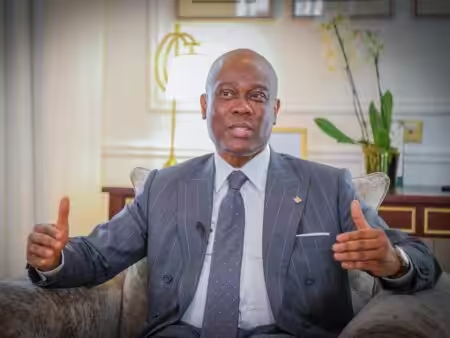

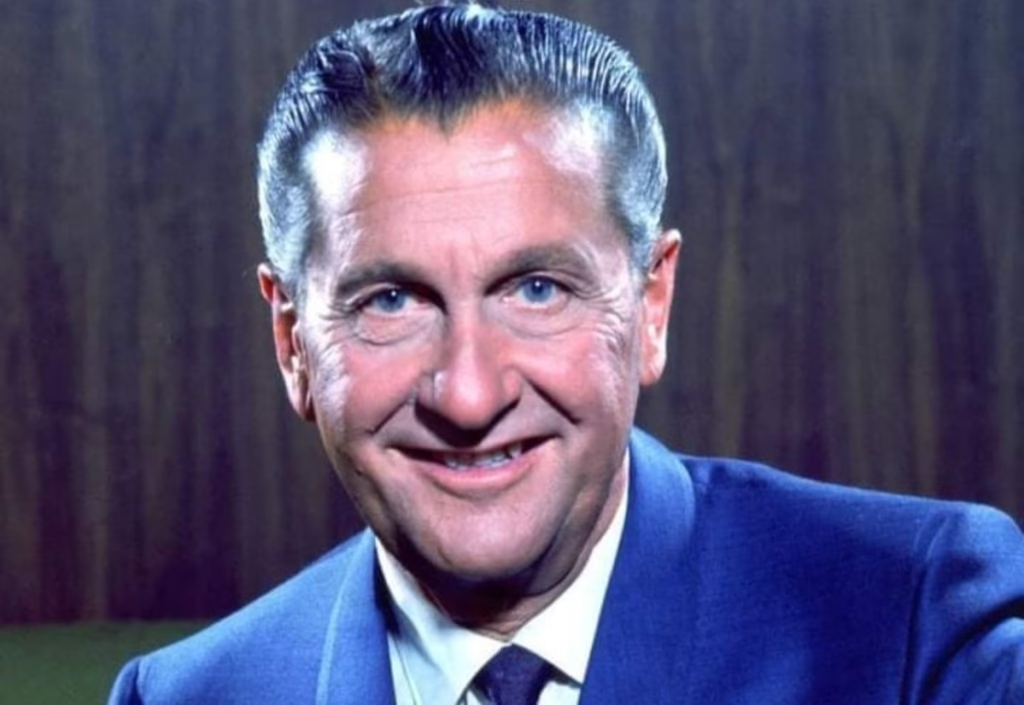
If you’re familiar with Lawrence Welk, the beloved American bandleader and television personality who brought “champagne music” into millions of living rooms during the mid-20th century, you might be curious about what became of his family legacy.
At the centre of that legacy is Lawrence Welk Jr., the only son of the famous accordionist, who spent over four decades building upon his father’s entertainment empire before becoming embroiled in a family legal battle in 2023.
Lawrence Welk Jr. is far more than simply the son of a famous entertainer. As a businessman and visionary in his own right, he grew his father’s modest music publishing company and resort holdings into a multimillion-dollar enterprise spanning recording labels, real estate, and hospitality ventures.
However, his story took a dramatic turn when he found himself in legal conflict with his own son and fellow board members over control of the family business.
Lawrence Welk Jr. Biography
Lawrence Welk Jr. (affectionately nicknamed “Ole Lar) was born in Harlingen, Texas, on March 11, 1940, as the only son among three children born to Lawrence Welk Sr. and Fern Renner.
His sisters were Donna Welk and Shirley Welk. Growing up immersed in the world of entertainment and music, young Lawrence experienced firsthand what it meant to be part of a musical dynasty that was reshaping American television.
The Welk household was unique in many ways. Lawrence Sr. had built his career on wholesome, family-friendly entertainment, and he carried those same values into his home life.
Young Lawrence Jr. watched as his father’s television show, which began broadcasting in 1951, grew into a cultural phenomenon that would run for over three decades. The program’s signature “champagne music” style and its famous bubble machine became icons of American popular culture.
Growing up as the son of such a prominent figure came with both privileges and expectations. Lawrence Jr. was groomed from an early age to understand the family business, and he developed a keen business sense that would later prove invaluable in expanding his father’s empire.
During his college years, he played trumpet in his father’s band, gaining an insider’s perspective on the entertainment business while developing his own professional skills.
Before joining the family business full-time, Welk Jr. founded Heartland Records. This recording company pioneered the concept of selling records by popular artists through direct sales on television, an innovative approach that presaged modern infomercial marketing.
Lawrence Welk Jr. Father
To truly understand Lawrence Welk Jr., one must first appreciate his father. Lawrence Welk Sr. was born into poverty in Strasburg, North Dakota, on March 11, 1903, the sixth of eight children born to Ludwig and Christiana Welk, Roman Catholic ethnic Germans who had emigrated in 1892 from Odessa in the Russian Empire, later part of Ukraine.
The family lived on a homestead that became a tourist attraction, having spent their first brutal North Dakota winter inside an upturned wagon covered in sod.
Young Lawrence Sr. left school during fourth grade to work full-time on the family farm. Despite these humble beginnings, he harboured dreams of a musical career. He persuaded his father to buy him a mail-order accordion for $400, promising to work on the farm until he was 21 in repayment.
He kept that promise, and on his 21st birthday in 1924, he left the family farm to pursue music professionally. He didn’t learn to speak English until he was 21 years old, and throughout his life, his English retained a marked German accent.
During the 1920s, Welk Sr. performed with various bands before forming his own orchestra. He led big bands throughout North Dakota and eastern South Dakota, including groups called the Hotsy Totsy Boys and the Honolulu Fruit Gum Orchestra.
His band became the station band for popular radio programming on WNAX in Yankton, South Dakota, leading to a daily radio show that lasted from 1927 to 1936 and brought many well-paying engagements throughout the midwestern states.
The term “champagne music” was derived from an engagement at the William Penn Hotel in Pittsburgh, after a dancer referred to his band’s sound as “light and bubbly as champagne.” Welk embraced this description, and it became his trademark.
He described his band’s sound by saying they played music with the champagne style, which means light and rhythmic, with an emphasis on melody and chords played almost exactly as the composer wrote them, all with a steady beat so dancers could follow.
In the early 1940s, Welk Sr.’s big band began a 10-year tour at the Trianon Ballroom in Chicago, regularly drawing crowds of several thousand. His orchestra also performed frequently at the Roosevelt Hotel in New York City during the late 1940s.
His big break came in 1951 when he settled in Los Angeles and began producing The Lawrence Welk Show on KTLA, broadcasting from the Aragon Ballroom in Venice Beach. The show became a local hit and was picked up by ABC in June 1955.
The Lawrence Welk Show became an instant success and ran for over two decades on network television. When ABC cancelled it in 1971 as part of a broader trend away from programs aimed at older or more rural audiences, Welk continued his program in broadcast syndication until retiring in 1982.
The show was known for its light and family-friendly style, and the easy listening music featured became known as “champagne music” to his radio, television, and live performance audiences.
Beyond television, Lawrence Welk Sr. was a savvy businessman. In the late 1950s, he founded Teleklew Inc., which made investments in music publishing, recordings, and real estate.
In 1967, he co-founded Ranwood Records with executive Randy Wood, buying back all his masters from Dot and Coral Records. By the 1970s, he had developed the Lawrence Welk Plaza in Santa Monica, California, a 21-story high-rise, along with the adjacent Champagne Towers apartment complex and the Wilshire Palisades office building. In 1970, his music publishing company purchased the works of composer Jerome Kern for $3.2 million.
Welk Sr. was deeply involved in managing both the on and off-camera reputations of his show’s performers. He vigorously sought to uphold a “clean cut” reputation and was known for being highly involved with his stars’ personal lives, often to the point of arbitrating their marital disputes.
He famously fired his original “Champagne Lady,” Alice Lon, because he believed she was showing too much leg, though viewer backlash was so intense that he offered her the job back, which she declined.
Lawrence Welk Sr. was married to Fern Renner for 61 years until his death from pneumonia on May 17, 1992, at age 89, at his Santa Monica home, surrounded by his family. He was buried in Holy Cross Cemetery in Culver City, California.
A devout Roman Catholic, he was a daily communicant throughout his life. Together, Lawrence Sr. and Fern had three children: Lawrence Welk Jr., Donna, and Shirley. His legacy continues through the many businesses he founded, the music he helped popularise, and the family members who followed in his footsteps.
Lawrence Welk Jr. Career
When Lawrence Welk Jr. came of age, he inherited more than just his father’s name. While he initially played trumpet in his father’s band during his college years, his true talents lay in business management and expansion. In 1980, as his father’s health began to decline, Lawrence Welk Jr. was appointed CEO of the Welk Group, which had been incorporated in 1955 as Lawrence Welk Enterprises.
Over the years, the name was changed and the entity merged with other businesses formed by the bandleader, including Welk Melodies Inc., Welk Record Group, Welk Desert Properties, and Welk Properties.
Under Welk Jr.’s leadership, the company evolved from primarily a music publishing and entertainment venture into a diversified enterprise with significant holdings in recording, real estate, and hospitality.
He grew Teleklew Productions, the Welk Group’s recording company, through strategic acquisitions. This included the purchase of a music publishing business that was later sold to PolyGram Records, generating significant revenue for the company.
One of Welk Jr.’s most significant achievements was his stewardship of the family’s music publishing assets. He acquired and revitalised Vanguard Records, a label with a rich history in folk and classical music.
Under the Welk Group’s ownership during Welk Jr.’s tenure, Vanguard achieved remarkable success, including three consecutive Grammy Awards for legendary drummer Levon Helm, multiple Grammy Awards for blues guitarist Robert Cray, and a certified platinum single for Matt Nathanson’s hit “Come On Get Higher.”
Welk Jr. also guided the acquisition of Sugar Hill Records, which became another jewel in the company’s crown, winning Grammy Awards for recordings by country music icon Dolly Parton and the progressive bluegrass group Nickel Creek.
Perhaps most notably, Welk Jr. expanded the company’s real estate and resort holdings substantially. With a strong foundation in the entertainment and hospitality industries, he successfully developed the Welk Resort Group, founded by his father in 1964, into one of the largest independent timeshare companies in North America.
He was also the general manager of Ranwood Records, the family’s recording company. The resort business provided a steady cash flow that supported the marketing and distribution of his father’s music and television shows.
In 1985, Welk Jr. preserved his father’s entertainment legacy by producing the television special “Lawrence Welk’s Christmas Reunion,” a festive program that brought together members of the Welk musical family for a heartwarming holiday celebration.
Two decades later, in 2005, he paid tribute to his father’s enduring legacy with the television special “Lawrence Welk: Precious Memories,” featuring a compilation of the most memorable performances from the long-running Lawrence Welk Show.
Welk Jr. played an instrumental role in producing the 2009 movie “The Welk Stars Through the Years.” This insightful film offered an exclusive look at the lives of former cast members from The Lawrence Welk Show, featuring candid interviews and highlighting unforgettable moments from the iconic television program.
Under his leadership, the climax of Welk Jr.’s business achievements came in 2021 when the Welk Resorts portfolio was sold to Marriott Vacations Worldwide Corporation for $485 million.
Throughout his 42-year tenure as CEO, according to his legal filings, the board of directors of the Welk Group never criticised his performance.
However, his career took a dramatic and contentious turn in late 2022 when he was removed from his position as CEO at age 82, leading to bitter legal disputes that would expose deep rifts within the Welk family.
Lawrence Welk Jr. Family
Lawrence Welk Jr.’s personal life intersected significantly with his father’s entertainment world. He met Tanya Falan during her debut performance on The Lawrence Welk Show on New Year’s Eve in 1967. Tanya, born Tanya Marie Falappino on May 4, 1949, in Glendale, California, was a multitalented performer who had appeared on television as early as age five on the Gene Norman Show.
Before joining The Lawrence Welk Show, Tanya had led her own band, Tanya and the Thunderbirds, while performing at Disneyland. She had also made appearances on Jerry Lewis’s Labor Day Telethon. Her talents extended beyond performance, as she was also an accomplished interior designer and even wrote a cookbook featuring family recipes. In 1971, she took on an acting role as a tavern owner on the popular soap opera General Hospital.
The chemistry between Lawrence Jr. and Tanya was evident, and they found each other to be worthy lifetime partners. They exchanged vows on August 11, 1968, at a Hollywood church. Their union produced three children: Lawrence Welk III, born on February 28, 1970, Kevin Welk, born in 1971, and a daughter, Lisa Welk.
However, their marriage ultimately ended in divorce in 1979 after 12 years together. The couple did not publicly disclose the reasons for their separation, but notably, they maintained a close relationship afterwards and continued to collaborate on various family business projects and ventures.
Following the divorce, Tanya remarried her childhood friend Kenny Roberts, a former world champion motorcycle racer and racing team owner, with whom she had two additional children, Nicky and Kenny Jr.
As for Lawrence Welk Jr., there have been no public reports of him remarrying after his divorce from Tanya.
Lawrence Welk Jr., Son, Lawrence Welk III
Lawrence Welk III is one of the accomplished sons of Lawrence Welk Jr. and Tanya Falan. He was born on February 28, 1970, and was named after both his father and grandfather, representing the third generation of the Welk family dynasty. Following in the family tradition of carving out his own path, he has played a significant role in various industries, leaving his mark on the aviation and hospitality sectors.
While his grandfather found fame in music and his father in business, Lawrence Welk III pursued a career in aviation and broadcasting. After graduating from university, he became a reporter and chief pilot for KCAL Television News in Los Angeles. His exceptional work in aerial news coverage earned him significant recognition, including two Emmy nominations, one Emmy Award, a National Sports Emmy Award, and honors from both the National Broadcast Pilots Association and the Greater Los Angeles Press Club.
He established his own company, Angel City Air, which specialises in purchasing helicopters for Electronic News Gathering, or ENG, and production operations across the country. He also serves as president of Welk Aviation.
He once served as an operator of the Welk Resort, the hospitality empire founded by his grandfather and handed down to his father, Lawrence Welk Jr.
In his personal life, he celebrated his marriage in 1993. While details about his children remain private, family tradition suggests the possibility of a Lawrence Welk IV continuing the family name into yet another generation.
Legal Battle
The wholesome, family-friendly image that Lawrence Welk Sr. cultivated so carefully was shattered in 2023 when Lawrence Welk Jr. found himself in bitter legal conflict with his own son, Kevin and other board members of the Welk Group.
The lawsuit revealed tensions that had been brewing within the family business and exposed the complex challenges of generational transitions in family enterprises.
In February 2023, Lawrence Welk Jr., then 82 years old, filed a lawsuit in Los Angeles Superior Court against the Welk Group, his son Kevin Welk, and fellow board members Jonathan Fredricks and Stephen Baron.
The complaint alleged wrongful termination, age discrimination, and failure to prevent discrimination. According to the lawsuit, the defendants had orchestrated his removal as CEO through a calculated change to the company bylaws.
The core of Welk Jr.’s complaint centred on a bylaw amendment passed in late 2022 that restricted the maximum age of a director to 74 years. This change meant that Welk Jr., at 82, was immediately rendered ineligible to continue serving on the board after his term expired.
The lawsuit pointed out that he was the only person affected by this new age restriction, suggesting it was explicitly designed to remove him from power.
Adding insult to injury, according to the complaint, the board voted to eliminate the position of CEO entirely, effective immediately, and informed Welk Jr. that he would be paid only through November 2022.
However, shortly after supposedly eliminating the CEO position, the board created a new position of president and appointed Jonathan Fredricks to the role. According to the lawsuit, Fredricks performed many of the same duties that Welk Jr. had carried out as CEO, suggesting that the elimination of the CEO title was merely a pretext for removing Welk Jr. specifically.
The lawsuit painted Welk Jr. as a victim of age discrimination, pushed out of the company he had led for over four decades despite an unblemished record of performance and success. His complaint stated plainly that “the purpose of the amendment was clear: to remove Mr. Welk from company affairs based on his age and to inflict emotional distress.”
However, the story became considerably more complicated when the defendants filed their countersuit in July 2023.
The Welk Group, Kevin Welk, Fredricks, and Baron struck back with allegations that fundamentally challenged Welk Jr.’s characterisation of events. Their countersuit alleged breach of contract, misrepresentation, and that Welk Jr. had placed his personal interests ahead of those of the organisation.
Most damagingly, the countersuit claimed that the Welk Group had discovered in October 2022 that Lawrence Welk Jr. had been paying himself an annual bonus of approximately $200,000, nearly equal to his annual salary, for many years without obtaining board approval. This revelation allegedly prompted a deeper investigation into Welk Jr.’s expense reports and use of company funds.
According to the countersuit, the investigation revealed what the defendants believed were numerous instances of inappropriate use of company money.
They alleged that expenses Welk Jr. had claimed as business-related were actually spent on private jet trips, luxury hotels, and birthday dinners for family members. The countersuit suggested that thousands of dollars in company funds had been diverted to personal use.
The defendants also noted that under Welk Jr.’s tenure, the hospitality assets and a majority of the music assets had been sold or spun off, and that property managers and asset managers had been contracted to handle the three remaining real estate assets.
This suggested, from their perspective, that the company had been substantially downsized and that Welk Jr.’s role had become less essential to operations.
The countersuit sought unspecified compensatory and punitive damages. It was filed simultaneously with a motion to compel arbitration, seeking to move the dispute out of the public courtroom and into private arbitration proceedings. A hearing on the motion to compel arbitration was scheduled for early 2024.
Frequently Asked Questions
Are Lawrence Welk Jr and Tanya still married?
No, after 12 years of marriage, Lawrence Welk Jr. and Tanya divorced in 1979. Despite the end of their marriage, they maintained a close relationship and continued collaborating on various family businesses and projects. Tanya later remarried her childhood friend, former world champion motorcycle racer and racing team owner Kenny Roberts, with whom she had two children, Nicky and Kenny Jr.
Is Lawrence Welk Jr still alive?
Yes, Lawrence Welk Jr. is still alive. His family has not announced his passing. However, his current involvement with the Welk Group remains unclear, given the ongoing legal disputes that emerged in 2023 when he was removed from his position as CEO at age 82.
How old is Lawrence Welk Jr?
Lawrence Welk Jr. is 85 years old. He was born on March 11, 1940, remarkably sharing the same birthday as his father, Lawrence Welk Sr., who was born on March 11, 1903. This unique coincidence meant father and son celebrated their birthdays together every year until Lawrence Sr. died in 1992.
Who is Lawrence Welk Jr married to?
Lawrence Welk Jr. was once married to Tanya Falan, a talented performer on The Lawrence Welk Show, but they divorced in 1979 after 12 years of marriage. Tanya remarried Kenny Roberts, a former world champion motorcycle racer, but there has been no news of Lawrence Welk Jr. getting married again following his divorce.